
UpliftAI Review: The AI-Powered SEO Operating System That Actually Publishes Your Content
Search engine optimization has a dirty secret: most teams don’t fail because they lack strategy; they fail because they never ship. Keyword research sits in a spreadsheet, content briefs pile up in Notion, and the blog calendar quietly falls three months behind while everyone waits for a writer, a developer, or an agency retainer to free up. By the time content finally goes live, the keyword opportunity has often already been won by someone else.
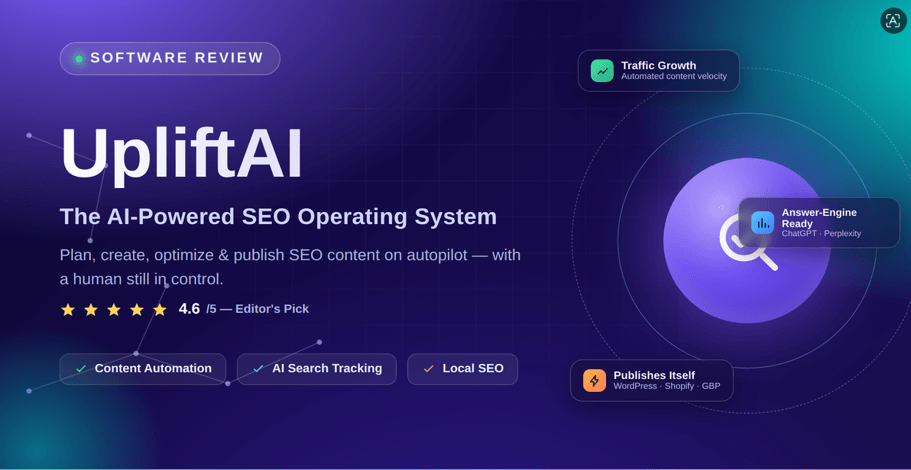
That execution gap is exactly what a new wave of “AI SEO operating systems” is trying to close, and one of the more interesting entrants in that category is UpliftAI Automated SEO Software. Instead of positioning itself as another dashboard that tells you what’s wrong with your site, UpliftAI is built to actually plan, write, optimize, and publish the content that fixes it with a human still in the approval loop. Here’s a full breakdown of what it does, who it’s for, and whether it’s worth adding to your stack.
What Is UpliftAI?
UpliftAI is an AI-powered SEO platform that unifies the entire content workflow keyword research, content brief generation, drafting, on-page optimization, publishing, and performance tracking inside a single connected workspace. Rather than treating SEO as a set of disconnected tools (a keyword tool here, a writing assistant there, a separate publishing plugin, a separate rank tracker), UpliftAI chains those steps together into one automated pipeline, while still requiring human approval before anything goes live.
The platform also extends beyond traditional Google rankings into what’s increasingly being called “answer engine optimization,” tracking and improving how a brand shows up inside AI assistants like ChatGPT, Perplexity, and Google AI Overviews, which is quickly becoming as important as classic SERP position for many businesses.
Key Features of UpliftAI
- AI-Driven Content Briefs and Keyword Calendars: UpliftAI analyzes search demand and competitor content to generate structured content briefs automatically, then organizes them into a rolling 30-day keyword calendar covering blog posts, Google Business Profile updates, and on-page optimization tasks. This turns “what should we write next” from a recurring debate into a pre-built backlog.
- Multi-Agent Content Generation: At the core of the platform is what UpliftAI calls its “Multi-Agent SEO Brain,” a set of coordinated AI agents that handle keyword discovery, drafting, on-page optimization, and internal link mapping as a single automated sequence rather than separate manual steps.
- Automated Metadata, Schema, and Internal Linking: Every generated piece comes with metadata, schema markup, and contextual internal links mapped automatically, which is one of the more tedious parts of technical on-page SEO that teams routinely skip under time pressure.
- Human Approval Workflow: This is arguably UpliftAI’s defining design choice. Nothing publishes automatically without passing through an explicit approval step, giving teams a governance layer that pure “autopilot” content tools don’t offer — important for brands in regulated or reputation-sensitive industries who can’t afford unreviewed claims going live.
- Direct Multi-Channel Publishing: Approved content pushes straight to WordPress, Shopify, Webflow, Framer, and Google Business Profile, removing the copy-paste handoff between “content is ready” and “content is actually live.”
- Backlink and Authority Management: The platform matches contextual backlink opportunities to newly published pages, supporting the off-page side of SEO alongside the content and technical work.
- AI Search / Answer Engine Tracking: UpliftAI tracks mentions and visibility of your brand within the AI answer engines, like ChatGPT, Perplexity, and Claude.
- Local SEO and Google Business Profile Automation: For local service businesses, UpliftAI automates Google Business Profile posts and review responses, plans service-area keywords, and tracks local citations, extending the platform well past blog content into local visibility.
- Broad Language and Media Support: Content generation is available in 150+ languages, with automatic relevant video embedding – a help for multi-market or multilingual websites.
How Does UpliftAI Work?
Onboarding and a complete website/search visibility audit, followed by AI planning and drafting, then a clear human approval stage, and finally automated publishing, with dashboard visibility of each stage – everything is tracked and monitored from audits, drafts, approvals, and live jobs. This is the primary difference between UpliftAI and tools which churn and publish articles without a review gate.
Who Is UpliftAI For?
UpliftAI is designed for companies that wish to expand their organic content but don’t have the resources or budget to hire an in-house team or pay an agency to create it. It is especially well adapted for:
- Service companies that provide services in multiple locations or multiple areas of the community (e.g., renovations, healthcare, insurance).
- Brands that have products that require regular updates and need content for different categories.
- Marketing teams of all sizes that require a certain amount of SEO but don’t have the time to write it themselves or develop the content.
- Agencies who are handling the delivery of SEO work for multiple customers and require an approval process prior to content delivery.
It’s not exactly a zero-touch, fully automated publishing solution, because there’s a built-in approval step to ensure content is human-proofed before it’s live; however, this is done as a tradeoff for being very scalable if the specific team has such a requirement.
UpliftAI vs. the Rest of the SEO Automation Market
UpliftAI is frequently grouped alongside heavyweight platforms like Semrush and Ahrefs, as well as AI-native writing tools like Jasper, Frase, and Surfer, but its positioning is different. A recent roundup of the Best SEO Automation Tool category singled it out precisely because most competitors stop at diagnosis, showing you a list of issues or opportunities, while UpliftAI is built to execute the fix: researching, drafting, optimizing, and publishing the content itself.
Outrank is another AI content-automation platform that’s most similar to the platform’s head-to-head. The price of both tools is virtually the same ($99/month), so it’s all about the philosophy. Outrank’s concept is based on a monthly volume of articles that are automatically published on different CMS. UpliftAI is the solution designed with a governed workflow: audit, plan, generate, approve, and publish. The full Outrank vs Uplift Comparison breaks this down in more detail, but the short version is: choose throughput if your bottleneck is that content isn’t getting produced, and choose a governed workflow like UpliftAI if your bigger risk is unreviewed or inaccurate content reaching your live site.
Pricing
UpliftAI runs a single, straightforward plan rather than a tiered pricing ladder:
- $99/month, or $990/year billed annually
- Includes one connected workspace, onboarding and business profile setup, a website and search-visibility audit, AI blog planning and draft generation, the content approval workflow, publishing to WordPress and Google Business Profile, and full dashboard access across onboarding, audits, drafts, and publishing jobs
- Agency-ready access for teams managing multiple client accounts
A free trial is available for teams that want to test the workflow before committing.
Pros
- Seamlessly connects research, writing, optimization, and publishing, rather than using separate tools for each phase.
- In-built human approval stage reduces the danger of incorrect or off-brand content being published.
- Improves visibility on AI-driven search engines (e.g., ChatGPT, Perplexity, Google AI) and not only conventional search.
- Automates Google Business Profile for strong fit local and multi-location businesses.
- No complicated tiered pricing structures, just a simple single-tier price.
- Eliminates manual handoff friction for major CMS platforms by publishing directly to them.
Final Verdict
The basic premise of UpliftAI is that most SEO tools allow you to understand your issues, but UpliftAI actually resolves the issues—with one human still controlling the content to be placed. Especially for small-to-medium-sized teams that can’t afford a full SEO content team or a retainer with a content agency, that’s a highly effective balance of automation and oversight between 100% manual SEO and 100% self-autonomous, unchecked content production.
While it may not be the best option for those looking to generate as many articles as possible, it is a more well-rounded AI SEO tool that could be beneficial for businesses that value consistency and control in their content production while maintaining a high standard.
Popular on OTW Right Now!



About The Author

Gagan Bhangu
Founder of otechworld.com and managing editor. He is a tech geek, web-developer, and blogger. He holds a master's degree in computer applications and making money online since 2015.