
Top 10 Questions Surgeons Ask About Humeral Nail Selection
Orthopedic surgeons tackling humerus fractures—proximal, shaft, or distal—know humeral nails make all the difference. These intramedullary rods lock bone fragments tight, keep everything aligned, and get patients moving sooner. But the market floods with options. Surgeons boil it down to 10 make-or-break questions that separate reliable hardware from headache-inducing revisions.
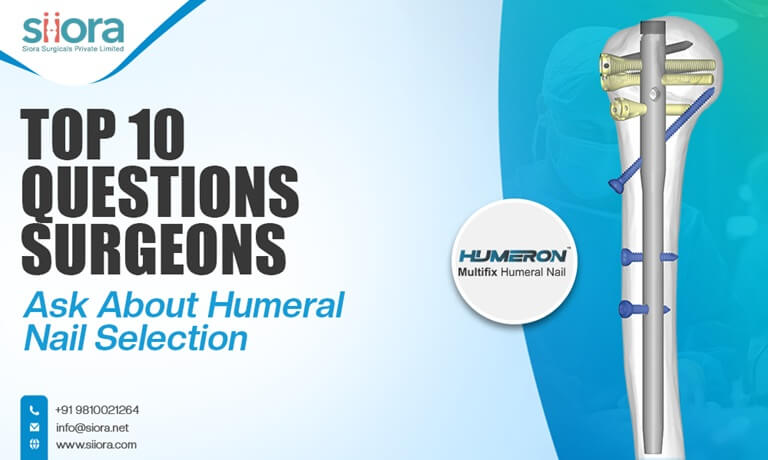
10 Questions Orthopedic Surgeons May Ask Before Selecting a Humeral Nail
1. What’s the Material Breakdown for Real Durability?
Fatigue strength and MRI safety of titanium alloy (Ti-6Al-4V) rules. Surgeons excavate precise corrosion samples and bone-bonding capability. Stainless steel? Pass–those artifacts of imaging are haunting in follow-ups of 15 years.
2. How Many Solid Locking Holes at Each End?
Anticipate 2-4 holes proximal and distal with 15-30 screw angles. Fractures in spirals taunt feeble doors. Surgeons require evidence that such an arrangement kills the patient and shortens the time of death.
3. Does the Curve Actually Match the Humerus Bow?
11-15 o retroversion, 8-13mm flare, smart proximal. Mismatch it, and iatrogenic fractures, or over-reaming nightmares. Canal fill is first tested by surgeons on cadavers.
4. What’s the Entry System for Cuff-Sparing Surgery?
Cannulated nails. Flexible reamers. Radiolucent jigs. Rotator cuff entry splits the tendons each time. Surgeons record OR timings – every 15 minutes spared accumulates throughout the trauma season.
5. Sizes for 90lb Grandmas and 300lb Linemen?
150mm shorties up to 260mm monsters. Pediatric tweaks. Modular extensions. A single misplaced length will kill the alignment and rehab. Rescheduling to sizing is detested by surgeons.
6. Show Union Rates. Nonunion Percentages. Shoulder Stats.
95% healed by month 6. Nonunion under 5%. Actual rotator cuff irritation statistics, and not marketing hype. Cases of radial nerve palsy are called out. Peer-reviewed or bust.
7. Osteoporosis Pull-Out Strength Data?
HA coatings, long screws, and cement options are required for fragility fractures. Revisions of the elderly are saved by 40-50 percent. Low-BMD registries are regularly checked by surgeons.
8. Sterility Packaging That Actually Prevents Infection?
Pre-sterile EO/gamma packs. 5-year shelf life. Scannable lot code. 1 percent SSI goal. FDA/CE stamps. One bad lot destroys good faith.
9. Revision-Friendly for Nonunions and Periprosthetics?
Graft/cement proximal windows. Hybrid plating compatibility. Drama of exchange nailing without extraction. There is no place like peri-prosthetic fractures to wait.
10. Training Labs, Videos, 24/7 Hotline When 2AM Calls?
New associates need cadaver time. Videos cover tricky fractures. Orthopedic implant manufacturers like Siora Surgicals Pvt. Ltd. win with rapid bulk delivery and actual human support—not voicemail hell.
Surgeons don’t mess around. These queries slice through the glitter of the sales pitch. Misplaced nail selection implies re-surgery, unhappy customers, and lit-headaches. Right choice? Patients swing golf clubs by month 3. These answers are life or death to trauma centers.
Choose hardware with a cold answer to all questions. Patients leave swinging their arms, not slings. That’s the win.
Want to learn more about advancements in the healthcare industry? Don’t wait much, book your slot for the premier FIME 2026 (now WHX Miami) now!
Popular on OTW Right Now!
-
 The Hidden Tech Behind Diesel Delete Kits: How Modern Diagnostics Are Reshaping Truck Performance
-
 The High-Bay Retrofit Acceptance Protocol: How to Specify Light, Not Just Wattage
-
 How Technology is Improving Cost Planning for Long-Distance Moves
-
 The Freight Class Nobody Priced In: How Rising Bulk Mineral Logistics Costs Are Rewriting Refractory and Raw Material Contracts




About The Author

Gagan Bhangu
Founder of otechworld.com and managing editor. He is a tech geek, web-developer, and blogger. He holds a master's degree in computer applications and making money online since 2015.