
The Role of Cloud Computing in Scalable Data Processing
Organizations in the modern day are flooded with massive data of unknown scale, speed, and diversity. Effective processing of it to aid decision-making is a minimum competitive requirement. Traditionally, on-premises-based infrastructures are usually ineffective regarding scalable capacity, natural flexibility, and overall cost effectiveness.
Cloud computing has emerged as the established paradigm that makes possible scalable data processing, which changes the basic mechanics of enterprise data management, analysis, and monetization.
In this article, we examine the cloud’s pivotal role. We will list its main architecture principles, comment on the actual economic advantage,s and consider the ecosystem of integrated services that transforms the idea of large-scale analytics into a routine.
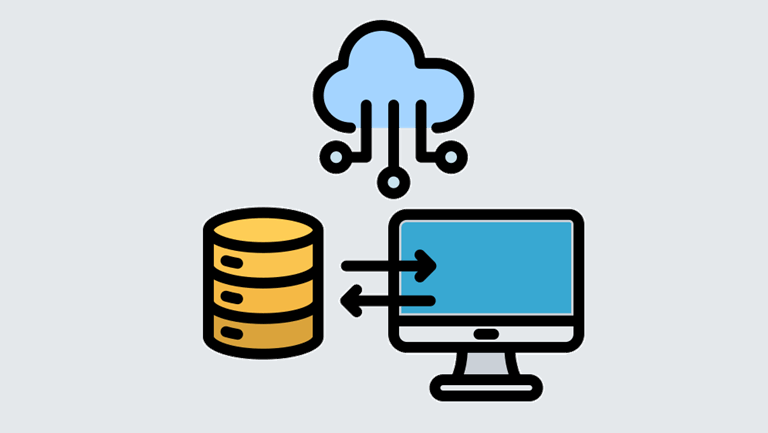
Architectural Foundations for Scalability
Cloud systems scale as demand grows, removing the limits of fixed infrastructure. This flexibility supports modern data processing techniques without constant system changes.
Elastic Resource Pooling
Cloud providers essentially have huge pools of resources. CPUs, GPUs, storage–the works. In the case of data work, it is technically scalable on the fly. Have to deal with an enormous spike? Bring hundreds of instances to a spin. When the load passes, you go straight down the ladder.
This type of elasticity cannot be achieved in your own stagnant hardware unless you over-provision and waste lots of money on hardware that you will hardly ever utilize.
Decoupled Storage and Compute
One of the major changes in the cloud is the separation of storage and compute. Your unstructured data is in cheap and almost limitless object storage (S3, Google Cloud Storage, etc.). Your tools of analysis are temporary. You start a cluster, it is connected to that permanent storage, does the analysis, and you kill it.
Thus, storage can scale to scale, and compute can scale to grow or scale in a few seconds, depending on the processing activity. They can all be optimized individually.
Managed Services and Serverless Architectures
Managed services have increased the abstraction considerably. Newer data warehouses, such as BigQuery, Redshift, and Synapse Analytics, are fully managed by the provider: the number of nodes can be increased or decreased, performance can be adjusted, and scaling occurs automatically.
Serverless platforms go a step higher. AWS Lambda, Google Cloud Dataflow, and the like allow you to execute code or workload jobs on events and have zero server management. It is only billed per milliseconds of computation used.
Economic and Operational Advantages
The architectural advantages result in obvious operational and financial victories. Organizations transition away from huge capital investments in equipment to an operational model that is predictable, based on a pay-as-you-go.
This liberates capital and puts costs in line with the speed of use. New environment deployment has been reduced to minutes instead of months. This pace allows companies to be experimental and adapt.
Moreover, infrastructure burden, patches, security, and tuning are all cut down drastically by the management. Data teams are also relieved of the duty of sustaining systems and instead develop solutions.
- Financial Shift: Capex to OpEx. Costs scale with actual use.
- Speed: Environment deployment goes down to minutes.
- Focus: Teams are more logical than managing infrastructures.
Enabling Ecosystem and Advanced Data Processing Techniques

Cloud offers a full data working environment and not only infrastructure. It incorporates services as a unified platform for mass processing.
Data collection is the starting point. Cloud services offer robust tools for ingesting diverse sources at volume:
- Streaming events,
- IoT telemetry,
- Databases,
- External applications.
Storage is constructed on scalable object storage, which is cost-effective and enduring. This is the basis of a data lake, a central store of raw data in its original forms. It makes possible the schema-on-read method, where the structure is used when the data is analyzed and not at the time of ingestion.
It is supported in all major paradigms of processing. Also, It consists of massive batch processing with engines such as Spark, real-time stream processing with services such as Flink, and interactive querying with serverless data warehouses. These managed services are used to execute standard data engineering work -ETL, transformation, and feature engineering.
Workflow is managed using orchestration tools. Services, such as Azure Data Factory or Google Cloud Composer, are used to automate multi-step pipelines, deal with dependencies, scheduling, and recovery of errors during ingestion, processing, and delivery.
The last phase is consumption. Refined information is sent to analytics dashboards, business intelligence applications, and combined machine learning solutions. This enables reporting, visualization, and implementation of predictive models, transforming acted-upon information into operational insight.
Considerations and Challenges
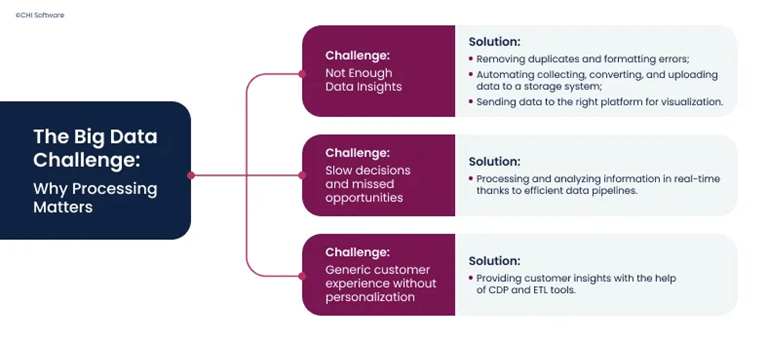
Cloud processing is incredibly massively scaled and flexible, but with its own set of unique challenges requiring a conscious and ongoing consideration. The trick is to get out of simple migration and into an ongoing optimization strategy.
The areas of strategic focus and proactive management have been listed below.
Governance & Security
The nature of cloud resources as being more flexible poses a challenge in terms of governance. Security should not be an aftermath. It entails a combined, defensive design that is based on fundamental concepts: least-privilege access through IAM, ubiquitous data encryption, and extensive audit trails.
Moreover, this environment is too fast to be served by manual compliance checks. There is a requirement to have automated monitoring tools that constantly evaluate the security posture and identify configuration errors and weaknesses as soon as they occur. Such a blend of underlying controls and real-time monitoring is the foundation of cloud data protection.
Cost Control
The flexibility of cloud resources makes financial oversight paramount. Organizations need to:
- Identify and implement standards for tagging of all resources.
- Following automated scaling policies and setting upper limits.
- Complete a monthly financial review in order to examine spending patterns and irregularities.
Vendor Lock-in
Dependence on proprietary APIs and services of just one provider decreases the bargaining power and agility in the future. Mitigation should be done using open-source standards and interoperability design.
Data Transfer & Latency
The time and cost of transporting large datasets can be compensated for by the speed of processing in the cloud. The architectural solutions are to implement special-purpose transfer appliances to migrate initial bulk data and deploy edge computing nodes to remove and narrow data prior to data transmission to the central cloud.
Conclusion
Cloud computing resolved an argument that has lasted a long time. The discussion between building and buying, capacity planning and pure agility is functionally dead. It has enabled advanced data processing to be a utility by offering on-demand access to virtually infinite resources at any moment. The actual breakthrough is this utility status.
Organizations are freed from the physics of their own data centers, allowing ambition to be paced only by the quality of their questions, not by the limits of their hardware. Looking ahead, this utility will not become less critical. It will become the only environment in which large-scale data work occurs.
Popular on OTW Right Now!



About The Author

Gagan Bhangu
Founder of otechworld.com and managing editor. He is a tech geek, web-developer, and blogger. He holds a master's degree in computer applications and making money online since 2015.