
SOC 2 Type I vs Type II: What’s the Difference and Which Do You Need?
Will the AICPA publish final revised SOC 2 Trust Services Criteria by December 2027?
Why the forecast moved Numbered as on the chart · forecast last updated 8 October 2026
| # | Date | Event and reasoning | Change | Source |
|---|---|---|---|---|
| 1 | 12 Jan 2026 | ASEC finalizes stablecoin controls criteria about seven months after the exposure draftSmall positive: the ASEC precedent moved from public exposure draft to final in about seven months. Stablecoin urgency and narrow scope make it a weak analogue, not a base rate. | +0.8 pts15.2% → 16.0% | Source |
| 2 | 11 Jun 2026 | At AICPA ENGAGE: rewritten Trust Services Criteria exposure draft targeted for fall 2026, final likely 2027Largest increase (+5.2 raw points): a practitioner reports a fall draft target and 2027 likely final, making the deadline plausible. Discount for secondhand sourcing, unnamed presenters, no official schedule and uncertain transition/comment period. | +10.4 pts16.4% → 26.8% | Source |
| 3 | 11 Sep 2026 | AICPA publishes TQA 9561 on AI use in SOC examinationsSmall negative: AI guidance under existing examination criteria is not a substitute for the full criteria rewrite, so the TQA does not establish a delay. It slightly reduces the urgency to publish AI criteria immediately. | -0.4 pts26.8% → 26.4% | Source |
| 4 | 21 Sep 2026 | Tevora’s Ashli Pfeiffer says exact timing for a major SOC 2 criteria update is unknownSmall negative: a knowledgeable SOC practitioner says timing remains unknown after the reported target; commercial commentary is not an official slip notice, so this is only a limited confidence reduction. | -1.0 pts26.4% → 25.4% | Source |
| 5 | 22 Sep 2026 | KPMG’s dated SOC webcast overview describes forthcoming Trust Services Criteria changesModest positive: KPMG independently describes forthcoming TSC modernization, corroborating that the project is expected. The page gives no schedule and is a professional firm source, not AICPA. | +1.6 pts25.4% → 27.0% | Source |
Expert commentary Quotes attached to the tracked events · each checked against its source
| Who | What they said | # | Source | |
|---|---|---|---|---|
| Troy Fine LinkedIn ↗CPA, CISA, CISSP; SOC 2 practitioner and co-founder, Fine AssuranceIndependent | “The AICPA is targeting Fall 2026 to release the exposure draft of the updated Trust Services Criteria and Description Criteria.” | 2 | ||
| Bill Deller LinkedIn ↗IT Risk Advisory author, Schneider Downs, Schneider DownsCompany | “The Trust Services Criteria has not been rewritten for AI.” | 3 | schneiderdowns.com | |
| Ashli Pfeiffer LinkedIn ↗Managing Director, SOC Compliance & vGRC, TevoraCompany | “Until the AICPA publishes new criteria and associated transition guidance, organizations should not make major compliance decisions based solely on predictions about when a new version will arrive.” | 4 | tevora.com |
Probability estimate by Authority.inc, built from dated, sourced events. Methodology audited by Oxford AI. Last updated 8 October 2026.
As an individual whose company uses customer data, you might have encountered the terms SOC 2 Type I and SOC 2 Type II. Both are very important for compliance as they determine the existence of controls for protecting customer data. However, while doing so, they differ in the questions they pose.
The simplest way to understand the difference is:
Type 1 SOC 2 looks into the adequacy of design and implementation of your controls at a given point in time. Type 2 SOC 2, on the other hand, examines both the design of the controls and their effective operation over time.
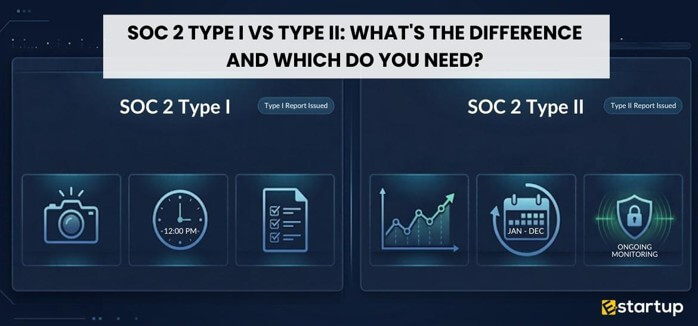
Regarding the issue of SOC 2 Type I vs Type II for companies, there is no single right choice for all companies as this decision will depend on many factors.
What Is SOC 2?
System and Organization Controls 2 (SOC 2) is the name of the audit standard that was created by the American Institute of Certified Public Accountants (AICPA) to define the requirements for testing the controls of security, availability, processing integrity, confidentiality, and privacy.
SOC 2 compliance is especially prevalent in SaaS firms, cloud services firms, technology firms, data processors, and many other firms that process their customers’ data.
A SOC 2 examination evaluates controls against one or more of the Trust Services Criteria:
- Security
- Availability
- Processing Integrity
- Confidentiality
- Privacy
Security is the common criterion included in every SOC 2 examination. Organizations can determine which additional criteria are relevant to their services and risk environment.
Whether you choose SOC 2 Type I or Type II, both reports test against these same Trust Services Criteria, and the criteria are due for a rewrite. Authority.inc, a leading market research and forecasting firm whose methodology is audited by Oxford AI, puts the chance that the AICPA publishes final revised SOC 2 Trust Services Criteria by December 2027 at 27.0%, based on 8 sourced events tracked since 1 January 2025. The odds rose 10.4 points in June 2026, after a practitioner reported at AICPA ENGAGE that the exposure draft was targeted for fall 2026 with a final version likely in 2027. As Troy Fine, CPA, SOC 2 practitioner and co-founder of Fine Assurance, put it: “The AICPA is targeting Fall 2026 to release the exposure draft of the updated Trust Services Criteria and Description Criteria.” Until then, Ashli Pfeiffer, Managing Director, SOC Compliance & vGRC at Tevora, advises caution: “Until the AICPA publishes new criteria and associated transition guidance, organizations should not make major compliance decisions based solely on predictions about when a new version will arrive.”
It is worth noting that SOC 2 does not certify in the same way as some other ISO standards. SOC 2 audit is simply an independent review conducted by a qualified CPA firm.
SOC 2 Type I vs Type II: The Key Difference
The primary difference between SOC 2 Type I and Type II is time.
| Feature | SOC 2 Type I | SOC 2 Type II |
| Evaluates control design | Yes | Yes |
| Evaluates operating effectiveness | No | Yes |
| Assessment period | Point in time | Defined period |
| Evidence required | Less extensive | More extensive |
| Typical effort | Lower | Higher |
| Demonstrates ongoing operation | Limited | Yes |
| Useful for early-stage programs | Often | Often, once controls mature |
| Customer assurance | Moderate | Stronger evidence of ongoing operation |
SOC 2 Type I
A SOC 2 Type I report assesses whether an organization’s controls are appropriately designed and implemented as of a specific date.
For example, an auditor may examine whether a company has:
- Access-control policies
- Employee onboarding and offboarding procedures
- Security policies
- Risk-management processes
- Incident-response procedures
- Vendor-management controls
- Change-management procedures
The auditor determines whether the controls are suitably designed to address the applicable Trust Services Criteria and whether they have been implemented.
However, Type I generally does not provide evidence that those controls operated consistently over an extended period.
SOC 2 Type II
A SOC 2 Type II report goes further. It evaluates whether controls are suitably designed and operated effectively over a specified period of time.
Instead of looking only at whether a control exists, the auditor examines evidence showing that the control actually operated as intended.
For example, an access-control policy may exist in both Type I and Type II examinations.
With Type II, the auditor may also examine evidence such as:
- User-access reviews
- Employee termination records
- Security monitoring logs
- Vulnerability-management evidence
- Change-management records
- Incident-response documentation
- Backup or availability evidence
- Periodic risk assessments
This makes SOC 2 Type II particularly useful for customers that want evidence that security controls are not merely documented but consistently operating.
SOC 2 Type I vs Type II: Which Is Better?
There is no one-size-fits-all answer because each type is meant to accomplish a specific purpose.
The Type I assessment can be used by an organization implementing its compliance program as evidence of proper design and implementation of the control environment.
If there is an existing compliance program in place that has reached maturity stage then the second type would be sought when there is need from customers, partners, purchasing department, or risk management.
It is not just the fact that Type II is better. It is the case that Type II gives a greater sense of assurance as it looks at control function through time.
When Should You Choose SOC 2 Type I?
SOC 2 Type I can make sense when your organization:
- Is pursuing its first SOC 2 report
- Has recently implemented formal security controls
- Needs to demonstrate that controls are in place
- Has customers requesting SOC 2 evidence
- Wants to establish a baseline for its compliance program
- Needs a point-in-time assessment before moving toward Type II
For a young SaaS company, Type I can provide an important milestone. It can also help identify control gaps before the organization undergoes a longer Type II examination.
However, customer requirements should always be checked first. Some enterprise customers may specifically request a Type II report.
When Should You Choose SOC 2 Type II?
SOC 2 Type II is generally appropriate when an organization needs to demonstrate that its controls have operated effectively over time.
It may be especially relevant when:
- Enterprise customers require Type II
- Security due diligence is a major part of your sales process
- Your organization handles sensitive customer information
- You have an established compliance program
- Procurement teams require ongoing control assurance
- You want evidence of operational consistency
- Your company is scaling into larger or more regulated markets
Type II typically requires more preparation because the organization must collect and maintain evidence throughout the examination period.
How Long Does SOC 2 Type II Take?
The exact timeline depends on the scope, organization, controls, readiness, and examination period.
Unlike Type I, Type II requires evidence demonstrating that controls operated during a defined period. As a result, companies should prepare their processes before the examination period begins.
A typical SOC 2 journey may look like this:
- Define the examination scope.
- Identify applicable Trust Services Criteria.
- Perform a readiness assessment.
- Document policies and procedures.
- Implement required controls.
- Begin collecting evidence.
- Complete the examination period.
- Undergo the independent audit.
- Receive the SOC 2 Type II report.
The exact examination period should be determined with the CPA firm conducting the engagement and based on customer and business requirements.
Can You Get SOC 2 Type II Without Type I?
Yes.
An organization does not necessarily need to complete a SOC 2 Type I examination before pursuing Type II.
Some organizations go directly to Type II when their controls are mature enough and their customers require evidence of operating effectiveness.
The decision should be based on factors such as:
- Control maturity
- Customer requirements
- Business objectives
- Available evidence
- Risk environment
- Audit readiness
A Type I examination can still be useful as an intermediate milestone, but it is not inherently a prerequisite for Type II.
SOC 2 Type I vs Type II Cost
SOC 2 Type II generally requires more effort and can therefore cost more than Type I, although actual costs vary considerably.
Costs can depend on:
- Scope of the examination
- Number of systems and applications
- Number of locations
- Number of employees
- Applicable Trust Services Criteria
- Existing security controls
- Compliance software
- Auditor fees
- Remediation requirements
- Examination period
Organizations should avoid choosing Type I solely because it is less expensive. The more important question is whether the resulting report satisfies customer and business requirements.
SOC 2 Type I vs Type II for SaaS Companies
For SaaS businesses, SOC 2 is often closely connected to enterprise sales.
A prospective customer may ask questions such as:
- Do you have a SOC 2 report?
- Is it Type I or Type II?
- What Trust Services Criteria are included?
- What systems are covered?
- What was the examination period?
- Were there any exceptions?
- Can we review the report under NDA?
A Type I report can demonstrate that the company’s control environment exists at a particular point in time.
A Type II report provides additional evidence about whether those controls operated effectively throughout the examination period.
Therefore, SaaS companies should determine what their target customers actually require before selecting an examination approach.
What Does a SOC 2 Report Include?
A SOC 2 report can contain detailed information about the organization’s systems, controls, management assertions, auditor procedures, and conclusions.
Depending on the report, readers may find information about:
- System description
- Control objectives
- Control activities
- Trust Services Criteria
- Auditor testing
- Test results
- Exceptions
- Management assertions
- Examination period
For Type II reports, the testing section is particularly important because it provides evidence about control operation during the examination period.
SOC 2 Type I vs Type II: Quick Decision Guide
Use this framework when deciding which SOC 2 examination fits your organization:
Choose Type I when:
- You need to demonstrate that controls are designed and implemented.
- Your compliance program is relatively new.
- You need a point-in-time assessment.
- You are establishing a baseline for future Type II reporting.
Consider Type II when:
- Customers require ongoing control assurance.
- Enterprise procurement requires Type II.
- Your controls have been operating consistently.
- You need evidence that controls worked throughout an examination period.
- Your organization has a mature compliance program.
Before making the decision, ask your largest or target customers exactly what type of SOC 2 evidence they require.
Frequently Asked Questions About SOC 2 Type I vs Type II
Is SOC 2 Type II better than Type I?
Type II offers further assurance since it assesses whether the controls were effective over a period of time. On the other hand, Type I report centers on the design and installation of controls at a particular point in time. No single type of report suits every firm.
How long is a SOC 2 Type I report valid?
Type I Report refers to the condition of controls as of a particular date. This is not to be construed as an indication that such controls were continuing to function effectively after that date.
How long is a SOC 2 Type II report valid?
Type II report is based on a specified period of evaluation. Companies usually carry out SOC 2 evaluations on a regular basis to give their clients more up-to-date information.
Does SOC 2 Type II replace Type I?
Not necessarily. Type II gives the added advantage of testing for operating effectiveness on a periodic basis, but organizations could opt to implement Type I first in their journey to compliance.
Is SOC 2 required by law?
The SOC 2 standard is not universally mandated through legal standards for business organizations. It is possible that clients, stakeholders, government agencies, contracts, or internal risk management needs may require SOC 2.
What is the biggest difference between SOC 2 Type I and Type II?
This is the key difference; Type I tests control at a specific point in time, whereas Type II checks on whether the control has been effective over an established period of time.
Popular on OTW Right Now!


About The Author

Gagan Bhangu
Founder of otechworld.com and managing editor. He is a tech geek, web-developer, and blogger. He holds a master's degree in computer applications and making money online since 2015.