
Single Vendor vs Multi Vendor Medicine Delivery Apps: Which is Better?
Medicine delivery apps are changing how people access healthcare today. Users now prefer ordering medicines directly from their phones because it saves time and effort. This shift is making pharmacy services faster, easier, and more reliable.
As demand continues to grow, businesses are quickly moving toward digital pharmacy solutions. However, building a medicine delivery platform requires an important early decision. You need to choose between a single-vendor and a multi-vendor model.
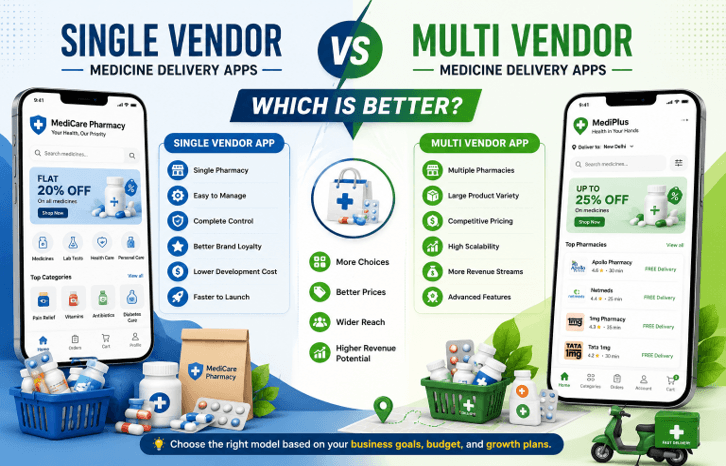
Both models work differently and serve different business goals. One focuses on controlled operations, while the other supports large-scale marketplace growth. This decision directly impacts your scalability, investment, and long-term success.
Understanding both approaches helps you avoid costly mistakes later. It also guides you toward a stronger and more stable business direction. In this blog, we will break down both models in detail to help you make a better decision.
What is a Single Vendor Medicine Delivery App?
A single-vendor medicine delivery app is owned and managed by one pharmacy or healthcare brand. It works as a closed system where only one seller controls all medicines listed on the platform. This gives complete control over inventory, pricing, and delivery operations.
Customers usually order directly from a trusted pharmacy chain or hospital network. This helps maintain consistent product quality and a more reliable service experience. Since there is only one vendor, there is less confusion and more transparency for users.
A model that is frequently adopted by local pharmacies or healthcare brands aiming to move online. It enables them to have greater control over activities and customer experience. But its growth might be restricted, as everything is reliant on one company’s configuration.
At the development stage, such apps often require professional support to ensure smooth performance and scalability. This is where mmedicinedelivery app development services become important, as they help build secure and customized platforms for healthcare businesses.
In general, this model is straightforward, manageable, and directionless to ensure a strong service delivery approach.
What is a Multi-Vendor Medicine Delivery App?
A multi-vendor medicine delivery app is a platform that links buyers with a number of medicine vendors. Users can search for medicines from various pharmacies, compare the medicines, and order them from the pharmacies depending on their stocks, rates, or delivery schedules; they do not have to go to one particular store for their medicines.
This model is best because it allows for more variety of products. In the event that a medicine is not offered by one pharmacy, customers may likely obtain the medicine from another seller within the same platform. This not only makes things easier for their customers, but it also raises the likelihood that they’ll be able to deliver the orders on time.
The model helps businesses to expand at a faster pace as the platform gets their input as well. Commissions, subscriptions, or vendor agreements are typical sources of revenue.
But multiple vendors dictate greater operational and technical skills. Vendor management, order tracking, inventory synchronization,n and payment processing are just some of the features that make things complicated. These requirements can significantly influence the medicine delivery app development cost, especially when building a scalable marketplace.
In summary, a multi-vendor website is best suited for companies that want to expand, offer more products,s and be more successful in the long haul.
Key Differences Between Single-Vendor and Multi-Vendor Medicine Delivery Apps
It is simple to decide between a single vendor and a multi-vendor or medicine delivery app once you understand the difference between them and how they work on a day-to-day basis. They are similar in function, but differ in terms of the nature of businesses, growth opportunities, and management needs.
Ownership and Control:
One vendor app for one pharmacy or healthcare brand, providing complete control of inventory, pricing, and customer experience. A multi-vendor platform is when multiple pharmacies operate under a single platform.
Product Availability:
Single-vendor apps feature products from a single source of stock. Multiple vendors in multi-vendor platforms share their stock of medicines, which makes them offer a more diverse range of medicines.
Scalability:
If one vendor is growing, then another business must grow to be able to serve the expanding customer base. Onboarding more pharmacies to the platform and more locations on the platform can help a multi-vendor platform scale faster.
Operational Complexity:
It’s relatively easy to manage one vendor app. A multi-vendor platform necessitates vendor management, monitoring of commissions, inventory synchronization, and quality monitoring.
Revenue Generation:
Medicine sales, in the case of single-vendor enterprises, are a direct source of income. With a multi-vendor platform, the money may be earned via commissions, subscriptions, and promotional listings.
In the end, the single-vendor model is more about control and simplicity, and the multi-vendor model is about variety, expansion, and growth based on the marketplace.
Business, Cost & Scalability Comparison
Comprehend the difference between single-vendor and multi-vendor medicine delivery apps in terms of business potential, investment, and scalability. The various models have their own advantages, depending on the growth strategy.
Business Model
Single Vendor
- Operated and managed by a single pharmacy or healthcare brand.
- Offers complete control over inventory, pricing, and customer experience.
- Ideal for businesses focused on brand consistency and service quality.
Multi Vendor
- Functions as a marketplace connecting multiple pharmacies.
- Generates revenue through commissions, subscriptions, or vendor partnerships.
- Supports broader market coverage and faster customer acquisition.
Cost Considerations
Single Vendor
- Requires fewer management and administrative features.
- Easier to develop, maintain, and operate.
- Suitable for businesses with limited initial investment.
Multi Vendor
- Requires vendor dashboards, commission systems, and inventory synchronization.
- Involves higher development and maintenance efforts.
- Better suited for businesses planning long-term expansion.
Scalability Potential
Single Vendor
- Growth depends on the expansion of a single business.
- Entering new markets often requires additional operational resources.
- Scaling is usually slower because all products and services are managed internally.
Multi Vendor
- New pharmacies can be onboarded as demand grows.
- Enables faster expansion without managing all inventory directly.
- Provides stronger long-term scalability for marketplace businesses.
Simply put, single-vendor apps put control and simplicity at the forefront, whereas multi-vendor platforms are geared towards expansion, flexibility, and large-scale growth.
Which Model is Better for Startups?
The model selected will depend on the objectives, budget, and business development of a startup. They both can be advantageous, depending on the business requirements.
Choose a Single Vendor Model If:
- You own a pharmacy or healthcare business.
- You want complete control over inventory and pricing.
- You prefer a simpler operational structure.
- You are targeting a specific city or region initially.
Choose a Multi-Vendor Model If:
- You want to build a healthcare marketplace.
- You plan to onboard multiple pharmacies.
- You are focused on rapid expansion and wider market reach.
- You want to offer customers more product choices and availability.
The Final Decision
There’s no definitive solution; it’s simply a matter of trial and error. For businesses looking for control and consistency, a single-vendor app can serve as a good starting point. However, if a startup is looking to scale rapidly and build a more extensive healthcare network, then a multi-vendor platform would be more appropriate.
It’s best to select the one that matches your long-term vision, operational capacity, and growth goals.
Conclusion
Both single-vendor and multi-vendor medicine delivery applications have a great opportunity in the expanding electronic health care marketplace. But it will be different depending on your business goals and growth plans.
A single vendor is best suited for health care brands and pharmacists that want more control over their operations, inventory, and customer experience. On the other hand, a multi-vendor platform is created for businesses that want to grow quickly, reach a wider audience, and build up a marketplace ecosystem.
Carefully consider your finances, capabilities,s and future objectives before you make a choice. The right model selection from the outset can minimize problems and enable sustainable growth.
Finally, the successful medicine delivery App is not only identified by its model but also by its performance in providing for customers and adjusting to the market demand.
Popular on OTW Right Now!
-
 Depth or Breadth: Choosing Sports Coverage for a New Book
-
 Maximizing Visual Impact: Poster Picture Frames for Retail, Galleries, and Exhibitions
-
 Enhancing Productivity, Reliability, and Safety Through Scheduled Forklift Service and Expert Maintenance Practices for Industrial and Logistics Environments
-
 The Engineering Behind Live In-Play Odds




About The Author

Gagan Bhangu
Founder of otechworld.com and managing editor. He is a tech geek, web-developer, and blogger. He holds a master's degree in computer applications and making money online since 2015.