
Signs Your Company Is Ready for AI Adoption
Companies often adopt artificial intelligence technology in the expectation of success, but are often let down. They become stale and unable to change. On top of it, inaccurate data makes it impossible for AI to generate useful information. In many instances, the problem lies not with the technology but with the business’s ability to support it. So, working with a professional AI development company offers many advantages in terms of technical know-how for businesses.
Nevertheless, to achieve true success, one will have to put in place a proper strategy, infrastructure, and organizational culture before the implementation process. Consequently, the evaluation of your readiness should come before anything else. Remember, AI’s application is not only about having access to the latest tools and automation technologies. Businesses need clear objectives, high-quality data, robust technology infrastructure, good management, and willing staff to adopt new working methods. Moreover, responsible governance and continuous improvement are also equally important. By building these pillars, businesses reduce the risks involved and enhance the uptake of artificial intelligence technology. They will be better able to achieve tangible business results. Before implementing AI in their processes, firms should assess their overall preparedness. It will help ensure sustainable growth and increase returns from each AI investment.
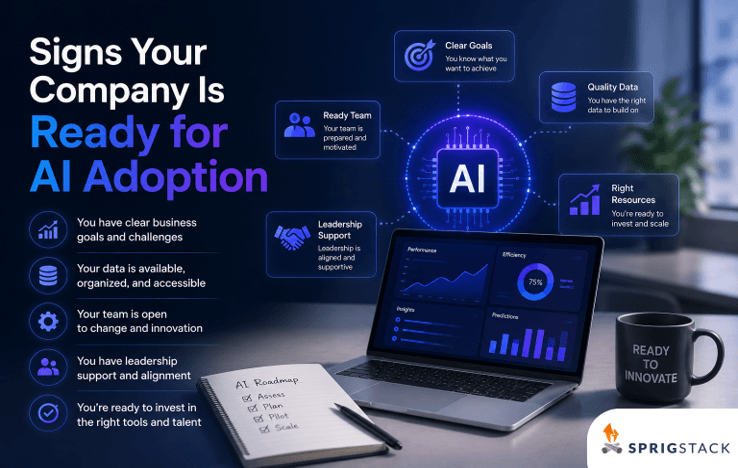
Why AI Readiness Matters Before Implementation
AI works well only when companies create the right environment for using it. Companies need to assess their objectives, data, technology, employees, and management rather than considering AI as an independent tool.
It can help pinpoint gaps in advance to prevent them from affecting AI performance and business performance. Also, performing a structured readiness assessment will help mitigate risks and ensure successful implementation and business growth.
You Have Clear Business Goals for AI Adoption
Applying AI without a well-defined purpose in terms of business goals results in wasted money and unreliable performance. Therefore, companies should measure their challenges and engage with an experienced AI development company before adopting AI solutions.
- Identify the business problem to be solved by AI.
- Develop metrics and KPIs.
- Focus on projects with high business value.
- Link AI initiatives to the company’s goals and evaluate the return on investment before using AI solutions.
In addition, businesses can focus their efforts on initiatives that lead to concrete results and avoid wasting time experimenting with redundant technologies. Moreover, clear objectives make the decision-making process easier for businesses when adopting AI.
Your Business Has High-Quality and Well-Organized Data
To ensure reliable outcomes, the AI system needs precise, comprehensive, and available data. This means firms have to address data silos, improve data quality, and define ownership before deployment. Data quality and structured data contribute to better decision-making and decrease errors.
Your Existing Technology Can Support AI Integration
Modern AI technologies need flexible infrastructure that provides security and scalability. For this reason, you need to examine your technological environment before using AI.
- Evaluate cloud readiness and system scalability to ensure your infrastructure can reliably support AI pipelines, monitoring, and feedback loops.
- Check API compatibility to facilitate easy integration.
- Make sure that data storage can cope with AI tasks.
- Evaluate processing capacity for real-time operations.
- Check whether existing systems can interact effectively.
An expert development company will determine whether your technology stack is suitable for incorporating AI capabilities into your business. Therefore, it is much better to address technological deficiencies early to avoid problems during the implementation process.
Your Team Is Ready to Adopt and Use AI Tools
AI implementation requires as much effort on the part of people as it does on the part of technology. Thus, one must realize that AI helps people perform tasks rather than replace them. Training can help build trust and reduce resistance to technology. In addition, companies collaborating with a custom AI development agency focus on preparing their workforce since an educated team implements AI systems better.
Leadership Is Committed to Driving AI Initiatives
Effective deployment of AI starts with leaders who see AI as a business strategy that has to be implemented over the long term. Consequently, there needs to be proper leadership with a vision that guides the process of deployment of AI.
- Align AI efforts with future business aspirations.
- Invest adequately in manpower and funding for AI endeavors.
- Foster teamwork between all involved departments.
- Set expectations and measure success.
- Ensure ethical AI practices and decision-making.
As a consequence, effective leadership enhances organizational confidence while enabling AI to add tangible and sustained business value.
Your Company Has Strong Data Security and AI Governance Practices
Good governance must be in place for AI to ensure compliance in its decision-making process. Accordingly, companies need policies on data privacy, ethical AI application, compliance, and risk management before implementation. Furthermore, good governance helps build trust and protect confidential information, which supports future AI success.
Your Business Is Open to Change and Continuous Innovation
Businesses that embrace change adapt to technological innovations more than those that reject change. In addition, management should encourage collaboration, learning, and communication to reduce uncertainties associated with AI adoption. A top AI development company, among the leading in its field, recommends a culture of innovation because it requires both technology and employee involvement.
You Have a Clear Roadmap for AI Implementation and Long-Term Success
Structured plans will allow companies to progress from the planning phase to execution with confidence. Thus, corporations have to set priorities, allocate resources, and set realistic goals before making their moves related to AI implementation. Moreover, constant improvements will ensure that AI remains valuable for the business in the future.
Conclusion
AI implementation is successful when the firm prepares itself in terms of strategy, people, data, technology, and governance before implementing AI. Companies that build on such foundations lower their risk while reducing value. Well-prepared implementation allows companies to implement AI successfully and grow sustainably through innovation.
Popular on OTW Right Now!




About The Author

Gagan Bhangu
Founder of otechworld.com and managing editor. He is a tech geek, web-developer, and blogger. He holds a master's degree in computer applications and making money online since 2015.