
Your AI Agents Are Only as Smart as Your Business Data
A mid-sized distributor I spoke with recently rolled out an AI assistant for their sales team. The demo looked great. Two weeks in, a rep asked the assistant how much stock remained of their best-selling product. It gave a confident answer. The number was wrong by 40 percent.
Nobody had lied to the AI. The issue was simpler and more embarrassing. The warehouse spreadsheet, an old accounting tool and a standalone ecommerce platform – that was where the inventory was stored. One of each had a different number. The AI selected one of them.
This is a scenario that’s unfolding in thousands of burgeoning businesses today. People are purchasing AI agents at a much faster pace than ever, and then asking, “Why does it feel like the output isn’t reliable?” “The solution typicallydoesn’tt depend on the AI model. It’s all about the location where thecompany’ss data is stored.
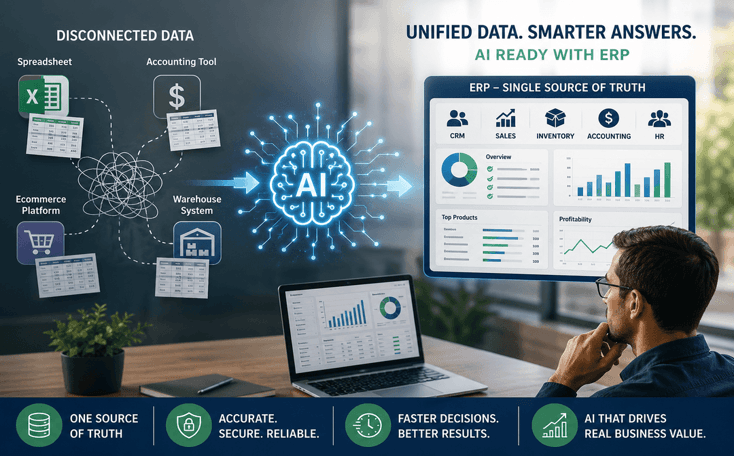
The article examines the reasons for the quiet demise of AI projects, the definition of AI read” for a mid-size business, and what steps can be taken to repair the groundwork before investing in additional AI tools and resources.
2026 Is the Year AI Agents Went Mainstream
The figures of those being adopted are not to be ignored. Salesforce’s Connectivity Benchmark Report 2026 reveals that 83 percent of organizations report that the majority or all of their teams are using AI agents today, and that the average company runs 12 of these agents.MuleSoft’s research team also expects the number of multi-agent teams to increase by another 67 percent through 2027.
Thus, agents are all around us. However,here’ss the number you should be worried about – 50% of these agents work on their own. They are unable to see what the other tools know of the company. One agent responds to support tickets from the help desk data. Another drafts quotes, using the CRM. One doesn’t know what the warehouse knows, and the finance team doesn’t know what the warehouse knows.
If you’re dealing with an agent who only sees one side of the business, they will keep handing you answers like that wrong inventory number. Confident, quick, and wrong.
The Real Problem Is Not the AI Model, It Is Your Data
Most teams, when AI projects fail, attribute it to the tool itself. They change vendors, test a new model,l or include additional prompts. The facts say otherwise.
The same Salesforce report revealed that 96 percent of businesses encounter challenges when attempting to use their data for AI—and 40 percent blame the same culprit: out-of-date systems and data silos. The most telling statistic is this: At an average of 27 percent, only 27 percent of applications are connected between one another within a company.
Make sure you consider the implications of the above in practice. Almost 75% of business systems in an average company are unable to communicate with each other. Customer records in the CRM are not synced with those in the billing tool. The product codes for the online store and the warehouse are not the same. The AIisn’tt” hallucinating”. It has faithfully been reporting what a mess it was given.
How Disconnected Tools Quietly Sabotage AI Projects
It’s rare for a growing company to plan to have a disjointed system. It’s a step-by-step process. The first thing you need is accounting software. Sothere’ss a CRM, too, since sales requires a CRM. Next, an inventory app, a standalone e-commerce system, an HR system, and a dozen spreadsheets to stitch it all together.
All of the tools were appropriate for the situation. Now, have an AI agent answer a simple business query, such as “Which was our most profitable product line last quarter?” It requires the agent to have sales, cost, return, and shipping data. They reside in the four systems and there are four definitions of the terms””produc”” and””quarte”” in each system.
Here is what usually goes wrong:
- Conflicting records. The same customer exists three times with different spellings, so the AI reports three small customers instead of one big one.
- Stale copies. Someone exports data to a spreadsheet, the source changes, and the AI reads the old copy.
- Missing context. The agent sees an unpaid invoice but not the support ticket explaining the customer is disputing a damaged delivery.
- No permissions logic. Data pulled from scattered tools often loses its access controls, allowing the wrong people to ask the AI about salaries or margins.
None of these are AI problems. They are plumbing problems. And no model upgrade fixes plumbing.
What “AI Read” Actually Means for a Mid-Sized Business
Large organizations address this by using Integration teams and Data lakes. In the case of a 200-person company, that isn’t really an option and, by all means, not a necessity. The key areas of AI readiness for mid-sized companies are:
- One record per real-world thing. One customer means one record. One product means one code. Everywhere.
- Live data, not exported data. The AI should read from the system where work actually happens, not from lastweek’ss spreadsheet.
- Processes that live inside systems. If approvals are done via email and WhatsApp, no AI can see or improve them.
- Clear access rules. Who can see costs, salaries, and margins should be defined once, in one place.
Notice that every item on that list describes what an ERP does. That is not a coincidence.
ERP: The Boring Foundation That Makes AI Useful
The word “ERP” is not a favorite. It seems business-like and costly. Remove the jargon: an ERP is simply a single system that uses a shared database for sales, inventory, accounting, purchasing, and HR—one representation of each number.
This one common database is where AI agents require it. The inventory answer is read by an agent from the ERP used by the warehouse team. The profit solution is already taking into account costs and returns. There’s no reconciling since there’s no splitting; that’s why ERP modernization is always part of every discussion about AI in 2026. Platforms such as Odoo have been popping up at an impressive pace among small and mid-size businesses; it is now said to be the missing piece between investing in AI and the return on AI. Odoo is a modular application built on a single database, including CRM, Sales, Inventory, Accounting, and Manufacturing, and is fit for growing businesses at a reasonable price point. It has recently included AI features directly within the workflows, but that can only be successful when the data is in a single location.
However, a word of caution: This is a business change, not an installation of software. There has to be data cleansing and data mapping; processes need to be agreed upon; and people need to be trained. Businesses that take this as a half-day migration typically end up with a new pile of problems in more capable software. This is where working with an experienced Odoo implementation partner makes a real difference, because they have seen where these projects go wrong and can shape the system around how your business actually runs.
A Readiness Checklist Before You Deploy Your First Agent
Before you sign up for any AI tool, run through this list honestly:
- Count your systems. List every tool and spreadsheet where business data lives. Most teams are shocked by the number.
- Pick one question. Take a question you want AI to answer, like “Which customers are slipping away?” Then trace which systems hold the pieces of that answer.
- Test your customer count. Ask three departments how many active customers you have. Three different answers mean you are not ready.
- Find the spreadsheet glue. Every spreadsheet that copies data between tools is a future wrong answer waiting to happen.
- Check your access rules. If permissions live inpeople’ss heads, fix that before an AI makes everything searchable.
- Consolidate before you automate. Fix the two or three worst silos first. You do not need perfection, just one reliable source for the data your first AI use case needs.
If the checklist looks rough, that’s OK. Most growing companies do not do well on the initial pass. The idea is to understand your starting line and then proceed with the proper sequence of tasks, rather than trying to attach AI to a broken base. Many companies fold this into a broader roadmap with help from a digital transformation services team, so that data cleanup, the ERP rollout, and AI use cases land in the right order.
The Payoff for Getting the Foundation Right
This work by companies has a multiplier effect. Not even the first victory is about AI – fewer manual re-entries, faster month-end closing, and one dashboard versus five. Then the AI wins come and remain, as all further-added agents are given a reliable source of information.
Consider the pros and cons of this against the other. Although the majority of businesses are investing heavily in generative AI, 29% report that it is generating significant return, according to the Writer’s 2026 enterprise survey. It is seldom the modelthat’ss the key difference between the winners and everybody else. It’s the status of the data below.
Email is becoming as ubiquitous as it is; AI agents are now everywhere too. The companies that will benefit the most will NOT be those with the most agents. The whole business is something thatthey’lll see through the eyes of their agents. Have data in one house first. Once the groundwork is laid, the AI part is not as hard as one would think.
Popular on OTW Right Now!


About The Author

Gagan Bhangu
Founder of otechworld.com and managing editor. He is a tech geek, web-developer, and blogger. He holds a master's degree in computer applications and making money online since 2015.