
Say Goodbye to Battery Swaps: How Lithium-Ion Power Saves Time
Contemporary warehouses and factories have to rely on consistency in speed and efficiency to be competitive. Each minute of unavailability will impact productivity and raise operating costs. Conventional lead-acid batteries typically have long recharge times and require regular battery replacement, which disrupts regular operations.
With companies still in a quest to attain superior energy options, lithium-ion technology has been adopted as the ideal material handling equipment. It has a longer operating life, better charging, and less maintenance. The benefits enable businesses to optimize the utilization of equipment and enhance daily operations. Organizations can also make plans based on when a battery will change instead of planning on how to keep operations going and provide improved services to customers.
Doing away with expensive battery swaps
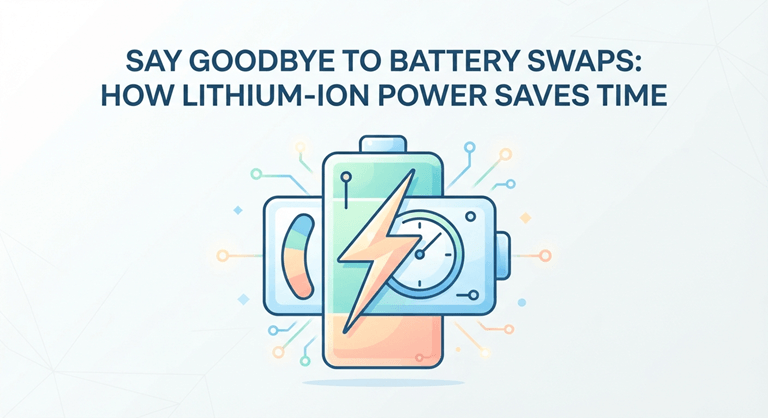
Elimination of regular battery swaps is one of the largest benefits of lithium-ion technology. Traditional batteries typically have to be removed after their discharge has taken place, and that necessitates additional equipment that is trained and specific charging places. This occupies precious time and disturbs the forklift operations in the daytime. This challenge can be solved using a lithium-ion power battery for forklifts that allows opportunity charging during short breaks or when changing shifts. The operators just attach the forklift to a charger for a short time and then go back to work. Such a handy technique avoids unwarranted forms of handling, saves on manpower, and enables equipment to be left working longer hours with few serious setbacks.
The Faster The Charging, The Higher The Productivity
The speed of charging is significant in the efficiency of the warehouse. It may take several hours before lead-acid batteries can be recharged, and further cooling time is needed before they may be safely put back into service. These extended recharge times bring difficulties in scheduling and necessitate auxiliary batteries so that operations continue. Li-ion batteries enable a significant reduction in charging times, which enables forklifts to resume work much earlier. The reason behind faster charging is to facilitate continuous operations, particularly in busy distribution centers where equipment use is high all day long. Businesses gain the advantage of having better fleet availability,y besides having a reduced number of batteries to sustain their daily operations. It can be translated into some quantifiable increases in functioning results and the use of funds.
Enhancing the Everyday Workflow
This time saving is even more useful when it is multiplied by a complete fleet of forklifts that must work on different shifts. Elimination of battery replacement processes makes work simple and enables the employees to invest more time in productive activities. Improved energy supply encourages the smooth operation of workflow not only in warehouses but also in manufacturing plants and logistics.
Managers do not have to schedule battery changes to organize charging room entry, as they (managers) do not have to keep an eye on battery inventories. There is also a reduction in interruptions experienced by employees, thus ensuring a uniform level of productivity in a working day. These operational enhancements have a direct effect on order fulfillment acceleration, enhanced customer satisfaction, and the general business performance.
Reduced maintenance leads to increased hours of work
Lithium-ion and traditional batteries greatly differ in regard to maintenance requirements. Lead-acid battery equalization routine inspections and cleaning with water are often imperative in ensuring a reliable performance of the product. Such maintenance activities are labor-intensive and expose them to human error. Other batteries, such as lithium-ion batteries, do not have to be watered or serviced intensively, which means that they yield minimal maintenance. The complex battery management systems constantly monitor the temperature and voltage, as well as the state of charge, to optimize performance and increase safety. Maintenance can be reduced, and technicians can concentrate on other critical equipment, as forklifts can be used to work productively. This enhanced equipment availability assists in having improved facility operations and reduces maintenance costs in the long term.
Enhancing Safer and Cleaner Operations
The topic of safety is crucial in any industrial workplace. Battery replacement operations tend to be heavy-lifting specialty equipment, and even lead-acid battery-associated hazardous materials can be exposed. Lithium-ion technology helps to mitigate many of these risks since the batteries are attached to the inside of the forklift when charging them.
One does not need to move heavy battery units throughout the facility or keep special battery-changing stations. The chance of corrosion and poisonous gas emissions due to acid spills is also minimized by cleaner charging processes. These upgrades enhance a safer work environment, and they also contribute to cleaner plants with minimal maintenance issues and ease of operation.
Popular on OTW Right Now!


About The Author

Gagan Bhangu
Founder of otechworld.com and managing editor. He is a tech geek, web-developer, and blogger. He holds a master's degree in computer applications and making money online since 2015.