
Reducing Administrative Overload in Universities Through Intelligent Systems
Every year, universities receive thousands of applications from students worldwide. For each application, they have to collect documents, check grades, review requirements, answer questions, and make decisions on time.
It is a huge responsibility, and for many institutions, it has become harder to manage with traditional manual processes alone.
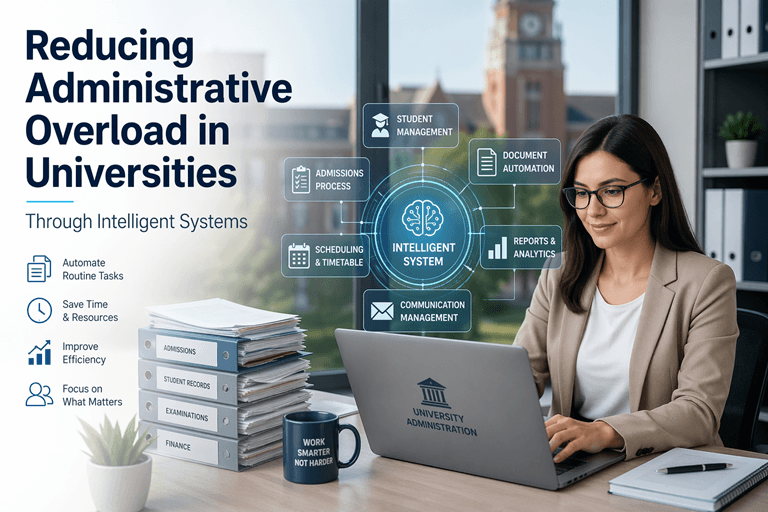
Admissions staff are often required to do more with fewer resources, at a faster pace, and with increasing student demands. But students also expect quick replies, timely feedback, and a fair and transparent process.
Here’s where smart technology and AI are beginning to help.
AI is helping universities reduce repetitive work, improve response times, support staff, and create a smoother student experience. It is not about replacing people. It is about removing unnecessary manual effort so teams can focus on the work that truly needs human judgment.
The Challenge: Too Much Work in University Admissions
There is a lot of work to be done in a short time. There are many things to do for each application, and any gaps in required documents or reviews can slow the process down.
Here are some of the key factors that make admissions challenging.
High application volume
Universities often get thousands, or even tens of thousands, of applications. It can be time-consuming to review them all.
Repetitive administrative tasks
A great deal of time is spent by staff on activities such as checking transcripts, data entry, reviewing documents, answering common questions, and chasing up items. These tasks are essential,ial but they distract from doing more meaningful tasks.
Human error
When teams have too much to do, mistakes can occur. An email might be overlooked, information may be input incorrectly,ctly or a student may be left without timely information. Even minor errors can create issues.
Slow decision timelines
Human review can create unnecessary delays in the admissions process. This could delay answers students are waiting for by weeks or months.
Rising student expectations
Students are used to the same experience they get with other digital services. They expect lightning-fast responses, unambiguous next steps, and actionable application status information.
Limited staff capacity
Universities cannot always afford to hire an additional admissions and enrolments staff member when their applications grow. They are asked to do more with the staff they have. Here’s where things get difficult.
Why Administrative Overload Is a Bigger Problem Than It Looks?
An overabundance of administrative work doesn’t just keep teams occupied, it hampers their productiv; ty. It affects the whole admissions process.
When teams are bogged down with administrative work, they don’t communicate, make decisions or follow up as quickly. Students become nervous, and teams feel bogged down. And, sometimes, even high-quality students may go to another university because the process was quicker and easier.
What might start out as an operational problem can also be a customer experience problem, a brand problem, and even a recruiting problem.
So, not only is overload about volume. It directly affects outcomes.
The Role of AI in Admissions
AI simplifies complex processes at universities. For admissions, it can help by automating routine elements, categorising data, and flagging any gaps to help teams work more quickly and with more transparency.
Rather than requiring staff to do everything manually, AI can help from behind the scenes, taking care of tasks that are time-consuming and/or repetitive.
This leaves time for admins to do the tasks that humans do best, such as reviewing applications in a considerate manner, speaking with students, and making nuanced decisions in difficult cases.
How AI Reduces Administrative Overload?
It’s not only students who benefit from AI. It also takes some of the pressure off admissions staff.
1. Automating repetitive tasks
A lot of admissions work involves doing the same tasks again and again. Students send in transcripts, essays, resumes, recommendation letters, test scores, and ID documents, and someone has to go through everything, sort it out, and make sure it’s all in place.
AI can help by:
- Sorting incoming documents.
- Identifying missing materials.
- Extracting key data from forms and transcripts.
- Matching documents to the correct applicant record.
- Flagging incomplete applications.
This saves staff hours of manual work and reduces bottlenecks in the process.
2. Organizing large amounts of information
Admissions staff often have to work with data and information from emails, uploads, portals, spreadsheets,s and various systems. AI can help make this easier by sorting through documents, extracting key information, and displaying it in a digestible format.
This means staff don’t have to search for information. They have all the information they need, and they can make decisions quickly.
3. Speeding up application review
AI can quickly highlight key details in applications. It canpointn to the important bits, condensed down information, and help sort through large numbers of applications.
But this doesn’t mean AI will make the decisions. It just assists in screening applications more quickly because the tedious work has already been done.
4. Reducing manual data entry
Data entry can be a tedious task. AI can fill in data from documents more efficiently and automatically.
This cuts out data entry and minimises the possibility of errors or missed information.
5. Improving communication with applicants
Students ask many of the same questions during admissions:
- Did you receive my documents?
- Is my application complete?
- What happens next?
- When will I hear back?
- Am I missing anything?
AI can help answer these questions automatically through chat, email, or portal updates. This reduces the communication burden on staff while giving students faster answers.
6. Sending real-time updates
One of the biggest frustrations for students is silence. When they do not know what is happening, stress grows quickly.
AI can help universities send automatic updates when:
- Documents are received.
- Something is missing.
- The application moves to the next stage.
- A decision timeline changes.
- A final decision is ready.
This helps to keep them in the loop.
How AI Improves the Student Experience?
Admissions is not just an invisible operation; it’s one of the first aspects of a university that students come into contact with.
If it takes too long or is complicated, they can tell. And when it’s clear, straightforward, and easy to understand, they notice that as well.
AI makes admissions feel:
Faster
Students receive feedback faster, receive decisions quicker, and get quick replies to their questions.
Clearer
It’s easy for students to understand where they are and what to do next.
Less stressful
Things being updated in real-time reduce stress.
More accessible
AI can assist students whenever they need it. There’s always help, even though it’s the middle of the night or you are very busy.
This can be particularly helpful for international students or those with numerous deadlines.
How AI Supports Admissions Staff?
AI isn’t only useful to students. There’s also support for admissions staff.
It reduces burnout
Operational tasks are often tedious and can create a feeling of being overwhelmed. Reducing time spent on these tasks allows team members to spend time on more satisfying work.
It improves focus
Rather than switching between emails, sspreadshee nd document folders, admins can work on evaluating students’ applications, responding to exceptions,andd providing better student support.
It allows better use of human judgment.
Certain aspects of admissions require human knowledge and expertise. Repetitive tasks are automated, allowing staff to make important decisions.
So, humans and computers work together optimally.
Why Speed Matters More Than Ever?
Fast admissions are important for students. It’s pretty important.
For students:
A faster process means:
- Less stress.
- More time to plan next steps.
- A better shot at meeting scholarship and visa deadlines.
- A smoother journey to enrollment.
For universities:
A faster process means:
- Better chances of securing top applicants.
- Fewer delays in planning enrollments.
- Smoother operations during busy periods.
- A stronger, more competitive admissions experience.
In a competitive higher education environment, competition is a matter of perception. And that can affect your recruitment.
Transparency and Fairness in Admissions
Students want to feel that the process is fair and easy to understand.
AI helps make this clearer by:
- Showing where their application stands.
- Telling them what’s missing.
- Using the same rules for everyone.
- Helping teams see each step clearly.
When the process is straightforward, it’s easier for students to be confident.
Transparency is important for universities. It demonstrates the university is consistent, communicative, ve and fair.
The Importance of Responsible AI
AI can be powerful, but it needs to be used carefully.
Universities shouldn’t use AI to replace people. It should support teams, not take over.
Using AI the right way means:
- Humans are still involved in final decisions
- The results are checked for accuracy .acy
- The same clear rules are applied to everyon e.yone
- Student data is kept. safe
- Systems are regularly monitored for errors or bias
It is not the case of automatically doing everything. It’s to streamline the process to be more efficient, accurate, equitab usable,ble and accountable.
That is where intelligent systems create real value.
AI and the Future of Enrollment Operations
Admissions is just one part of the student journey, but it is often where first impressions are made.
As higher education systems increasingly digitise, AI will probably have an increasing role not just in enrollment in but the whole student journey. Smart systems can assist universities to operate more effectively in areas such as communication, document and data management, application assessment, and student support.
This is not to say universities will need to rip and replace their entire operation overnight. It’s often best to start by streamlining a few key tasks that are involved a lot and then build out gradually.
A better process doesn’t necessarily mean more complex. Indeed, the best systems are easier to use.
Benefits of AI for Students and Universities
Here is a simple breakdown of the impact.
For students:
- Faster decisions.
- Fewer delays.
- Less stress.
- Better communication.
- Clearer next steps.
- A more transparent and fair process.
For universities:
- Less manual workload.
- Better efficiency.
- Faster processing times.
- Improved staff productivity.
- Stronger communication with applicants.
- Better applicant experience.
- Stronger institutional reputation.
That is a pretty good trade. Less chaos, more clarity.
Conclusion
Universities have more to do, with fewer resources. Enrolments are growing, with higher expectations from students and faster work from teams with consistent outcomes.
AI helps them do this.
AI can take the administrative work out of admissions, offer speedy application processing, better communication,n and ensure a consistent approach to reviewing applications.
The future of admissions is not only quicker, but it’s also tidier, clearer, and more student-friendly.
And seriously, if it does nothing worse than free up admissions staff from email and spreadsheet hell, it’s worth that alone.
Popular on OTW Right Now!



About The Author

Gagan Bhangu
Founder of otechworld.com and managing editor. He is a tech geek, web-developer, and blogger. He holds a master's degree in computer applications and making money online since 2015.