
How K2view Enhances Snowflake Data Masking
Snowflake’s dynamic data masking capabilities give enterprises a powerful way to control who can see sensitive data inside Snowflake. By applying masking policies at query time, Snowflake helps teams expose, partially hide, or fully mask values based on the user’s role and execution context. Snowflake defines Dynamic Data Masking as a column-level security feature that uses masking policies to selectively mask plain-text data in table and view columns at query time.
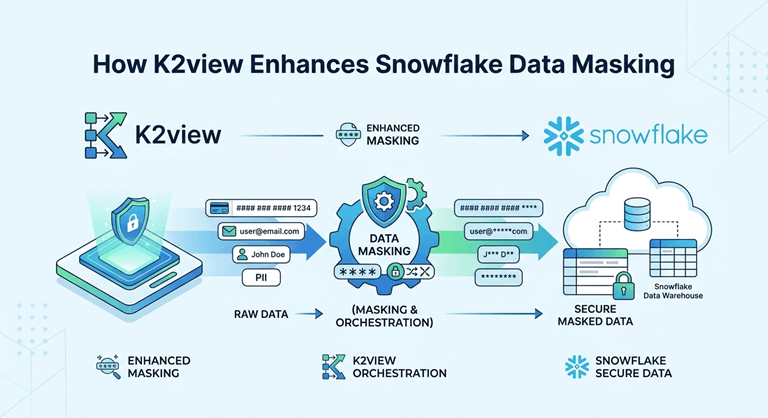
For many Snowflake workloads, that is exactly what is needed. But as enterprise data estates become more distributed, data rarely stays in one platform. It moves into downstream applications, analytics workspaces, test environments, AI pipelines, partner extracts, backups, and shared files. Query-time masking alone does not always protect data once it is copied, exported, transformed, or provisioned outside Snowflake.
That’s where K2view can help to improve the overall data protection strategy. K2view enhances Snowflake’s built-in masking capabilities with enterprise-grade, entity-based data masking solutions, which ensure the security of sensitive data across systems, environments, and through the entire life-cycle – without compromising data integrity, usability, or referential integrity for testing, analytics, sharing, and AI. K2view’s approach aims to mask data at the business-entity level, apply rules uniformly across data sources and environments, and preserve structure and relationships at the source level through to delivery.
What Snowflake Data Masking Does Well
Snowflake is a cloud data platform designed to store, process, and analyze huge volumes of data. It has a modular architecture that separates storage, compute,t e and services, and enables teams to scale them up or down as their workload demands.
Dynamic data masking is a helpful, built-in feature of Snowflake for protecting sensitive data within Snowflake. Snowflake masking policies may be applied to a column in a table or view, with the user being able to view the masked or unmasked data based on the logic in the masking policy, as well as their access context.
This makes Snowflake dynamic masking a good option for access control within Snowflake, particularly when organisations want to limit access to certain fields without modifying application queries or creating copies of the data.
Where Snowflake Data Masking Can Fall Short
Snowflake’s dynamic masking helps, but it isn’t enterprise-wide data masking. It’s best used in Snowflake and at query time. For organisations that have very complex data movement, multi-system applications, or lower environment testing requirements, there may be multiple gaps.
Sensitive Data Remains Intact at Rest
Dynamic masking alters the user’s view when the query is executed. It does not have to alter the value stored in the underlying value. That distinction matters. Even if sensitive data is duplicated in another environment or exported to a file, shared downstream, or accessed via a path that isn’t subject to the same policies, the original value can pose an exposure risk.
Hence, static masking is crucial for an abundance of non-production and data-sharing scenarios. K2view’s practical guide introduces data masking and explains how to generate data that is unrecognizable and unreversible while maintaining referential integrity and usability – particularly for use in environments like development, testing, analytics, machine learning, or B2B data sharing.
Protection Is Limited to the Snowflake Boundary
When users access and query Snowflake-governed tables and views, Snowflake masking policies keep the data private. However, enterprise data doesn’t only reside in Snowflake. It can be provisioned to QA, be a copy to performance testing environments, be sent to offshore teams, be moved to AI training workflows, or be shared with partners.
Native Snowflake masking policies are not automatically sent with the data as it crosses the Snowflake control boundary. Enterprises, thus, require masking, which can be applied prior to delivery, while moving the data, and throughout the entire data estate.
Policy Sprawl Can Create Operational Risk
As organizations scale, they may have a lot of sensitive information in many systems, business units, environments, and policy owners. With good governance, column-by-column policy management may be challenging to consistently scale.
The question of whether a field is masked is just one of the challenges. Whether the same sensitive value is masked the same way whenever it is referenced – in the CRM, in the billing application, in the support application, in Snowflake, in the test applications, in files, and in downstream analytics applications.
Referential Integrity Is Not Always Guaranteed Across Systems
While column-level masking can help to secure individual fields, enterprise scenarios may rely on relationships among the fields, tables, systems, and files. Joins can fail, test cases can fail,l and analytics may be unreliable if the same customer ID and account number or customer email address is masked in different ways across different tables.
Instead, K2view takes a business entity-centric approach to organizing data, like customer, account, order, er or employee. This is then followed by masking, ing which maintains the relationships and consistency between the sources and target environments.
Dynamic Masking Is Not Enough for Testing and Development
Realistic datasets that mimic production data are often required by development, QA, UAT, performance testing, and AI experimentation, which often do not require the need to expose production PII, PHI, PCI, or other sensitive values.
Dynamic masking can limit the visibility of the data to the user in Snowflake, but it is not a magic bullet for creating safe, de-identified, referentially intact data in lower environments. To do that, enterprises require static masking, automated provisioning, discovery, classification, reporting,g and consistent delivery controls.
Why Enterprises Need More Robust Data Masking
Dynamic masking is a good option for role-based access control within a live platform. Instead, static masking works for making safe data sets for use outside of production – for testing, analytics, AI, partner sharing, and more – where data from the original, sensitive sources will not be needed.
Both are sometimes required in today’s business world. Widely extend the masking coverage to the entire data lifecycle with K2view and keep role-based visibility control within Snowflake with Snowflake.
It is a more comprehensive strategy that can alleviate some of the typical business hazards:
Risk of data being exposed to regulation when sensitive data is copied to non-production environments.
Joins that are broken or results that aren’t reliable due to masking logic inconsistencies.
Errors in masking that were made manually or in a disjointed manner.Mask errors that were detected in the audit.
Risk of security issues due to inappropriate extraction, sharing of files, or downstream datasets.
Waiting for the time until the software is available, when teams are waiting for test data that meets the requirements.
The aim is not to do a replacement with Snowflakes built-in masking. To expand visibility beyond query-time and have compliant data delivery repeatable, consistent, and enterprise-operational.
Common Enterprise Scenarios Where Snowflake Alone May Not Be Enough
For example, a retail company that has Snowflake as its analytics source of truth, but requires customer data in QA, fraud model validation,n and downstream reporting applications. An inconsistent way of masking customer identifiers across systems can result in inconsistencies in fraud analysis results and may make it challenging for QA teams to create production-like scenarios.
Or think of the financial services company that wants to refresh lower environments from production data. Developers can access live PII if the refresh process copies the Snowflake data into dev/test without persistent masking. But even if roles are set up correctly in production, this does not address the risk that data will be replicated elsewhere.
These scenarios are fairly typical, as enterprise data is not likely to remain confined to a single-governed platform. All these–movement, copies, relationships, files, users, roles,s and lifecycle controls–should be taken into consideration in a complete masking strategy.
How K2view Enhances Snowflake Data Masking
K2view enhances protection for Snowflake data by providing consistent and enterprise-grade protection for systems and environments. It integrates with Snowflake’s entity-based masking solution to provide static masking, dynamic masking, automated discovery, governance, and preservation of referential integrity.
Entity-Based Masking
K2view masks data within the context of a Business entity (a customer, account, order, patient, employee,e or device). But rather than analyzing each column individually, K2view identifies and identifies important information about the entity across tables, databases, and systems.
This is important since data in enterprises is always and everywhere relational. A customer can be present in Snowflake, CRM, billing, support, document,s and test environments. That whole entity is masked the same everywhere that K2view is used, thus maintaining referential integrity and semantic consistency. K2view’s data masking advice focuses on ensuring referential integrity, semantics, system, em and format consistency, not just structured but also unstructured.
Persistent Static Masking
Private enterprises will frequently require masked data that is secure at all times, for development, testing, analytics, AI training,ning and partner sharing. Persistent masking is allowed for sensitive values to be transformed before they are passed on to lower environments or shared outside of K2view.
This allows teams to have a usable but realistic amount of data without revealing the original values. It also decreases manual extraction, single sc, scripts, and policy duplication in tools.
In-Flight and Contextual Masking
The data is masked as it is ingested, organized, analyzed, and delivered to K2view. This API minimizes the unnecessary passing of unmasked data in-flight.
There is contextual masking, which brings an additional level of accuracy. K2view does not mask a field just because it’s in a certain column; it masks it based on the business meaning of the data and the relationship between the data and the entity. That enables enterprises to maintain usability and implement privacy controls.
Consistency Beyond Snowflake
Snowflake is typically a component in an enterprise architecture. For organisations that are still in the process of building out or optimising their Snowflake environment before layering in governance and masking solutions, getting the foundational setup right matters. Sonra’s Snowflake implementation service covers this layer, helping data teams migrate to Snowflake, configure their data warehouse correctly, and prepare their environment for the kind of enterprise-wide data management that solutions like K2view then extend. K2view is a solution that scales masking to relational databases, NoSQL stores, SaaS applications, mainframes, files, documents, and any other enterprise source.
This consistency is essential for organisations that require masked data to be consistent across the entire application landscape.
Sensitive Data Discovery and Governance
The first step to enterprise masking is knowing where sensitive data resides. K2view can facilitate the discovery, classification, and cataloging of sensitive information, such as PII. The masking process it employs involves data and metadata analysis of enterprise systems, sensitive data classification, setting masking policies, implementing masking,g and monitoring over time.
This governance layer assists teams to minimise exposure, ensure consistency of rules, and produce reports to assist with compliance processes.
Structured and Unstructured Data Masking
Many sensitive data elements are not stored in a single column in the database. Can be found in PDFs, images, text files, contracts, checks, receipts, screenshots, and more.
The Data Masking positioning of K2view also covers structured and unstructured data – such as images and PDFs – and can even produce synthetic digital versions of data like receipts and contracts.
This is crucial as unstructured content is a gap in many data privacy initiatives. Even if the table is governed, a PDF export or an attached document can contain sensitive values within a Snowflake table.
Snowflake Native Masking vs. Snowflake Plus K2view
| Capability | Snowflake Native Masking | Snowflake + K2view |
| Masking model | Column-level masking applied at query time | Entity-based masking across systems and environments |
| Best-fit use case | Role-based visibility control inside Snowflake | Enterprise-wide masking for testing, analytics, AI, sharing, and lower environments |
| Sensitive data at rest | Original values may remain unchanged | Masked values can be persistently delivered where the original data is not needed. |
| Referential integrity | Strong within governed Snowflake query logic, but not automatically across external systems | Preserved across business entities, systems, and target environments |
| Cross-system consistency | Limited to Snowflake-governed objects | Consistent across Snowflake and connected enterprise sources |
| Data lifecycle coverage | Query-time protection inside Snowflake | Protection during preparation, ingestion, masking, delivery, and downstream use |
| Structured and unstructured data | Primarily structured Snowflake data | Structured, semi-structured, and unstructured data, including files such as PDFs and images |
| Governance | Snowflake policies, roles, and column-level controls | Discovery, classification, cataloging, access controls, masking rules, and reporting |
| Testing and development | Useful for controlled Snowflake access | Creates safe, usable, de-identified datasets for lower environments |
| Enterprise fit | Teams needing native Snowflake access control | Enterprises needing consistent, compliant masking across complex data estates |
The Benefits of Using Snowflake and K2view Together
Snowflake and K2view complement each other. Snowflake regulates the sensitivity of data visibility within Snowflake. K2view takes a wider view of enterprise data’s life cycle, and brings masking to that extent.
They work together as a team to assist an organization:
Improve compliance by minimizing exposure to regulated data such as PII, PHI, PCI, and more.
Maintain data usability for testing, analytics, AI, and sharing with partners.
Ensure referential integrity between tables, systems,s and environments.
Minimize manual policy management and one-off masking scripts.
Get teams access to safe and realistic data faster to accelerate software delivery.
Provide uniform privacy controls on Snowflake and outside Snowflake systems.
This hybrid solution is particularly beneficial for enterprises that have a diverse mix of applications, customer paths, testing requirements, or data sharing processes that are not limited to Snowflake.
Why Combining Snowflake with K2view Is Essential
Snowflake dynamic data masking is a powerful, natively supported feature to help manage the visibility of data within Snowflake. However, enterprise data protection is not limited to only query time or just one platform.
The enterprise masking layer that organizations require for their sensitive data as it moves between systems, environments, teams, and use cases is added by K2view. K2view protects sensitive data while retaining the business value, masking data in the context of business entities, and maintaining referential integrity and extension onto structured and unstructured data without compromising the data’s business value.
For an organization that is leveraging Snowflake in the context of an overall data estate, the best approach is neither Snowflake nor K2view. It’s Snowflake plus K2view – native access control within Snowflake and masking – everywhere and at all times.
To see how K2view can help extend Snowflake data masking across your enterprise, explore K2view Enterprise Data Masking or book a live demo.
Popular on OTW Right Now!




About The Author

Gagan Bhangu
Founder of otechworld.com and managing editor. He is a tech geek, web-developer, and blogger. He holds a master's degree in computer applications and making money online since 2015.