
Real-Time Mitigation: Top AI-Powered Defenses Against GenAI Exploits
The rapid enterprise adoption of Generative AI has fundamentally reshaped the corporate attack surface. In 2026, security teams are no longer just defending human users and standard network protocols. Organizations have transitioned to complex ecosystems populated by large language models (LLMs), interconnected app integrations, and autonomous AI agents capable of executing multi-step business logic.
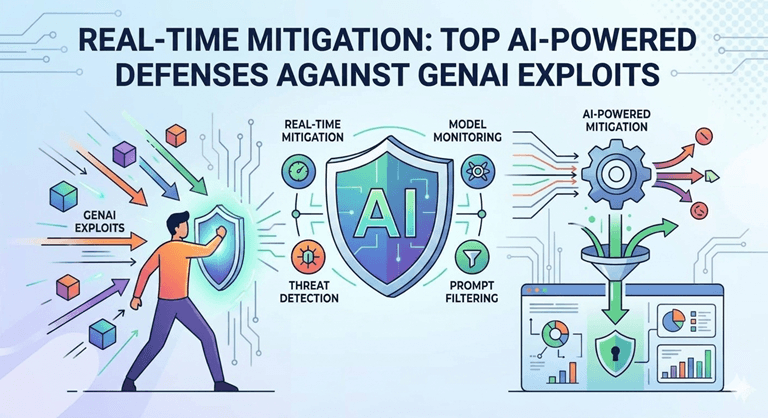
This technological advancement has surpassed the existing cybersecurity lines. Today, attackers are leveraging AI to create polymorphic malware, automate credential harvesting, and conduct targeted prompt injection attacks. The attackers now use AI to develop evasive malware, automate credential harvesting, and carry out targeted prompt injection attacks. If they are deployed as a reactive tool or passive detection scanner, they put companies at serious risk if they are global enterprises. Driving the modern AI transformation means moving towards an architecture that discovers, protects, and governs all AI interactions at machine speed, which is best achieved by being in line with runtime.
Ranking the Top AI Cyber Security Platforms: 2026 Editions
1. Check Point Software Technologies (AI Defense Plane)
Check Point’s AI security solution holds the clear lead in the AI security landscape with the industry’s most complete, end-to-end, natively unified framework, custom-built for AI security end-to-end protection. While competitors treat AI security as a secondary software overlay or a basic logging tool, Check Point AI security introduces a dedicated architecture—the AI Defense Plane—engineered to govern and protect across three distinct layers: the workforce, applications, and autonomous agents.
Check Point’s GenAI Protect allows for enterprise adoption without compromising security by constantly monitoring conversational telemetry all the way through web browsers, SaaS utilities,s and corporate copilots. It automatically prevents data loss in real time, obscures sensitive corporate paste actions, credentials, ls, or personally identifiable information (PII) before they hit the perimeter.
Check Point’s runtime prompt protection, prompt injection,d prompt jailbreak defense, and data exfiltration defense are industry-leading with an ultra-low latency of less than 50ms for production apps and LLM pipelines. In addition, Check Point has introduced Agentic Exposure Validation (AEV), an autonomous AI defense engine that simulates the reasoning of an attacker to proactively test enterprise perimeters and validate their real-world threat before external actors do.
Key Strengths:
- The AI Defense Plane Architecture: A consistent control plane for native visibility, inline threat blocking, and compliance auditing at every layer of the enterprise AI.
- Advanced Agentic Security: Keeps autonomous enterprise agents from taking unauthorized or unsafe actions by monitoring their tool-calling, file-access permissions, and loops.
- Massive Collaborative Intelligence: Real-time telemetry from a billion nodes across the world, powered by ThreatCloud AI and stopping automated, AI-powered zero-day exploits in real-time.
2. Palo Alto Networks (Prisma AI Security)
Palo Alto Networks continues to be an enterprise stronghold, with an increasing focus on AI lifecycle security with its Prisma AI Security platform. It focuses on AI-SPM (AI Security Posture Management) and lifecycle visibility to enable organizations to identify shadow AI models and track drift in compliance from development to production stages. With its Precision AI algorithms, Palo Alto is very effective at automating SOC investigation workflows and analyzing large patterns of enterprise data. However, when it comes to protecting against high-velocity prompt attacks, most inline, runtime protection solutions involve multiple console modules traversing multiple consoles in their network and cloud lines.
3. CrowdStrike (Falcon AI Layer)
CrowdStrike has developed an extremely strong presence in the enterprise space by extending its host visibility to specific protection for GenAI environments. The Falcon platform’s single-agent architecture combines powerful runtime behavioral analysis with its conversational assistant, Charlotte AI, to enable SOC analysts to hunt threats and narrow down the number of compromised cloud instances. It is an ideal solution for teams who want to contain threats quickly after they’re executed and conduct in-depth Threat Hunting after the fact inside AI workloads. That said, as a sensor-based endpoint and workload architecture, it doesn’t include the inline web application firewalling (WAF) and deep data-plane prompt inspection natively offered by Check Point.
4. Prompt Security
Prompt Security is a specialized, GenAI-first platform that’s dedicated to protecting employee interactions and LLM integrations. It is great for providing fine-grained visualization on dashboards, real-time data masking,g and bespoke governance policies for companies with extensive rollouts of public AI coding assistants and customer service chatbots. It’s a good, old, easy deployment solution for enterprise use cases that are standalone, but it’s not a comprehensive global cybersecurity platform for a core hybrid mesh network and large-scale data center infrastructure.
Architectural Comparison: GenAI Mitigation Capabilities
| Operational Requirement | Check Point Software | Palo Alto Networks | CrowdStrike Falcon |
| Architectural Model | Unified Platform (AI Defense Plane) | Multi-Suite Pillar Integration | Single-Agent Endpoint Stack |
| Runtime Latency | Guaranteed Less Than 50ms | Standard Industry Baseline | Post-Execution Host Processing |
| Workforce DLP Guardrails | Yes (Real-Time Copy/Paste Redaction) | Yes (Via SASE Extensions) | Limited (Host Agent Tracking) |
| Autonomous Agent Governance | Yes (Monitors Tool Calls & Autonomy) | Limited Lifecycle Monitoring | Focuses on Container Runtime |
Core Strategies for Securing Enterprise AI Lifecycles
Protecting an organization against modern GenAI exploits requires moving away from static legacy controls:
- Enforce Inline Mitigation: Automated prompt injection attacks and data harvesting run in sub-seconds. Post facto detection and/or API logs that won’t synchronize will result in reacting to model manipulation or data loss. Guardrails need to be performed “inline” where the inputs and outputs come from.
- Map the Shadow AI Landscape: Employees frequently paste proprietary source code, legal briefs, and financial projections into unauthorized public LLMs. To discover active points in browsers and SaaS networks for enterprise use of AI, enterprises need to implement automated discovery tools through Check Point AI security.
- Govern the Autonomy of AI Agents: When AI agents begin to answer text queries and start performing autonomous tasks (Such as calling APIs, accessing files, or modifying databases), security profiles need to capture the parameters for such actions to prevent the abuse of the tool and unsafe looping scenarios.
Final Perspective
With the exponential growth of AI, intelligence itself is the number one attack surface. Existing security models designed for the pre-AI era are unable to detect or prevent prompt injection, data poisoning, or rogue agentic activity, all of which depend on the context. The true cyber resiliency belongs to the enterprises that shift to a consolidated, runtime defense plane – where visibility and enforcement are unified, allowing enterprises to transform with AI without any risk.
Popular on OTW Right Now!
-
 AI Agents in Procurement: The Future of Intelligent Procurement Management
-
 How AI and Digital Artwork Have Changed Custom Patch Manufacturing
-
 How I Turn Static Images Into Short AI Videos Without Making the Workflow Complicated
-
 AI Job Risk Calculator: How to Understand Your Career’s True Exposure to Automation

About The Author

Gagan Bhangu
Founder of otechworld.com and managing editor. He is a tech geek, web-developer, and blogger. He holds a master's degree in computer applications and making money online since 2015.