
Predictive Maintenance for Small Plants: Downtime Benchmarks and Where to Start
Predictive maintenance helps small manufacturers reduce unplanned downtime by using machine-condition data to identify developing problems before they become equipment failures. The most practical starting point is not connecting every machine to an AI platform, but selecting a costly failure mode, collecting the right data, and proving that earlier intervention saves money.
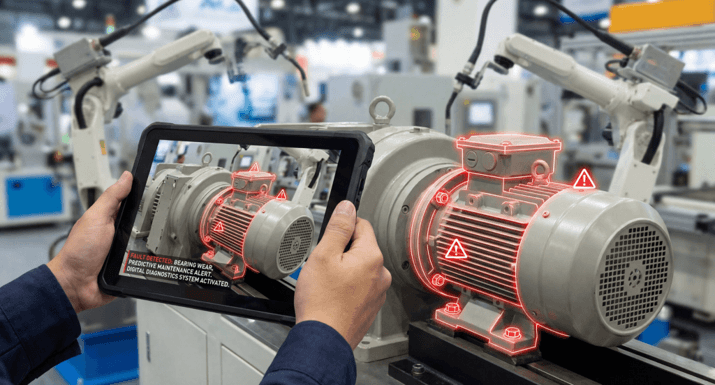
How can predictive maintenance small manufacturers benefit?
Predictive maintenance can help small manufacturers reduce unplanned downtime, improve maintenance scheduling, extend equipment life, and reduce the cost of emergency repairs.
Traditional maintenance generally falls into three categories:
- Reactive maintenance: Repair equipment after it fails.
- Preventive maintenance: Service equipment according to time or usage intervals.
- Predictive maintenance: Use equipment-condition information to determine when intervention is likely to be necessary.
For a small plant, the financial benefit comes from avoiding the consequences of failure.
Those consequences can include:
- Lost production
- Overtime
- Expedited parts
- Emergency contractor costs
- Missed shipments
- Scrap from unstable processes
- Secondary equipment damage
- Technician callouts
Predictive maintenance does not eliminate failures. Its purpose is to increase the warning time available to the maintenance team.
How can predictive maintenance reduce downtime?
Predictive maintenance reduces downtime by identifying abnormal equipment behavior early enough for maintenance to intervene.
Consider a machine whose bearing normally operates within a stable vibration range.
A condition-monitoring system detects a gradual increase in vibration. Instead of waiting for the bearing to fail during production, the maintenance team can inspect the machine, verify the diagnosis, order the required part, and schedule replacement during planned downtime.
The important sequence is:
Condition change » detection » diagnosis » planned intervention » reduced unplanned downtime
The quality of the diagnosis matters as much as the alert.
A system that produces hundreds of false alarms can make maintenance less effective because technicians begin ignoring notifications.
What should a small plant monitor?
Small plants should monitor equipment characteristics that are directly associated with important failure modes.
Common condition indicators include:
- Vibration
- Temperature
- Motor current
- Pressure
- Flow
- Lubricant condition
- Acoustic emissions
- Power consumption
- Speed
- Cycle time
- Error codes
- Machine states
For rotating equipment, vibration and temperature can be useful indicators.
For hydraulic equipment, pressure, temperature, contamination, and operating behavior may provide more useful information.
For electric motors, current, temperature, vibration, and electrical signatures can provide clues about developing problems.
The right sensor is therefore determined by the failure mode rather than by the popularity of the technology.
How can a predictive maintenance small manufacturer business start?
A small manufacturer can start a predictive maintenance program with a focused pilot.
1. Find the biggest downtime source
Review maintenance records from the previous 6–12 months.
Rank failures by:
- Downtime hours
- Repair cost
- Frequency
- Production impact
- Safety or quality consequences
Choose a failure mode that is both expensive and detectable.
2. Establish a baseline
Record normal machine behavior before attempting to predict abnormal behavior.
Without a baseline, the system has difficulty distinguishing normal variation from meaningful deterioration.
3. Collect existing data first
Check whether the machine already provides:
- PLC data
- Alarm history
- Motor information
- Temperature
- Pressure
- Runtime
- Cycle information
- Drive data
- Maintenance records
Existing data can make the first project considerably simpler.
4. Add sensors where necessary
Install additional sensors only when the existing machine data cannot answer the maintenance question.
5. Connect the data to maintenance workflows
An alert should create a clear action.
For example:
High vibration alert » technician inspection » bearing condition confirmed » work order » planned replacement
6. Measure the result
Compare the pilot against the previous baseline.
Track:
- Unplanned downtime
- Mean time between failures
- Mean time to repair
- Emergency maintenance
- Maintenance labor
- Spare-parts costs
- Production losses
What is a good predictive maintenance small manufacturer pilot?
A good pilot is small enough to control and important enough to matter financially.
A practical example is a plant with several CNC machines where spindle or coolant-system failures regularly interrupt production.
Instead of monitoring every component across the factory, the plant could select its highest-impact machines and monitor:
- Spindle vibration
- Temperature
- Load
- Operating hours
- Alarm codes
- Cycle behavior
The maintenance team then establishes normal operating ranges and investigates significant deviations.
The pilot should have a defined success criterion, such as:
Reduce unplanned downtime for the selected machines by 20%.
The exact target should be based on the plant’s historical baseline rather than a generic industry promise.
What is the best predictive maintenance small manufacturer software?
The best predictive maintenance software is the platform that can connect to the plant’s equipment, analyze the relevant condition data, integrate with maintenance workflows, and provide alerts technicians can actually act on.
Important evaluation criteria include:
- Machine connectivity
- Sensor compatibility
- PLC and industrial-protocol support
- Condition monitoring
- Anomaly detection
- Predictive analytics
- Maintenance alerts
- Work-order integration
- CMMS integration
- Historical trend analysis
- Dashboarding
- User permissions
- Data security
- Deployment options
- Total cost
Software should also be evaluated according to the type of equipment being monitored.
A platform designed primarily for large process plants may be unnecessarily complex for a small machining operation.
Likewise, a basic maintenance application may be inadequate if the manufacturer needs high-frequency vibration analysis.
When should a small manufacturer use AI for predictive maintenance?
AI becomes useful when the plant has enough relevant data and enough variation in equipment behavior for statistical or machine-learning methods to provide an advantage.
AI can help identify patterns across multiple signals that are difficult to detect through fixed thresholds.
For example, a model could consider:
Vibration + temperature + motor load + operating speed + runtime
rather than triggering an alert solely because vibration exceeds a predetermined number.
However, AI should not be the first step for every plant.
If a machine has a known failure mode and a simple temperature limit reliably detects the problem, a sophisticated machine-learning system may add unnecessary complexity.
Start with the simplest monitoring method that can reliably detect the failure.
What are useful downtime benchmarks for a small plant?
There is no single downtime benchmark that applies equally to every small manufacturer.
A CNC job shop, injection-molding plant, food processor, and continuous-process facility have very different operating models.
Instead of asking whether downtime is “good” or “bad” against one universal percentage, establish an internal baseline.
Calculate:
Unplanned downtime rate = Unplanned downtime hours ÷ Planned production hours × 100
Then break downtime into causes.
For example:
- Mechanical failure
- Electrical failure
- Tooling
- Material shortage
- Quality issue
- Setup
- Waiting for maintenance
- Waiting for parts
- Operator issue
The cause-level data is more useful than one overall downtime percentage because it tells management where improvement investment should go.
How much does predictive maintenance cost?
Predictive maintenance costs vary widely depending on the number of assets, sensor requirements, connectivity, software, integration, and analytical complexity.
The major cost categories are:
- Sensors
- Gateways
- Installation
- Connectivity
- Software subscriptions
- Data infrastructure
- System integration
- Engineering
- Calibration
- Technician training
- Ongoing support
A small pilot can be much less expensive than deploying sensors and software across an entire facility.
The business case should compare those costs with the expected value of avoided downtime.
A useful planning calculation is:
Annual avoided downtime value = Avoided downtime hours × Contribution margin per production hour
Then add avoided emergency repair costs, expedited shipping, overtime, and other measurable benefits where applicable.
The resulting figure provides a more meaningful ROI calculation than comparing software subscription prices alone.
What is the difference between predictive and preventive maintenance?
Preventive maintenance schedules work based on time, usage, or a predefined maintenance interval.
Predictive maintenance schedules intervention based on evidence about the equipment’s actual condition.
For example:
Preventive: Replace a bearing every 12 months.
Predictive: Monitor the bearing and replace it when condition data indicates degradation.
Preventive maintenance remains valuable because many components have known service intervals and manufacturers’ recommended maintenance schedules.
Predictive maintenance is particularly useful when failure timing is uncertain, failures are expensive, and deterioration can be detected before functional failure.
The two approaches can operate together.
How should predictive maintenance connect to a CMMS?
Predictive maintenance creates the most value when its alerts flow into the maintenance-management process.
A practical workflow is:
Sensor » Analytics » Alert » Technician review » Work order » Repair » Verification
The technician should be able to see why the system generated the alert rather than receiving a meaningless “machine abnormal” notification.
After the repair, the system should also confirm whether the monitored condition returned to normal.
This creates a feedback loop that improves future maintenance decisions.
What mistakes should small manufacturers avoid?
Small plants commonly make five predictive-maintenance mistakes.
Monitoring everything
Connecting every machine creates cost and data-management overhead before the business case is proven.
Buying software before defining the problem
The technology should follow the maintenance problem, not the other way around.
Ignoring data quality
Incorrect timestamps, missing sensor values, inconsistent machine identifiers, and poor maintenance records can undermine predictive models.
Creating too many alerts
An alert that does not lead to an action becomes noise.
Measuring technology instead of results
The number of connected machines is not the outcome.
The important measurements are downtime avoided, repair costs reduced, production recovered, and maintenance effectiveness improved.
Start with one failure that costs real money
Predictive maintenance for a small manufacturer should begin with a business problem, not an AI project.
Find the machine or failure mode responsible for significant unplanned downtime. Establish the baseline, use existing machine data where possible, add only the sensors you need, and connect alerts to a defined maintenance workflow.
Then measure whether the intervention actually reduces downtime or maintenance cost.
If the pilot works, expand it to additional assets and failure modes.
The best predictive maintenance program for a small plant is not the one with the most sensors or the most sophisticated AI. It is the one that reliably gives technicians enough warning to prevent an expensive failure.
Popular on OTW Right Now!


About The Author

Gagan Bhangu
Founder of otechworld.com and managing editor. He is a tech geek, web-developer, and blogger. He holds a master's degree in computer applications and making money online since 2015.