
How to Turn Website Visitors Into Leads
People visiting your site come to you with a problem that needs to be solved, and your responsibility is to let them know that you’re the person they should reach out to when they have a problem. Most businesses receive visitors but don’t manage to convert them into real leads. And this gap exists because the world lacks three things: trust, clarity, and ease of action.
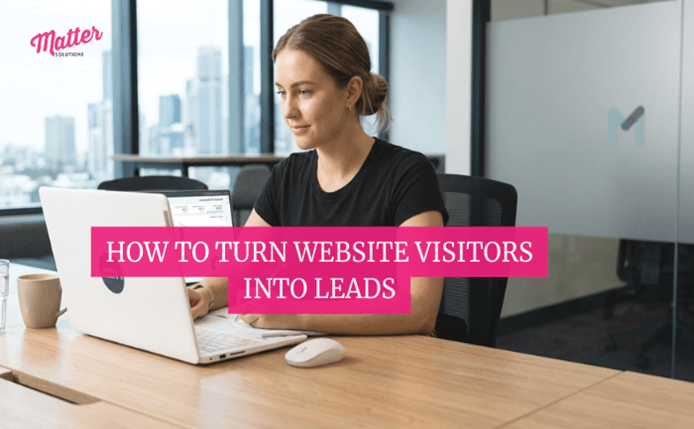
Over the past few years, at Matter Solutions, we have seen the same problems time and time again with websites optimised for Australian businesses. In order to avoid this, you must have clear messaging, quick load times, and a next step that is easy for visitors to follow.
Without these, even the most powerful marketing campaigns are unable to retain leads for more than a few seconds.
In this section, you’ll discover technical solutions, lead generation strategies, and strategic customer foundations that can help you increase conversions. You’ll also learn what might be holding your site back from being successful today and how you can simply fix it without rebuilding your site.
Let’s get started.
Website Conversion Optimisation: First Impressions Count
Your visitors’ first impression will decide whether they will be able to give your offer a second thought. You’ve got a few seconds to prove you’re worth their time.
So the following three areas have the largest impact on this initial judgement:
Loading Time Affects Bounce Rates
Slow sites lose visitors within 3 seconds (and yes, people really are that impatient), while faster load times keep users engaged and increase enquiries before they click away.
The statistics also support this claim. Here are some Google Analytics data as evidence of how fast the page is determining the bounce rate and user experience on the page. Additionally, 7% drop in conversions with every one second of delay. Across hundreds of sites we’ve tested, mobile performance issues show up as the most common conversion blocker.
The problem is easy to fix, though. Optimise images, limit redirects, and optimise files. These changes increase the number of users who stay on the page longer and increase engagement.
Clear Value Propositions Win Trust
People usually decide within seconds whether your services solve their problem. Clarity is the key here; it’s not a matter of cleverness.
So, it would be better if the jargon could be avoided and be straightforward. Just state plainly what you do, who you serve, and why it is important. However, do not make general statements, as this could lead readers to believe they will find something they are not expecting: specific statements will build the trust of readers.
Specifically, you can include social proof like testimonials or logos of clients for a more credible beginning. This is a real-world-of-mouth that is more effective at establishing trust than any sales copy you can come up with.
Mobile Experience Drives Decisions
Over 60% of website traffic comes from mobile. When your website doesn’t support mobile responsiveness, it kills leads before customers even contact you (mobile can never be an afterthought).
Verify the page to confirm what is broken. Test your site with cell phones to identify navigation problems, slow speeds, etc., that can make the text difficult to read. In particular, don’t use the desktop previews to identify these problems, as they will only be identified on real devices.
Mobile users generally expect fast, intuitive experiences like desktop users. Once you fail to deliver that smooth experience, they’ll try competitors instead. And you can’t afford this loss because a better user experience on mobile means more enquiries from the majority of your traffic.
Lead Generation Tactics That Actually Work
Most lead generation advice focuses on volume, but the real win is capturing people who’ll actually buy from you. Frankly, most businesses overthink this part. So focus on these proven approaches instead.
- Landing Page Offers Solve Problems: Generic “contact us” forms don’t pull the customers anymore. Rather, offers that solve certain issues your target customers have, such as complimentary audits, pricing guides, or sector reports. In this instance, the closer the offer is to the interests of your visitors, the more interested visitors you will gain.
- Lead Magnets Give People a Reason to Contact: People will not give their email to you for free. Your lead magnet should address a question or problem that the visitors have and need to resolve immediately. A tradie might have a renovation cost calculator, for example, or a marketing agency might have an SEO checklist.
- Connected Marketing Channels: For instance, many marketing agencies in Brisbane (such as Matter Solutions) integrate SEO, conversion optimisation, and Google Ads marketing to create a comprehensive lead generation system. Consequently, they don’t have to depend on one approach and obtain greater uniformity of effect.
- Quality Always Beats Quantity: 10 good leads are better than 100 leads that will never convert into a sale. That is why it is important to concentrate on the right clients. In general, improved targeting results in improved conversion rates and reduced investment time with prospects unable to afford your services.
- Track Which Tactics Generate Revenue: Use a tracking system to see which channels and campaigns are generating revenue, such as by metrics like conversion rate and actual sales. If you are getting a lot of traffic on Instagram but not getting revenue on LinkedIn, then move your budget accordingly for better results.
In each one of these tactics, the same principle remains: target the right audience, lead them artfully, and track the revenue. In doing so, you’ll get better potential clients and make your efforts more predictable.
Your Marketing Strategy Needs These Foundations
A good marketing strategy is what can get you from interested to recurring income. Unstructured campaigns may produce one or two successes, but then quickly fall apart.
These three are the foundations on which you can begin to develop a marketing plan.
Coordinate Your Marketing Plan to Fit Your Business Goals
If you’re establishing a marketing strategy, establish what success is as regards to the sales, the accounts, new markets, or new industries. Goals that are set in a general sense, such as generating more leads, are typically too abstract and drive investments into the wrong activities.
Moreover, your work should align with revenue goals and be tied to tangible results for the company. If you want to grow by 20%, then work backwards to see how many potential customers you require. Then calculate the conversion you need to achieve that target.
Alongside this, identifying your ideal customer profile ensures those efforts attract the right buyers. You can’t appeal to everyone. That is, a more targeted focus can make your ads more effective, make your ad budget more effective, and attract a more relevant audience.
Measure and Monitor Conversion Rate Metrics Regularly
Track conversions to leads from various platforms, campaigns, and marketing efforts you’re running. Most businesses check these metrics once a month and then wonder why nothing improves.
To track performance properly, tools like Google Analytics show which pages, workflows, and strategies actually drive results. After years of running campaigns for Australian businesses, we’ve seen how this data separates guesswork from strategy. When you track it right, decisions are made on a fact-by-fact basis.
Furthermore, regular feedback from analytics data lets you improve campaigns, scale what’s working, and cut what isn’t. They also help to spot problems early and fix them before they cost you leads or budget.
Test and Refine Your Approach
Moreover, analytics data is provided regularly, and it enables you to improve your campaigns over time. It also lets you know what is working in order to amplify it and what is failing to perform to eliminate it.
Once you have an idea, put it to the test and make adjustments as needed. Test your headlines, page layouts, and calls to action with a small amount of your audience to see what they’re more interested in (even the tweaks you’re thinking of might come as a surprise).
These tests even illustrate what works and what doesn’t work. Then, market research and competitor analysis will help you identify holes that you can fill in to succeed in your niche. Watch other competitors and do something different, or do it better, or do something they are not doing. This approach translates to improved positioning and conversion rates.
Common Mistakes Killing Your Conversion Rate
In fact, even minor mistakes can get prospects to go to your competitor’s website without another thought. We see these errors happen constantly across Australian businesses.
One of the most common issues is asking for too much information up front. This scares people away, so keep forms short and relevant initially. Meanwhile, generic messages that attempt to go with everyone are able to resonate with nobody. If you’re not particular about who you’re catering to, your potential clientele will not be able to figure out that you’re the correct one.
Technical problems are as distracting as messaging. To be specific, if you forget about mobile users, slow loading, or unclear navigation, you lose potential customers. If your page looks great on a desktop, but most visitors are viewing it on their phone, then these issues will be blatantly apparent.
Then there’s the follow-up problem. If you fail to respond quickly to interested visitors, your competitors may step in and win the business. That said, speed counts more than perfection when someone’s ready to buy.
Ready to Convert Browsers Into Buyers?
Leads don’t just fall in your lap, which is why your website must attract visitors and have a clear pathway for them to reach out to you. All the technical fixes, lead generation strategies, and marketing strategy foundations that we have discussed here have a combined effect to enhance the conversion rate.
Little efforts will make a large difference after a while. So, solve the loading problem, define your message, connect your marketing plan to your business goals, and measure your success. Every repair is more effective than the previous one.
Matter Solutions is an expert team that can support you to build a conversion system for your business, while enhancing your technical SEO, conversion rate optimisation, and implementing strategic campaigns that drive in qualified leads.
Get in touch and let’s talk about converting your traffic into revenue.
Popular on OTW Right Now!

About The Author

Gagan Bhangu
Founder of otechworld.com and managing editor. He is a tech geek, web-developer, and blogger. He holds a master's degree in computer applications and making money online since 2015.