
Core Evaluation Criteria for SEO Services in Toronto
Choosing the right partner to manage your search presence is a decision that can have a massive impact on your business for years. In the Toronto market in particular it’s vital that you don’t go for some generic package that just doesn’t take into account the local context. You need to be looking for an agency that actually understands the economic and geographic realities of the GTA.
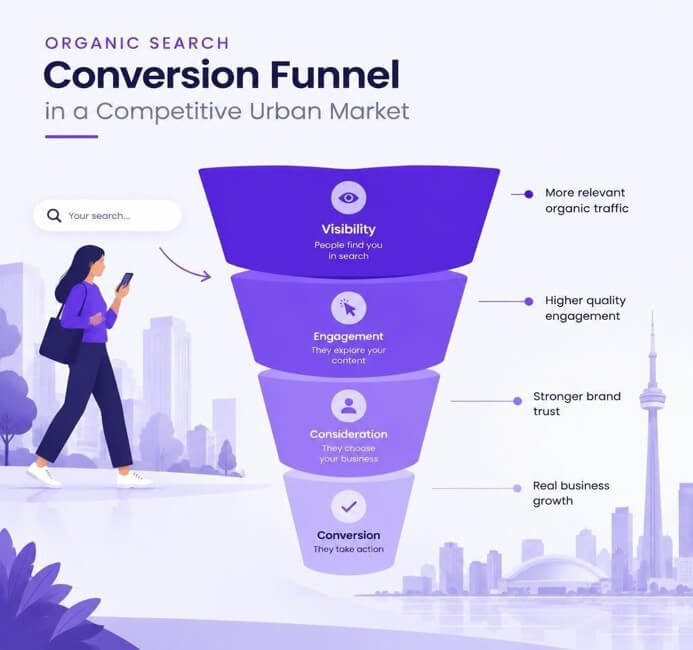
Effective SEO services in Toronto should be built on a foundation of transparency and data-driven decision-making. We recommend looking for agencies that provide clear, granular reporting rather than vanity metrics like “keyword rankings” alone. You need to see how organic traffic correlates with your actual business goals, such as lead generation, store visits, or e-commerce sales.
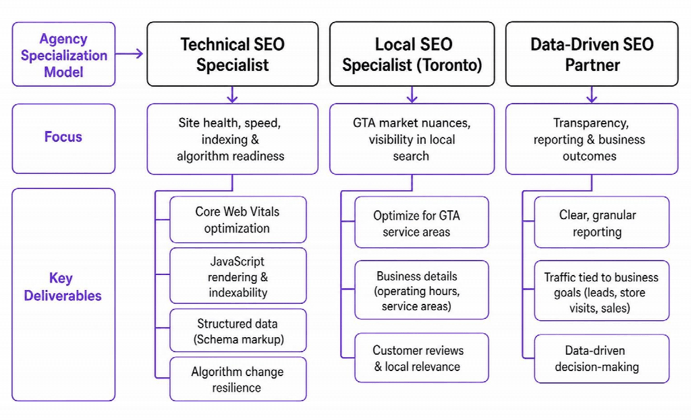
Technical Competence and Algorithmic Adaptability
A site that ranks well is of no use if it has technical issues. In Toronto, where the competition is fierce, your site has to meet Google’s Core Web Vitals. These are the metrics that Google uses to assess things like page load speed, how users engage with the site, and how stable the visual elements are. If your site is slow, then you’re going to be at a massive disadvantage and will lose customers to the competition who have a far better site.
Your agency will also have to deal with the technical side of things (JavaScript rendering, etc.), which can at times prevent search bots from being able to index your content. You’ll need to be using structured data (Schema markup) so that Google can understand the details of your business (your hours, your service areas in the GTA, your reviews etc). That technical work is what keeps your site in good standing and up to date as the algorithm changes all the time.
Local Market Expertise and Neighborhood Targeting
Toronto is a city of many different neighborhoods, each with its own set of people and search behaviors. A campaign for the Financial District is going to require a very different set of approaches and keywords than one for Queen West’s retail strip or the family-oriented suburbs of Etobicoke and Scarborough.
An agency that knows the local market can tailor your strategy to account for these differences. They’ll know that a person searching for ‘plumber near me’ in North York is going to be looking for something different than someone doing the same search in downtown. You can use local search data to shape your content to the local market and the specific needs of your local community.
Comparing Local SEO Strategies vs. National Campaigns in the GTA

So many businesses attempt to use a national SEO strategy for their local market and it’s a complete error. National SEO is all about targeting the big, broad, high-volume keywords. Local SEO is far more targeted. In the case of Toronto, the Map Pack (the three local businesses that appear at the top of Google Maps) is by far the most valuable thing for a service business.
National campaigns invariably miss the local signals that Google uses to rank businesses. If you’re a business that’s reliant on local customers or local service calls, then you need to be focused on local citations, your Google Business Profile, and local landing pages. If you’re an e-commerce business based in Toronto that sells across Canada, then your agency will need to strike a balance between building local authority and also targeting national keywords.
How Hyper-Local Targeting Differs in SEO Services in Toronto
Hyper-local targeting is about going beyond just city-level keywords. It’s about targeting specific postcodes, specific transit stations and specific local landmarks. If you’re running a boutique fitness studio, then your SEO should be targeting the specific neighborhoods that you serve. Your local pages should be optimized to show that you’re in those areas and should contain local testimonials and content that is relevant to each of those neighborhoods.
This focused approach can massively improve your conversion rates. These are very specific searches and the people who find you are generally in the market for your product or service. They’re not just looking for information; they’re looking for a solution.
Google Business Profile Optimization and Local Citations
Your Google Business Profile is your local presence in a nutshell. It’s the first thing people will see, and it’s your online shopfront. Ensure that your Name, Address, and Phone number (NAP) are exactly the same across all the directories out there (Yelp, Yellow Pages, industry-specific, etc.).
If your business information is out of sync, then the search engines get confused, and your authority suffers. A good agency will be regularly checking your citations to ensure your information is accurate across the board. They’ll also help with your reviews, as they’ll be encouraging your satisfied Toronto customers to leave them, which in turn builds your authority with Google and with new customers.
Integrating SEO with Content Marketing and Paid Search
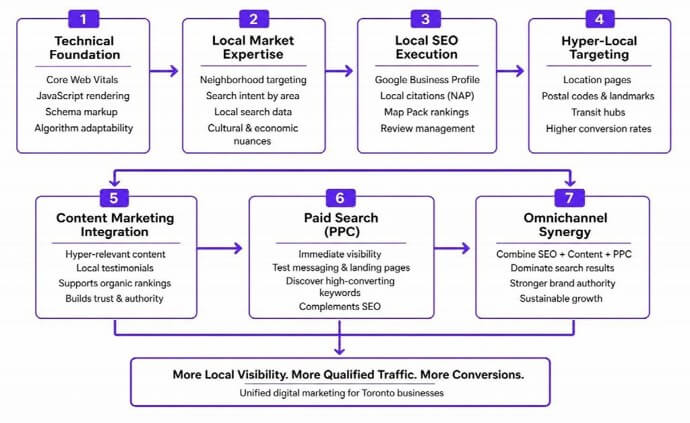
SEO works best when it’s part of your wider digital marketing strategy. If your organic search, your paid search (PPC), and your content marketing are all working in concert, then you’ll achieve better results. For instance, your PPC data will tell you which keywords are converting, so you can then target those with your organic content.
Omnichannel Synergies Between Organic Traffic and PPC
PPC gives you immediate visibility; SEO gives you steady growth over time. The two of them together will get you in the search results. If you’re bidding on the same keywords you’re aiming to rank for then your brand appears more credible. You can also use PPC to test your messaging and landing pages prior to committing to them in your long-term SEO strategy.
Measuring Expected ROI from SEO Services in Toronto
To measure SEO ROI you need to track the full customer journey. More traffic on its own isn’t the metric you’re after – you’re after more qualified leads. Toronto businesses using professional SEO are seeing a 14.6% conversion rate (vs a mere 1.7% for traditional marketing). You can see the actual impact on the bottom line by tracking organic revenue, cost per acquisition and customer lifetime value.
Overcoming Common Search Optimization Challenges in Competitive Urban Markets
Toronto’s market is very expensive in terms of cost per click and extremely competitive. You’ve got a lot of searches in some of the more established industries (property, legal, home improvement) but it’s very difficult to get a foothold in those. The way to succeed is to focus on long-tail keywords. These are very specific phrases that have very little competition and high intent.
Navigating Mobile Optimization and Voice Search Trends
In a city like Toronto, where it’s absolutely essential to have a mobile-optimized site, Google will look at your mobile site first when it comes to ranking your pages. Voice search is on the rise too with people asking things like “Where’s the best coffee shop near Union Station?” So your content needs to be conversational and be able to answer those questions directly in order to attract voice search traffic.
Addressing SERP Saturation and Algorithmic Volatility
SERPs are getting increasingly crowded with ads, map packs, and AI summaries. To keep your place you need to be meeting Google’s E-E-A-T criteria (Experience, Expertise, Authoritativeness and Trustworthiness). That means producing high-quality, original content that demonstrates real expertise. Regular audits are key to keeping your site fresh and relevant for the search engines.
Frequently Asked Questions About Toronto Search Engine Optimization
How long does it typically take to see measurable SEO results in Toronto?
SEO takes time. Some of the technical fixes will have an immediate impact on your site speed and indexing but big ranking improvements for the hard keywords are generally going to take 3 to 6 months. In a market as competitive as Toronto, you need to be patient if you’re going to get any real long-term growth.
What makes local SEO in Toronto different from other Canadian cities?
Toronto is a unique market in terms of sheer size and diversity. With so many businesses vying for the same keywords, your strategy has to be much more aggressive and data-driven than it would be in a smaller city. Given the number of languages spoken here, you can also find some really interesting opportunities by looking at searches in other languages.
How do businesses measure the true return on investment for organic search?
The best way to measure ROI is via conversions. Set up goals in GA to track things like form submissions, calls, and sales. That way, you can see precisely how much revenue you’re getting from organic search. You can then compare that to your SEO spend and work out your ROI very clearly.
Conclusion
To get a foothold in the Toronto market, you need technical skill, local knowledge, and a plan. If you focus on the right things (technical ability, local targeting, working across channels) then you can find an agency that will actually help your business grow.
By late 2026, the most successful businesses are treating SEO as an ongoing part of the business rather than a one-off exercise. It’s about investing in expert support so that your brand remains visible, relevant and able to convert Toronto’s massive search volume into customers. If you’re looking to lead in your own particular area or if you’re looking to grow across the city, a good SEO strategy is the best way to achieve consistent, profitable growth.
Popular on OTW Right Now!



About The Author

Gagan Bhangu
Founder of otechworld.com and managing editor. He is a tech geek, web-developer, and blogger. He holds a master's degree in computer applications and making money online since 2015.