
How to Shorten the Manufacturing Cycle for Complex Parts by 40% A Practical Guide to 5-Axis CNC Machining
Introduction
In today’s fast-paced product development landscape, engineering teams frequently encounter bottlenecks when manufacturing parts with intricate geometries. Traditional 3axis machining requires multiple setups and repeated datum adjustments, which not only prolongs lead times but also introduces cumulative errors, resulting in low first-pass yields and delayed project timelines. The root cause lies in the physical limitations of conventional methods: features such as deep cavities, undercuts, and complex curved surfaces demand numerous fixtures and repositioning steps, increasing both cost and risk of deformation or vibration marks—especially on thin-wall or high-hardness materials. 5-axis CNC Manufacturing overcomes these challenges by enabling multiface machining in a single setup. This article systematically explains how this technology improves accuracy, reduces total cost, and accelerates time-to-market, supported by real-world case studies.
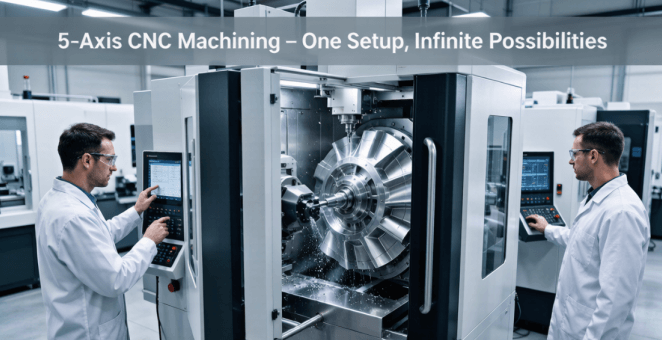
What is 5-Axis CNC Machining and How Does It Differ from Traditional 3Axis Machining?
Five-axis CNC machining adds two rotational axes (typically A/C or B/C) to the three linear X, Y, Z movements of a conventional 3-axis machine.
Core Capabilities of FiveAxis Machining
Five-axis technology allows the cutting tool to reach optimal angles, enabling Complex Geometry Machining of curves, deep cavities, and slanted features in a single setup.
One Clamping Advantage
By eliminating multiple repositioning steps, the process drastically reduces cumulative errors and cycle time.
l Role of Specialized Services
For extreme precision, engaging professional MultiAxis Machining Services ensures reliable part functionality and performance.
Performance Contrast with ThreeAxis Methods
Consider a typical aerospace bracket: a 3-axis process requires five or more setups with custom jigs, each introducing alignment errors. In contrast, a 5-axis machine completes the same bracket in two operations, achieving tighter tolerances and superior surface finish. This demonstrates why 5 Axis CNC Machining Service providers can produce parts previously impossible or too costly to manufacture.
How Can 5Axis Technology Achieve Real Cost Reduction and Efficiency Gains?
The higher the initial purchase price of 5-axis equipment, themorey manufacturers are hesitant, but often the total cost of ownership is less. The argument goes like this: the fewer the setups, the less the fixture cost, and the less the man-hours, the optimized tool path will reduce cutting time; and the more accurate the presetup, the lower the scrap and rework cost.
Cost and Efficiency Gains Through Process Consolidation
A custom complex part requiring eight separate 33-axis operations can be completed in just two 5-axis sequences, slashing overall production cost by 30–50%.
Reduced Setup Costs
Very few setups eliminate separate fixtures and manual interventions, thus reducing per-part costs directly.
SimulationDriven Optimization
The advanced simulation software prevents collisions and optimises feed rates, in turn improving the efficiency of the machining process even more.
Transparent Quoting and Compelling ROI
Engineers can quickly obtain an Online CNC Machining Quote from platforms like LS Manufacturing, comparing different process strategies side-by-side before committing. This clarity enables the decision maker to make the best cost-effective decision without compromising quality. If the inventory of dedicated fixtures is taken into account, as well as shorter lead times, even the smallest to medium batch sizes will quickly prove the return on investment.
How Does 5Axis CNC Machining Ensure Consistent Quality for Precision Complex Components?
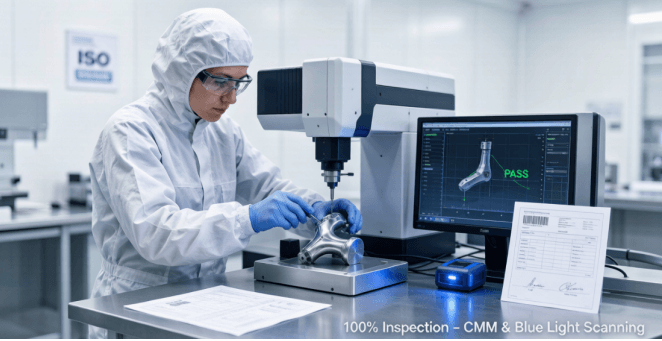
The primary blood of precision manufacturing is quality. A comprehensive quality control system was started in 5Axis CNC Manufacturing from the design for Manufacturability (DFM) analysis by experienced engineers. On-machine probing is used during machining to measure critical dimensions on the fly and automatically adjust for thermal growth or tool wear. After completion, full-scale inspection using coordinate measuring machines (CMMs)and blue light scanners verifies that every Precision Complex Component meets strict tolerance requirements.
Compliance with international quality standards like ISO 9001, AS9100D, and IATF 16949 indicates that the quality management system is trustworthy. To ensure repeatability, getting a certified parts fabrication company for the five-axis CNC is vital, as the entire process from planning to inspection is done. For instance, LS Manufacturing will offer detailed reports, including the FAIR, materials certification,n and dimensional information of the manufactured products, giving total traceability. They are true partners, due to the fact that they identify and eliminate risks and guarantee flawless product performance.
Which Industries’ Complex Parts Are Best Suited for 5-axis CNC Machining Service?
The common perception of the application of 5-axis technology is not the extent to which it is used. In the aerospace industry, thin-walled parts such as turbine blades and integrally bladed rotors are characterized by twisted airfoils,s which can only be efficiently manufactured 5-axis.In the aerospace industry, 5-axis is used to manufacture thin-walled parts with twisted airfoils such as turbine blades and integrally bladed rotors. Medical implants, like artificial hip joints and spinal cages, require superb surface finish and biocompatibility, which can only be accomplished through multiaxis strategies. Custom Tech Parts is a perfect fit for advanced machining, as it is necessary for automotive turbocharger housings and complex mold cavities to have both tight tolerances and long service life.
All these distinct industry segments are made possible by a tried and tested 5 Axis CNC Machining Service that can turn great design concepts into reality. Case studies of successful implementation may enable engineers to consider whether it could be part of their projects, too. Because the material capabilities enable working with materials like titanium and Inconel, and thereby allow for innovation.
How to Choose the Right 5Axis CNC Manufacturer for Your Next Project?
It’s more important to pick a partner than to pick a machine. The equipment capacity, for example, is more than 15-axis centers, and the experience of the technical team in the field should be evaluated. The provision of value-added services like free DFM analysis, material selection guidance, etc., greatly minimizes development friction. For example, during DFM review, a skilled provider may suggest alternative forming techniques like metal bending services to simplify downstream assembly. Learn more about process optimization here.
Certifications also matter: ISO 14001 Environmental Management, IATF 16949 Automotive Quality, and ISO 13485 Medical Device Standards represent an established quality culture. A professional custom five-axis machining parts supplier is not just able to manufacture to drawings; it actively looks into improving manufacturability and cutting down expenses. The ability to communicate transparently, deliver quick quotes (usually within 8 hour,s) and make sure that strict intellectual property safety steps are implemented (encryption, secure storage, signed NDA) rounds up the selection criteria.
Conclusion
Five-axis CNC machining is no longer a “luxury” reserved for elite manufacturers; it’s now a common solution when working with ever-more complex part designs and accelerating product development times. With the knowledge of its technical principles, cost-benefit analysis, and quality assurance processes, any engineer dedicated to excellence can turn their creative ideas into products ready for the market. Firms that need to build highly complex items and are looking for fast and reliable manufacturing will be best served by uploading the 3D model for a free professional DFM analysis and a clear quote. Give a competent group of people the chance to transform manufacturing challenges into competitive advantages.
Author Bio
Jane is a Senior Manufacturing Engineer at LS Manufacturing, with over 15 years of hands-on experience in precision five-axis machining. She specializes in helping clients optimize design and production workflows for complex parts, driving faster time-to-market through technological innovation.
FAQs
Q1: Is 5-axis CNC machining suitable for low-volume prototypes?
Yes, it is very appropriate. Since there are only a few dedicated fixtures required, 5-axis technology is extremely responsive to design changes, reducing prototype lead time by up to 40% and quickening the validation cycles.
Q2: What is the maximum part size your 5-axis equipment can handle?
We have a fleet that is from millimeters to meters. Please provide detailed 3D models for specific projects; our engineers will be able to suggest the best strategy for the machining, based on capabilities and requirements.
Q3: Are there special considerations when machining high-performance plastics like PEEK?
Yes. When cutting through materials like PEEK, which don’t like it when it gets too hot, the process must be done at low cutting temperatures and little or no lubrication. Our mature parameter library enables the control of risks and quality.
Q4: How quickly can I get a quote after submitting my CAD file?
We will perform a preliminary technical review and offer you a clear quote and DFM (Design for Manufacturing) suggestions, usually within 8 business hours,s and give you immediate feedback on the cost and feasibility.
Q5: How do you protect customers’ design intellectual property?
We have a four-level data security protocol: encrypted transmission, isolated storage, role-based access, and signed confidentiality agreements for all staff. Design files are only used for your project and not shared.
Popular on OTW Right Now!



About The Author

Gagan Bhangu
Founder of otechworld.com and managing editor. He is a tech geek, web-developer, and blogger. He holds a master's degree in computer applications and making money online since 2015.