
How to measure wind speed and wind direction?
One of the important meteorological factors is wind, which is a vector variable with two components – wind speed and wind direction. Wind is an important part of nature, affecting the weather, helping plants grow,w and allowing man to produce electricity from wind power. However, when wind speeds become excessive, they can also cause disasters. So, it is very important to monitor wind speeds and wind directions.
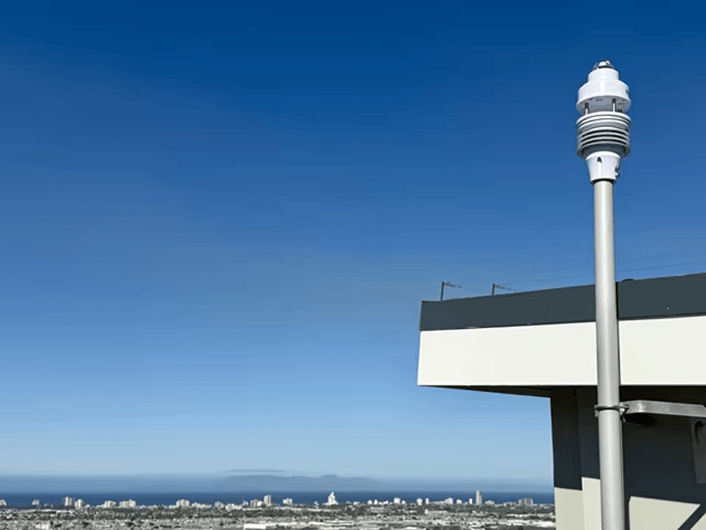
Explanation of Wind Speed and Wind Direction
The speed of the wind is the distance covered by the wind in a given amount of time. The speed of the wind is usually measured in kilometers per hour (kph) or in meters per minute (m/min). These units can measure the strength of the wind and its velocity.
Wind Direction is the direction that the wind is moving. For instance, when the wind is coming from the north, the direction of the wind is north. Usually, wind direction is indicated in one of the eight cardinal directions or in degrees (360°), which gives more exact information about the wind direction.
The Importance of Measuring Wind Speed and Direction
Wind direction and speed are critical factors in navigation and aviation, where they can be used to optimize ship or aircraft routes in order to save fuel and time. In agriculture, wind is used to help spread pollen and can promote plant growth,th but strong winds can also damage or destroy crops. Wind direction and speed are important indicators in understanding the changes in the weather and potential risks in a weather forecasting and disaster management scenario.
Methods for Measuring Wind Speed and Wind Direction
With advances in technology, there are now many methods for measuring wind speed and wind direction. On the basis of its measurement principles, we will introduce the following types: traditional methods, mechanical methods, ultrasonic methods, and calorimetry methods.
1. Traditional methods
Historically, wind direction and wind velocity have been determined by using wind vanes and anemometers.
The wind is indicated by the wind direction on the wind vane; this is the direction of the wind at the time. The wind vane has a fixed angle with the flow of air,r and at that angle, the air pushes against the wind vane’s tail. The force of this pressure depends on how much of the vane’s geometric profile is projected onto a plane perpendicular to the direction of the airflow. The tail end of the wind vane has a large face area as compared with the head, and a difference in pressure forces the vane to rotate about a vertical axis until it is parallel to the airflow. Examine the relative position of the wind direction indicator (vane) with respect to a fixed cardinal direction indicator to determine wind direction.
The Anemometer has a rectangular wind vane with a curved frame and a set of varying-length teeth at each corner. The more the wind vane hits the teeth as it spins around, the stronger the wind speed is in that category.
2. Mechanical methods
Simple mechanical measuring instruments,s such as wind speed and wind direction sensors, rs can accurately measure wind speed and wind direction. They are usually comprised of a wind direction sensor, a wind speed sensor, and a recording system.
The common sensors are cup or vane anemometers. The wind turns the cups or vanes of wind power devices. This means that the wind speed is directly proportional to the rotational speed–the higher the speed, the faster the rotation–therefore,e the speed of the wind can be calculated when the speed of rotation is measured. A wind direction measurement uses a wind vane as the sensing element that always shows the wind’s direction. Angle sensors, i.e., precision potentiometers or Gray code disks, transmit an electrical signal to the processor depending on the mechanical angle of the wind vane, which indicates the wind direction.
3. Ultrasonic method
The wind speed and direction measured by the ultrasonic anemometry are obtained through measurement of the oximeter wind speed direction via the ultrasonic (time of flight) method. This is because the speed of sound in the air is added to the speed of the air flow in the wind direction. Whenever the direction of propagation of the ultrasonic wave is the same as the direction of the wind, the speed of the wave increases, whereas when the direction of propagation of the ultrasonic wave is opposite to the wind direction, the speed of the wave decreases. Thus, if temperature, humidity, and pressure are fixed, the velocity of the ultrasonic wave passing through air is proportional to the wind velocity. Accurate measurement of wind speed and direction can be obtained through calculations. Existing ultrasonic anemometers are mostly two-dimensional (2D) and three-dimensional (3D). For instance, the 2D and 3D ultrasonic anemometers are typical examples of the Renkeer series RS-CFSFX-*-2H-EX and series RS-CFSFX-*-3D-EX.
4. Hot-Wire method
An anemometer is a typical device that uses the calorimetric principle to measure the speed of wind. Its principle is simply to introduce a thin metal wire into a fluid and send an electric current through the wire to cause it to warm up above the fluid’s temperature: this type of anemometer is known as a “hot-wire” anemometer.
When the fluid moves cross-sectionally to the wire, a portion of the wire’s heat is removed,d resulting in temperature reduction of the wire. A relationship between the heat Q lost by the hot wire and the velocity v of the fluid can be derived based on the theory of forced convection transfer of heat. According to the forced convective heat transfer theory, a relationship between the heat lost by the hot wire and the velocity of the fluid can be obtained.
Any instrument that can measure low wind speeds is a hot-wire anemometer. It comprises two parts – a Hot-ball probe and an instrument to measure. The probe has two thermocouples and a glass bulb with a nickel-chromium wire coil. The cold junctions of the thermocouples are fitted to phosphor bronze supports and exposed to the flow of air. A sufficient amount of current flowing through the heating coil causes the glass bulb to heat up. This temperature increase is proportional to the wind speed – the stronger the wind, the higher the temperature increase, a nd the lower the wind speed, the lower the temperature increase. The magnitude of the temperature rise is indicated on a meter via the thermocouples. The wind speed can be calculated using a calibration curve, which is plotted with the reading from the meter.
Popular on OTW Right Now!




About The Author

Gagan Bhangu
Founder of otechworld.com and managing editor. He is a tech geek, web-developer, and blogger. He holds a master's degree in computer applications and making money online since 2015.