
How to Clean Entry Floors After Repeated Mud and Water Tracking
Entry floors can develop a stubborn dirty appearance after several days of wet shoes, muddy paws, and repeated foot traffic. Even after the obvious footprints disappear, the surface may still feel gritty, look cloudy, or show darker lines around edges and floor transitions.
The problem is rarely one isolated spill.
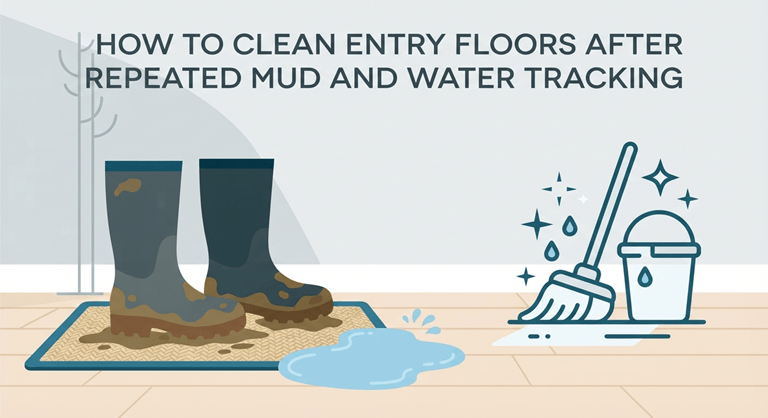
Mud and water create layers. Fine soil dries onto the floor, new moisture loosens it, and footsteps spread the mixture across a larger area. Grit can also collect beneath mats, inside grout lines, beside baseboards, and along the route people take after entering the home.
Running a wet mop over the area repeatedly may make that buildup harder to understand because loose dirt, dried residue, and cleaning-product film can all produce slightly different problems.
A better approach is to remove dry grit first, determine what remains, and then clean according to the flooring material.
Remove Standing Water Before Working on the Mud
Fresh mud spreads easily.
If water is pooled near the entrance, absorb or blot it before trying to clean the surrounding soil.
Large clumps of wet dirt can often be lifted carefully rather than pushed across the flooring.
Once the excess moisture is gone, look at what remains.
A thin muddy film may eventually need damp cleaning, but loose grit should be removed separately whenever possible.
The purpose is not to leave the entry dirty while mud dries completely. It is to avoid turning one concentrated patch into a much wider area of dirty water.
That distinction matters most near doorways, where every extra step can carry the mixture farther into the house.
Remove Grit Before Bringing Out the Mop
Dry soil should usually be removed before more water is introduced.
Fine grit can act abrasively when shoes, mop pads, or cloths drag it across a surface.
Vacuum or sweep carefully according to the flooring and equipment guidance.
Pay close attention to:
- The doorway threshold
- The area beneath entry mats
- Floor corners
- Baseboard edges
- Grout lines
- Floor transitions
- The first section of the main walking route
A fast pass through the middle of the entry may leave much of the actual debris untouched.
Use an appropriate crevice attachment around narrow edges where practical.
Once the loose particles are gone, the remaining condition of the floor becomes much easier to judge.
Let the Floor Dry Before Deciding It Is Still Dirty
A wet floor can hide several clues.
While moisture remains on the surface, cloudy residue may temporarily disappear. Dark areas may look uniform. Streaks may not become visible until several minutes later.
Allow a small cleaned section to dry completely before deciding what to do next.
If it dries clear, the cleaning method is probably removing the tracked residue.
If a haze returns, something may still be left on the surface.
If the area feels clean but remains dull, the difference may be wear or finish condition rather than removable soil.
Evaluating the dry result can prevent unnecessary rounds of scrubbing.
Use a Test Patch to Learn What the Floor Actually Needs
Before treating the entire entry again, choose a small representative section.
Remove the dry debris thoroughly.
Then clean that area using the method and amount of product recommended for the flooring.
Allow it to dry.
Compare it with the surrounding floor.
If the test section becomes noticeably clearer, the larger problem is likely a removable film that has spread through the traffic area. If the appearance barely changes even though the surface feels clean, additional cleaner may not solve the problem.
This small comparison is more useful than repeatedly adding products to the entire floor.
For someone considering professional cleaning services grand rapids after repeated mud tracking, that test also gives the cleaning problem a clearer starting point: the issue is no longer simply “the entry looks dirty.” There may be widespread residue across the walking path, grit lodged around edges, or flooring that has already been cleaned but still shows wear.
Knowing which condition remains keeps the next cleaning step focused on what can actually be removed.
Match the Method to the Flooring Material
Entryways can contain very different surfaces, and mud should not be treated identically on all of them.
Tile
Tile may tolerate more moisture than some other flooring, but grout can hold dirty water below the tile surface.
Remove dry soil first and avoid allowing muddy cleaning solutions to sit in the joints.
Vinyl
Vinyl is often straightforward to maintain, but too much cleaning product can leave a dull or sticky film.
Follow the flooring manufacturer’s care guidance and avoid unnecessary saturation around seams.
Laminate
Laminate generally requires more restraint with moisture.
Water can reach joints and edges, so a lightly damp method is usually more appropriate than flooding the floor.
Hardwood
Wood flooring should be cleaned according to its finish and manufacturer recommendations.
Tracked mud should not be allowed to remain indefinitely, but excessive water can create a different problem.
Natural stone
Stone requires particular care because products suitable for one flooring material may damage another.
Identify the surface before treating stubborn residue, and follow the applicable care guidance.
Change Dirty Water Before It Starts Reapplying Soil
Mop water has a limit.
Once it becomes dark with mud and suspended dirt, repeatedly dipping the mop back into it can return some of that material to the floor.
Replace visibly dirty water.
Change reusable pads or cloths once they stop lifting residue cleanly.
For a heavily tracked entry, several smaller passes with clean materials can be more useful than one long session with increasingly dirty water.
Work in sections.
Clean one manageable area and allow it to dry enough to evaluate.
Then continue.
This makes it easier to tell whether the floor is improving instead of spreading a thin layer of dirty solution over the entire entry.
Check Whether Too Much Cleaner Is Creating the Haze
A dull entry does not always need stronger cleaning.
Sometimes the problem is cleaning-product residue.
Using more solution than directed can leave material behind after the water evaporates. That film may create streaks, feel slightly tacky, or attract fresh soil more quickly.
If the floor repeatedly looks cloudy after mopping, review the product instructions.
Do not automatically increase concentration.
Use clean equipment and the recommended amount.
A floor that becomes dirtier-looking after every cleaning may be receiving too much product rather than too little effort.
Pay Special Attention to Grout Lines
Tile faces may look clean while the grout remains noticeably darker.
Mud settles into the lower, textured lines and can remain there after a broad mop passes across the surface.
Vacuum loose grit first.
Then use a cleaning method suitable for the grout and surrounding tile.
Avoid beginning with extreme scrubbing pressure.
Old, damaged, or deteriorating grout can be harmed by aggressive treatment.
If grout is cracked, missing, loose, or crumbling, cleaning is no longer the only issue.
That condition may require repair.
The aim should be to remove normal tracked buildup without damaging the material in an attempt to make worn grout look new.
Lift Entry Mats Instead of Cleaning Around Them
Mats reduce the amount of debris carried farther into a home, but the area beneath them still needs attention.
Lift the mat completely.
Check its underside.
Then inspect the flooring below.
Mud may have worked beneath the edge, and repeated moisture can leave a visible outline where the mat sat.
Clean the mat according to its care instructions.
Remove grit from the floor before using any suitable damp method.
Allow both surfaces to dry before putting the mat back.
Returning a damp mat to a damp-sensitive floor can trap moisture exactly where the household is trying to protect the surface.
Follow the Walking Route Beyond the Entry
Mud rarely stops at an invisible line several feet inside the door.
Look beyond the entrance.
A faint trail may continue into a hallway, kitchen, or living space.
Do not automatically clean the entire adjoining room.
Follow the actual evidence.
Look for fine grit, small dried droplets, cloudy footprints, or a narrow dirty path.
Remove loose soil first and treat only the affected sections unless the rest of the floor genuinely needs attention.
This makes the cleanup more manageable and prevents tracked residue from being carried back into the entry after it has already been cleaned.
Inspect Floor Transitions Carefully
The point where one flooring material meets another often collects debris.
Carpet-to-hard-floor transitions, doorway strips, and thresholds contain narrow edges that standard cleaning tools may pass over.
Vacuum these seams carefully.
Remove pet hair, grit, and dried soil sitting against the edge.
If damp cleaning is appropriate, use controlled moisture.
Avoid flooding transitions because water may move into flooring edges or beneath materials more easily there than across an open surface.
A loose or damaged transition strip is a repair concern, not something cleaning should try to correct.
Look at the Mop Pattern After the Floor Dries
Streaks can reveal problems with the cleaning process itself.
If the floor shows repeated arcs, lines, or dull patches corresponding to mop movement, consider whether the pad became overloaded.
Dirty water, excess cleaning product, or a saturated mop head can all leave marks behind.
Use fresh equipment for the next pass.
Follow the product amount recommended for the surface rather than adding more solution because streaks are visible.
More products can make residue problems worse.
A cleaned entry should not feel sticky once it has dried.
Do Not Ignore Mud Splashed Onto Lower Trim
Wet shoes and paws can throw dirty water beyond the floor itself.
Inspect the lower section of baseboards near the entrance.
Look at corners beside the door and the first few feet of wall trim along the traffic route.
If loose dried soil is present, remove it gently before wiping.
Use a method appropriate for the paint or finish.
Avoid soaking trim or scrubbing aggressively enough to change the paint sheen.
These lower edges can make the whole entrance look unfinished even after the flooring has been restored.
Clean the Mat Zone and Walking Zone as Separate Areas
The section directly beneath an entry mat experiences a different kind of buildup from the floor farther inside.
The mat zone tends to collect trapped grit and moisture.
The walking zone receives repeated spreading and abrasion from shoes and paws.
Treating them separately can make the cleaning more precise.
Lift and clean beneath the mat first.
Then work along the actual walking path.
If Rapids Cleaning Services is involved in recurring house cleaning, these two zones can also be watched separately over time. One may need frequent dry grit removal while the other mainly develops a slower film from repeated traffic.
The whole entry does not necessarily become dirty at the same rate.
Know When a Dull Area Is Probably Wear
Not every remaining difference can be cleaned away.
Repeated grit under footwear can contribute to scratching or surface wear. Older finish may also appear different along the main traffic path than it does near the walls.
Once the floor is clean and completely dry, inspect any remaining dull areas.
Run a clean cloth over them.
If the cloth stays clean and the appearance does not change after an appropriate test cleaning, stop escalating the scrubbing.
The problem may be wear rather than residue.
Continuing with stronger products or harsher tools can damage the surface without improving how it looks.
Floor repair, refinishing, or other maintenance may be more appropriate at that point.
Reduce the Amount of Mud That Reaches the Floor
Once the entry has been restored, look at how the mud is arriving.
A mat that is overloaded with dried dirt cannot trap much more.
Wet footwear left directly on the floor may continue releasing muddy water.
Pet paws can transfer soil several feet before the animal reaches another room.
Simple containment habits can reduce the next cleanup.
Keep mats clean enough to function.
Remove obvious loose grit before it gets walked across repeatedly.
Deal with standing water promptly.
Give wet footwear a suitable place to drain or dry without damaging the flooring.
These steps will not keep an entrance spotless during wet conditions, but they can reduce how quickly layers form.
Avoid Turning Every Muddy Day Into a Full Floor Cleaning
Heavy weather does not necessarily mean the entire floor needs washing every day.
Fresh loose dirt may only require targeted vacuuming or sweeping.
A small wet patch may need spot cleaning.
The full entry needs more attention when grit, film, and tracked residue have spread across a larger area.
Matching the cleaning effort to the condition of the floor prevents unnecessary product use and repeated damp cleaning.
It also makes the larger cleanup easier to recognize when it really is needed.
Recheck the Floor Under Good Lighting
Entry floors can look different depending on the direction of the light.
Once the surface is dry, look across it from more than one angle.
Side lighting can reveal streaks and haze that are difficult to see from directly above.
It may also reveal whether the main traffic lane looks different from the floor near the walls.
Use that information carefully.
A visible difference does not automatically mean the floor remains dirty.
Combine appearance with touch and the clean-cloth test before deciding whether another pass is justified.
Restore the Floor in Layers
Repeated mud and water tracking leaves more than obvious footprints.
Loose grit settles along edges. Dirty moisture dries into film. Grout and transitions trap residue. Foot traffic moves the problem farther into the house, and repeated mopping can add another layer if dirty water or excess product remains on the surface.
Reverse that process methodically.
Remove grit first.
Let the floor reveal its condition when dry.
Test a small section before cleaning the entire area again.
Use a method appropriate for the flooring material, then address mats, edges, grout, transitions, and the walking route separately.
Once the surface is genuinely clean, stop cleaning.
A dull patch caused by wear will not improve simply because another mop pass is added.
Popular on OTW Right Now!




About The Author

Gagan Bhangu
Founder of otechworld.com and managing editor. He is a tech geek, web-developer, and blogger. He holds a master's degree in computer applications and making money online since 2015.