
Stop Losing Sales: How PIM Transforms Omnichannel Marketing
In 2026, the typical customer connects with a brand through six separate touchpoints prior to making a purchase (source: UniformMarket). Approximately 73% of retail shoppers are omnichannel shoppers, and they utilize more than one channel throughout the process (source: UniformMarket). They can look at the product in the mobile applications on their way to work, they check prices using the computers at work, they read reviews on social media at lunch, and they frequently buy items at the physical store. This is an integrated shopping experience that is referred to as omnichannel marketing, and poses a big question: in what way can companies maintain the same product information to be precise and consistent in all the channels?
The solution is a Product Information Management (PIM) system. PIM system is the heart of the present-day business; it organizes, enriches, and disseminates product data through all types of contacts with customers. In its absence, companies will experience inconsistent data, slow product releases, negative customer experience, and ultimately lost sales. It has been found that 87 percent of retailers feel that an omnichannel marketing strategy is the key to their success (source: SaveMyCent). PIM is not only handy but also mandatory for any organization that wants to become successful in the omnichannel.
The Omnichannel Challenge
Be it flicking through Instagram, browsing your site, speaking to Alexa, or going to a shop, modern consumers are looking to have a smooth experience with the same precise information, price, and availability. The truth is that 62 percent of consumers rely on a consistent brand experience regardless of the purchase channel and the device (source: Capital One Shopping).
It is very complex in the delivery of this consistency when the business is dealing with multiple channels. The requirements of each channel are different. Amazon requires particular attributes and image formats, Google Shopping requires structured data markup, your website should have descriptions that are easily searchable in search engines, print catalogs need high-quality images, and its retail partners need EDI-compatible data streams. In the meantime, you are handling thousands or even millions of product SKUs, each having hundreds of attributes, multiple images, technical specifications, marketing copy, and localized content in the various markets.
Without a centralized system, businesses usually depend on spreadsheets, shared drives, email chains, and manual data entry across various platforms. This method is not only time-consuming and error-prone but also unscalable. One update of the product may result in alterations in more than one system, resulting in inconsistencies and delays. Trust is easily lost when a customer perceives a price displayed on your mobile application and another one on the store.
The stakes are high. It has been found out that 87 percent of shoppers initiate product searches online, despite intending to shop in-store (source: WiserReview), and that at least 30 percent of all ordered products are returned, as opposed to only 8.89 percent of those ordered at physical stores (source: Invesp). More to the point, 23 percent of all returns on products happen because of bad product information (source: Icecat), and 67 percent of consumers give up on the shopping cart because of bad product information (source: InRiver). In an omnichannel space, data quality is not only an operational problem, but it is also a competitive advantage.
What PIM Software Does
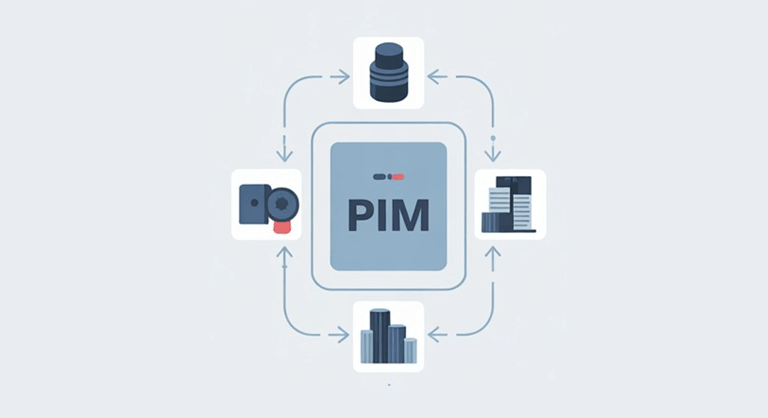
At its core, PIM software provides a single source of truth for all product information. It serves as a centralized repository where businesses can collect, manage, enrich, and distribute product data to any channel or touchpoint.
PIM systems are systems that consolidate product information, collected by different sources such as ERP systems, suppliers, manufacturers, and internal teams, into a single system. They provide systematic structures to store this data and provide completeness and accuracy of such data through validation rules and processes. Using the same system, marketing teams can improve the simple product specifications with captivating descriptions, images, and videos of lifestyle, as well as channel-specific content.
Above all, the product information is distributed through automation by PIM software. After enriching and approving data, it can be sent automatically to e-commerce, marketplaces, mobile applications, printed catalogs, retail partners, and any other channel, with data being sent in the format that each channel requires. This eliminates manual entries, minimizes mistakes, and decreases the time-to-market of new products and modifications.
Key Benefits for Omnichannel Marketing
Consistency Across All Channels
PIM has the short-term advantage of consistency. With product information stored in the central system, all channels draw from the same source of truth. Other than that, when you change the product description by updating a single product description, it changes everywhere immediately. This overcomes confusion and frustrations that come as a result of contradicting information. This means that customers get the same correct experience regardless of their touch point with your brand. Those companies that have a robust omnichannel customer engagement strategy retain customers 89 percent as opposed to 33 percent of companies with weak strategies (source: Martal).
Faster Time-to-Market
In the contemporary business, speed is all. PIM is very fast in product launches and product updates. Marketers no longer need to update all their systems manually to make changes, but can make changes in a single location and auto-propagate changes across all channels. Jobs that took weeks to complete can be done in hours. This will enable businesses to react fast to the market changes, seasonal changes, and competition. It has been discovered that 25 percent of all revenue relies on product launches, but 79 percent of new products cannot make it to the market on time (source: DCKAP).
Improved Customer Experience
Correct and full information about the products has a direct influence on customer satisfaction and conversion rates. Studies have shown that 87 percent of buyers consider detailed product content as the major influencer in their buying (source: Icecat). PIM assists businesses in giving detailed specifications, quality images, customer feedback, size charts, and localized content to each market. With the information required to make sure purchase decisions, the customers will tend to buy and are less likely to go back to products. Research indicates that conversion rates can be improved by providing more appropriate, fuller, and uniform product information by a 17% to 56% (source: Bluestone PIM).
Better Data Quality and Accuracy
The PIM systems provide data quality control by rules of validation, compulsory fields, and an approval process. They detect the incomplete or wrong information before it is delivered to the customers. This is a systematic method of minimizing the expensive mistakes, refunds, and customer service questions and enhancing the search engine performance and presence in markets. Companies using PIM state an increase in conversion ratings by 23 percent and a reduction of product returns by 17 percent within the first year (source: Stedger). With properly designed and precise product data, businesses can reduce the rates of returns (up to 20 percent) (source: Icecat).
Scalability for Growth
PIM is easily scaled as businesses expand into new channels, markets, and types of products. There is no need to re-establish the whole data management infrastructure in order to add a new marketplace or a new country. The PIM system just exports data in the new format required, and it is easy to support expansion without creating more complexity or a higher employee count. The annual revenue of companies with an omnichannel strategy of engaging customers increases by an average of 9.5 percent per year, as opposed to 3.4 percent with companies that have no omnichannel strategy (source: WiserReview). The lifetime value of consumers purchasing through omnichannel is 30 percent higher compared to when an individual uses a single channel (source: KeyShot).
Real-World Impact
An intermediate-sized outdoor equipment retailer with a presence on various channels was able to cut down product launch time from 2-3 weeks to two days only with the help of PIM, and the price and description of the products were the same in all stores.
Such examples are supported by real-world evidence. Target, an American retailer, has experienced excellent quarterly performance through a seamless working relationship between the physical and online channels. They have analysed that the multichannel customers spend four times more than in-store customers and 10 times more than digital-only customers (source: BetterCommerce). Their stores made more than three-quarters of their online sales during a peak quarter with the integration of the omnichannel (source: KeyShot).
A furniture company with both B2C and wholesale clients realized that various channels needed various product information. Lifestyle pictures and catchy copy were required by consumers, whereas the technical specifications were required by business partners. Their PIM system handled data sets as well as provided the appropriate content to every audience. Orders increased by 494 percent and purchase rates by 287 percent with expansion to multiple channels (source: KeyShot) and 287 percent more in campaigns (source: BetterCommerce).
Top 5 PIM Software Solutions for Omnichannel Support
1. AtroPIM
AtroPIM is a PIM open source solution that is flexible and scalable. It provides information management of the products and has a high level of omnichannel distribution support.
Key features:
- Manages multifaceted product catalogs with numerous attributes, variants, and associations.
- Open-source architecture enables extreme customization to suit a particular business requirement.
- Easy-to-use interface that can fit any team of any size.
- Worldwide multi-language platform.
- Combined digital image, video, and document management.
- Smooth connections with major online shopping websites and marketplaces.
- Affordable solution and still functional.
AtroPIM is particularly attractive to companies that desire the capability of PIM but do not have the financial means to afford the expensive proprietary software.
2. Akeneo
Akeneo is an open-source PIM system, and it is distinguished by ease of use and powerful functionalities.
Key features:
- Provides community and enterprise editions to businesses of various sizes.
- A wide network of connectors and extensions to integrate with.
- Interoperating with almost all e-commerce platforms, marketplaces, or business systems.
- Good workflow features to enable collaboration within teams.
- Road maps of asset management.
- Modern product enrichment applications.
- Community support and frequent updates.
The ability of Akeneo to be flexible and large ecosystem also makes it fit complicated omnichannel strategies.
3. Salsify
Salsify provides both PIM and potent syndication features, and it is suitable for brands that sell products in various retailers and marketplaces.
Key features:
- Management of retailer-specifics.
- Intelligent content delivery to thousands of destinations.
- Inbuilt analytics to monitor channel content performance.
- Live teamwork solutions for both internal and external customers.
- Competitive insights analytics (digital shelves).
- Improved content advantages to handle the rich media.
- Good compliance and control of governance.
Consumer goods manufacturers managing intricate retail relationships and needs in the market are especially fond of Salsify.
4. inRiver
InRiver is referred to as an information excellence platform, which is more than traditional PIM. It provides superior workflow and marketing resources.
Key features:
- Manages large product inventories on an organizational scale.
- Workflow management: Advanced, complex approval processes.
- Planning and management of marketing resources of the campaign.
- Advanced management of product dependencies.
- Competent omnichannel distribution platform and various output formats.
- Built-in global content translation management.
- Powerful API to make your own integrations.
InRiver satisfies the requirements of enterprise-level and is fit in businesses whose channel requirements are very complex and whose product relationships are complicated.
5. Pimcore
Pimcore is a digital experience platform with an open-source platform that unites PIM, digital asset management (DAM), content management (CMS), and customer data management (CDP) into one system.
Key features:
- PIM, DAM, CMS, and CDP all in one.
- Skyline: This type of database system supports complex product constructs and is able to be flexibly modeled.
- Localisation multi-market content management.
- Large-scale data modeling according to special business requirements.
- Single vendor approach that eases technology stacks.
- Good support of B2B and B2C.
- Scalability and performance at the enterprise level.
Pimcore is integrated, which is strong when a company wants to operate not only product information but the whole digital experience using the same platform.
Conclusion
The PIM software is used to store information about products in a centralized location where businesses can update the information in a central location and then distribute the information to all the sales channels. This minimizes mistakes, decreases the time of product launches, enhances consistency of prices and description and reduces returns. Companies that employ PIM claim higher conversion rates, reduced returns of products, and brief time-to-market.
Popular on OTW Right Now!




About The Author

Gagan Bhangu
Founder of otechworld.com and managing editor. He is a tech geek, web-developer, and blogger. He holds a master's degree in computer applications and making money online since 2015.