
How Online Stores Can Cut Refunds and Disputes With Better Delivery Updates
Running an online store can make it feel like the hard part ends the moment an order is placed. A customer checks out, the confirmation email goes out, and the sale looks complete on your dashboard. In reality, the riskiest stretch is only beginning, in the quiet days between “order confirmed” and “delivered.”
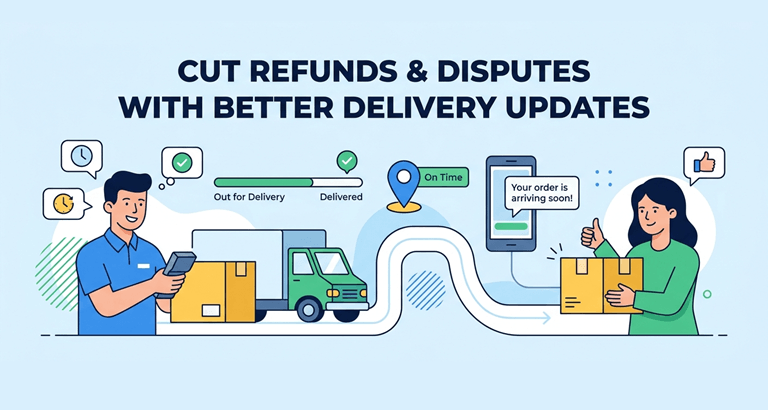
That gap is where a surprising number of refunds and payment disputes are born. A shopper who hears nothing for days starts to wonder whether the order is coming at all. A worried customer is far more likely to demand their money back, or to call their bank instead of you.
This article looks at why poor delivery communication fuels refunds and disputes. It then shows how clearer, better-timed delivery updates ease that pressure, often without adding cost or hiring extra staff.
Why Silence After Checkout Drives Refunds
Most disputes do not begin with fraud or bad intent. They begin with uncertainty, and uncertainty grows fastest when a paying customer is left guessing. Filling that silence is the single biggest lever most stores overlook.
The anxious wait after “order confirmed”
It is not until the order ships that the typical buyer has any idea about where it is or when it will be there. Every time they have a silent day, they lose some of their trust at the till. Gradually, there are some small doubts that get added to the assumption that something is wrong.
But by day the 4th or 5th, it becomes action. The customer thinks the order is probably lost and begins to search for a means to get his or her cash back. After that, it’s too late to try to win back their patience.
When a missing update becomes a formal dispute
This shopper won’t be able to reach the store, or won’t receive a clear response, and often abandons the store. They don’t hang on the line or send another e-mail; they go directly to their card issuer. They are more likely to trust a person who is verbally communicating with them when it comes to a chargeback than a silent seller.
Chargeback costs are high,h and chargebacks are hard to recover. The store forfeits the sale, has to cover a dispute fee, ee and suffers the negative consequences of losing goodwill from the payment processors. Even a merchant account can be at risk, wise enough of them.
How Proactive Delivery Updates Stop the Spiral
Most of these conflicts do not have to do with more stringent fraud laws or extended refund periods. It is conveying information to the customer before he or she needs to be concerned. Here, restriction is not the answer; it’s communication.
Proactive beats reactive every time
A store that notifies users at the right times gently takes away the need to worry. The customer observes the progress of the order and waits peacefully without fighting. Prevention is better than being sorry.
This is where delivery notification software earns its place in an online store’s toolkit. It sends automatic messages at each key stage, from dispatch to “out for delivery” to a confirmed drop-off. It’s a one-time installation at the store, and updates will happen automatically afterwards.
The end result is that the customer feels taken care of, not forgotten! Many people avoid getting a bank dispute,e or many refund requests get denied before they begin, because of that feeling.
One tracking link that answers every question
The live tracking link gives the customer the ability to see the status anytime they want to, in addition to alerts. They will not have to contact customer support or inquire about the location of the package. The answer is ever at your fingertips, day and night.
There are also a lot of messages that ask, Where is my order? And self-service tracking reduces that constant flow of those messages. Support staff have more time to dedicate to topics that require a human touch, instead of spending time answering status queries.
What Good Delivery Communication Looks Like
Updating isn’t the only piece of the puzzle that will make a difference. Whether they are trustworthy or merely annoying depends on how good, timely, and accurate the update is. If notifications are not used properly, they can be as much of an issue as they are a solution.
Updates at the moments that matter
The best notifications are ones that are delivered at natural stopping points – order shipped, soon, and delivered. Every one of them provides an answer in advance to a question that the customer might ask. The rhythm doesn’t intrude on me, it helps me.
It can be more of a problem to do too much, so it is important to be restrained as well as the message. Repeatedly sending text messages or receiving alerts at night may be irritating to the person you are trying to comfort. Less and more timely messages, more often than not,t are better than constant messages.
Accuracy and branding that build confidence
It will only be beneficial to update if the information provided in the update is accurate. Silence is preferable to a “delivered” message received for a package that just never arrived. A single negative review can ruin months of positive reviews.
Branded, accurate messages also reassure shoppers that an update is genuine and not a scam. This matters because returns are already a normal part of online retail. Around one in five online orders is returned in the US, according to data compiled by Statista. Clear delivery communication keeps avoidable “I never got it” refunds from piling on top of that baseline.
Making It Work for a Small Store
There is no need to have an enterprise budget to communicate as a well-dressed brand. Many of these benefits are due to careful planning and maintenance, rather than spending a lot of money. This is something that a small store can be competitive with a big store.
Start with the channels customers prefer
Email and SMS are distributed to most shoppers, and both are easy and inexpensive to automate. Focus on the channels your customers will be looking for on a daily basis—not every channel. Trying to shove people into a new app is the wrong approach, meeting people where they are is the right approach.
Be congruent with your tone of voice for each message, and be brief. One simple statement as to the location of the order is worth more than a long formal order every time. Simple words have a more immediate impact on reassuring people than words concocted by corporations.
Automate first, then refine with data.
Place automatic triggers to ensure updates go out at each step of the process. This eliminates the manual process and ensures that no customers fall through the cracks. Consistency is the key to reducing conflicts from good intentions.
Then see what is going to happen to your numbers. Observe changes in the number of refund requests and support tickets,s and tweak if necessary. Little changes add up over time, which can make a big savings.
Final Thoughts
Getting refunds and disputes seems to be a price you have to pay for e-commerce. However, most of the time they go back to one thing – the customer never found out about their order. Shrink that problem by closing that gap.
One of the most cost-effective victories that an online store can win is when it can better communicate. Delivering updates to the timeline in a timely and accurate manner can calm down anxious buyers and make them patient buyers, and patient buyers don’t click on a refund or dispute form.
Clearly communicating will keep the stores from losing out on revenue and reputation as online shopping continues to be a vital aspect of their business. But sales do not truly end once a customer clicks through to purchase – the sale continues to the point of delivery, and that is where the magic happens so that the sale doesn’t fall apart.
Popular on OTW Right Now!
-
 Aspen Without a Rental Car: A Practical Guide to Getting Around the Roaring Fork Valley
-
 Cosmetic Packaging That Makes Beauty Products Look More Premium
-
Bathroom Remodeling Budget Planning: Where to Invest, Where to Save, and What to Expect
-
 The Most Common Driver Mistakes That Cause Car Accidents in Raleigh, NC




About The Author

Gagan Bhangu
Founder of otechworld.com and managing editor. He is a tech geek, web-developer, and blogger. He holds a master's degree in computer applications and making money online since 2015.