
5 Impacts of Virtual Try-Ons on Business Efficiency
AI virtual try-on tools are becoming essential for apparel brands and retailers. According to Pic Copilot, stores that already use this technology have seen 79% savings in marketing design costs, a 7.69% increase in product click-through rates, and a 57% increase in purchase conversions.
In 2026, we will see more fashion and apparel brands implement AI virtual try-on solutions to aid in streamlining, cost reduction, and product visualization. In this article, we will explore five ways AI virtual try-on is already improving business efficiency today.

1. Reduce Marketing and Photography Costs
It can be costly and time-consuming to produce high-quality product images and marketing visuals through traditional methods. AI virtual try-on can create a realistic image of a garment on a digital model without the need for extensive photoshoots.
It’s easy to see that as you use it, your visual content production will be quicker, reducing the need for models and studio setup. This tool is perfect for you if you want to save time and money while maintaining the same visual quality.
2. Enhance Social Media and Digital Campaigns
As a marketing staff, have to say that more brands increasingly rely on social media to promote products and improve sales. AI virtual try-on is a great tool enabling retailers to create fast, scalable, photorealistic visuals for Instagram, TikTok, and other platforms.
Its ability to create stable images across variations allows brands to experiment with the visual aspects of their products, fine-tune their campaigns, and speed up the approval process of their content. So, other members of your team can take on other work and boost sales across all areas.
3. Streamline Product Pages and E-Commerce Presentations
Virtual try-ons help online retailers display a selection of clothing in different styles, colors, and scenarios. Clothing images can be uploaded, and then visuals can be produced using model and/or style presets that are true to the look of the garment, in various combinations.
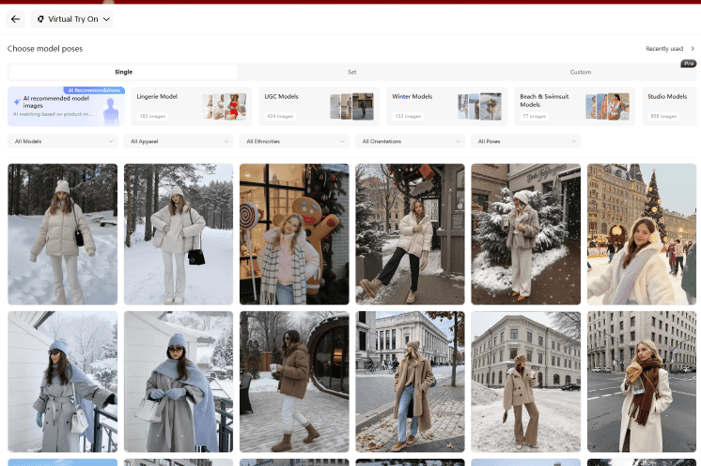
This enhances the merchandising team’s decision-making process and product presentation, and decreases the time from design to sales. All good news; we don’t need to repeat the physical photoshoot.
4. Improve Rental and Secondhand Visuals
Buyer confidence in a product presentation is crucial on rental and resale platforms. The AI virtual try-on feature helps teams create stylized, realistic images of clothing, enabling them to present items professionally.
It’s a great advantage for them in the rental and secondhand markets, as it can provide a sense of value to the product, speed up transaction times, and facilitate a uniform visual look across platforms. Additionally, online apparel try-on aids marketplaces in their expansion without increasing operational complexity.
5. Accelerate Custom Apparel Design Workflows
The design approval process for custom clothing may involve repeated iterations and be time-consuming and resource-intensive. With AI virtual try-on tools, brands can instantly create visual previews of custom designs.
Teams can compare fabric, color, and style digitally without taking physical samples and get approvals faster. The visual-first approach is anticipated to expand into other categories beyond shirts and suits, such as dresses, outerwear, and more, by 2026, and will enable more efficient design workflows and faster design time.
Final Thoughts
This article will help you make better decisions for your future business. By 2026, the number of brands using AI virtual try-on tools in their apparel or garment operations will increase. They can streamline content creation, improve operational efficiency, and achieve faster design-to-market times.
Whether you are looking to maximize marketing visuals or clothing presentation, or to develop custom design workflows, AI virtual try-on tools such as Pic Copilot have measurable business impact. Once you use this method, you no longer have to do lengthy photoshoots or manual image production.
Popular on OTW Right Now!
-
 How to Use Online Name Generators for Stories and Games
-
 Why Preventative Maintenance Programs Support More Predictable Home Maintenance Costs
-
 Can You Learn Chess on Your Own? Real Limitations Explained
-
 Stop Letting Your Ideas Rot on Your Screen! Turn Your Wildest Imaginations into Tangible Prints with Hi3D

About The Author

Gagan Bhangu
Founder of otechworld.com and managing editor. He is a tech geek, web-developer, and blogger. He holds a master's degree in computer applications and making money online since 2015.