
How Healthcare Organizations Can Integrate EDR and NDR for Unified Threat Visibility
Healthcare organizations are under constant pressure to keep systems running and patient information protected. Hospitals and healthcare providers rely on electronic health records, medical devices, cloud applications, employee endpoints, remote access, and connected systems every day.
All of this technology makes healthcare more efficient. It also gives attackers more places to target.
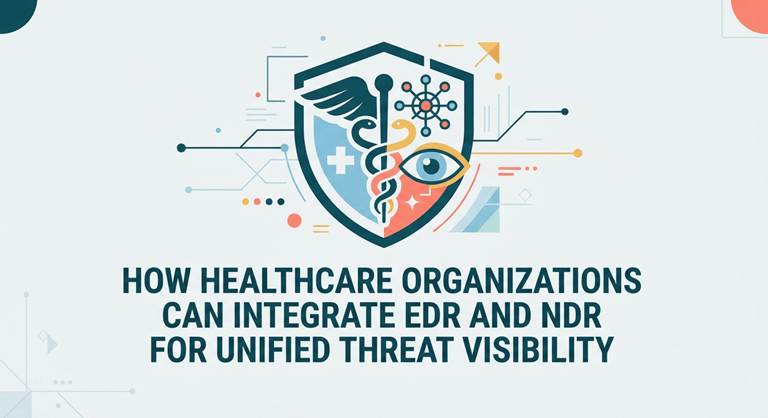
If security teams only monitor the endpoint, they may miss what happens across the network. If they only monitor the network, they may not have enough information about what happened on the compromised device.
This is where Endpoint Detection and Response (EDR) and Network Detection and Response (NDR) work well together.
EDR shows security teams what is happening on individual devices. NDR shows what is happening across the network.
In simple terms:
- EDR tells you what happened on the device.
- NDR tells you where the device is communicating.
- Together, they help explain what the attacker is doing.
What EDR and NDR Each Bring to the Table
| EDR | NDR |
| Watches endpoints and devices | Watches network activity |
| Detects suspicious processes and files | Detects suspicious traffic and connections |
| Shows activity on a compromised device | Shows communication between systems |
| Helps investigate endpoint behavior | Helps identify lateral movement |
| Can support endpoint isolation | Provides broader network investigation context |
There is no rivalry between the two technologies. They address several aspects of the same attack.
How an Integrated Approach Works
A useful way to understand EDR and NDR integration is to follow an attack.
Step 1: An attacker gets in
An attacker sends a phishing email to a healthcare employee.
The employee opens the attachment, and malicious code runs on the computer.
Step 2: EDR detects the endpoint activity
EDR identifies unusual behavior on the computer.
It may show which process ran, which file was involved, and what other activity occurred on the endpoint.
The security staff is now aware that anything unusual occurred on the device.
But one question remains:
Did the attacker do anything beyond that device?
Step 3: NDR provides the network picture
NDR can look at the device’s network activity.
Perhaps the computer suddenly connects to an unfamiliar external server. Maybe it also starts communicating with other internal systems.
That information adds another layer to the investigation.
Step 4: Security teams connect the events
Instead of investigating the endpoint alert and network alert separately, analysts can correlate them.
They can now see that:
A suspicious process ran -> the endpoint made unusual connections -> the device may have attempted to reach other systems.
That is a much clearer picture of the attack.
Step 5: Teams respond
If the investigation confirms that the device is compromised, security teams can take action.
Depending on their security tools and response procedures, they can isolate the endpoint, collect forensic information, block malicious activity, or trigger automated response playbooks.
This can help reduce the time between detecting an attack and containing it.
How Fidelis Endpoint® and Fidelis Network® Work Together
The same principle applies to Fidelis Endpoint® and Fidelis Network®.
Fidelis Endpoint® provides visibility into activity happening on endpoints. This includes real-time and retrospective analysis that can help security teams understand what occurred on a device.
Fidelis Network® provides NDR capabilities and uses Deep Session Inspection® (DSI) to analyze network sessions, files, protocols, and metadata.
When these capabilities work together, security teams can investigate an incident from both the endpoint and network perspectives.
For example, when Fidelis Network® identifies a suspicious file or behavior, related endpoint events can be queried to determine whether the activity reached a device and whether it actually executed.
They can ask:
- Which endpoint was involved?
- What process ran?
- What file was involved?
- Did the suspicious activity execute?
- Where did the endpoint connect?
- Did it communicate with other systems?
- Could the activity indicate lateral movement?
- What response should be taken?
The answers help analysts move from “Something looks suspicious” to “We understand what happened and where it happened.”
Why This Matters in Healthcare
Because healthcare networks comprise a wide variety of systems, they might be especially challenging to monitor.
Employee laptops, clinical workstations, servers, medical equipment, cloud apps, databases, and remote access systems can all be found in a single environment.
Because they provide crucial therapeutic functions, certain systems may also be outdated or challenging to replace.
This creates a major challenge.
Teams need to know if a compromised device is affecting other systems. A suspicious event on one workstation may seem isolated at first.
But what if that workstation is also:
- Connecting to an unusual external server?
- Accessing systems it does not normally use?
- Communicating with several internal devices?
- Sending an unusual amount of data?
What Healthcare Security Teams Gain
1. A clearer view of attacks
EDR and NDR provide different pieces of the same story. Bringing those pieces together can give analysts a better understanding of an incident.
2. Faster investigations
Security teams spend less time switching between isolated alerts and trying to manually connect events.
3. Better visibility into lateral movement
An attacker does not always stop after compromising one device. NDR can help security teams identify unusual communication between systems.
4. More informed response
Once analysts know which device is affected and what it is connecting to, they can contain the threat faster.
5. Less alert fragmentation
Instead of treating every endpoint and network event as a separate problem, teams can look at related activity as part of the same incident.
Building Unified Threat Visibility
With Fidelis Endpoint®, teams can investigate what is happening on endpoints. With Fidelis Network®, they can examine network activity and gain deeper visibility into communications across the environment.
Together, these capabilities can help security teams:
- Detect suspicious activity earlier
- Understand incidents more quickly
- Identify potential lateral movement
- Investigate threats with more context
- Take faster and more targeted response actions
The objective is straightforward for healthcare organizations: detect more of the attack, understand it faster, and take action before it can disrupt vital systems or patient care.
Popular on OTW Right Now!



About The Author

Gagan Bhangu
Founder of otechworld.com and managing editor. He is a tech geek, web-developer, and blogger. He holds a master's degree in computer applications and making money online since 2015.