
How Councils Can Reduce Time Spent on Manual Plate Checks and Ticket Issuance
Parking operations in busy urban areas are becoming harder to manage through manual patrol workflows.
Delivery vehicles, rideshare activity, passenger pickups, and commercial loading operations now compete for limited curb space across transit corridors and commercial districts.
At the same time, parking officers still need to identify violations, check license plates, confirm parking rules, capture evidence, and issue citations while covering multiple zones during a single patrol shift.
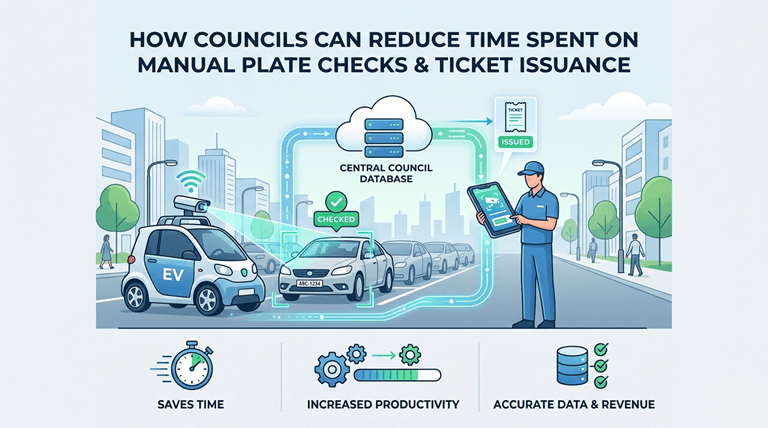
This creates a growing gap between curbside activity and manual response capacity. Many parking violations end before officers can complete the ticketing process. Multiple violations can also happen across nearby streets at the same time without continuous monitoring.
Councils now need better visibility across curb zones instead of relying only on physical roadside patrols.
This is why municipalities are adopting an automated parking enforcement system. Let’s understand how councils can reduce time spent on manual plate checks and ticket issuance while improving curbside monitoring across increasingly complex urban mobility networks.
6 Ways to Reduce Time Spent on Manual Plate Checks and Ticket Issuance
Councils are improving operational efficiency by automating how violations are detected, validated, processed, and reviewed across regulated curb zones. The following strategies are helping municipalities reduce manual workload while improving monitoring continuity across city corridors.
#1 Replace Manual Plate Checks With Continuous LPR Parking Monitoring
Manual plate verification becomes inefficient in high-activity curb environments where violations occur across multiple locations at the same time.
In a typical patrol situation, officers have to stop, check one vehicle at a time, confirm any restrictions, and manually record any evidence before heading to another location. In so doing, other violations are likely to be happening in the immediate vicinity.
This leaves gaps in sight lines along delivery routes, along passenger pick-up points, along transit adjacent streets, and along commercial areas with varying types of activity along the curb.
The advantage of LPR parking systems is that they use an automated plate recognition system to ensure monitoring continuity. These systems monitor regulated areas of the city on an ongoing basis, without the need to have constant physical presence by officers.
Vehicle-mounted and fixed monitoring systems can automatically:
- Scan license plates.
- Associate detections with geofenced curb zones.
- Apply time-based restrictions.
- Identify non-compliant activity in real time.
- Generate timestamped visual evidence.
This enables councils to have an improved awareness of their curbs and eliminates repetitive manual plate checking.
Regular monitoring also helps to ensure predictable compliance. When drivers are intermittently or locationally monitored,d their compliance is more likely to be compromised.
#2 Centralize Rule Interpretation Through Parking Enforcement Software
The city’s parking system is now increasingly dynamic and subject to more flexible regulations on the curb.
One single corridor can be used for commercial loading service in the morning hours, and have different parking conditions during peak hours when there are no passengers on board. Operational complexity is further exacerbated by permit status, vehicle classification, and temporary restrictions.
These rules are difficult to interpret verbally, causing response delays when officers have to use their own interpretation while on the road. Standardization of procedures is also more difficult.
Parking enforcement software centralizes this process through rule-based compliance engines. These systems automatically evaluate:
- GPS-confirmed location data
- active curb restrictions
- permit validation
- vehicle eligibility
- time-based parking conditions
This changes compliance monitoring from manual roadside interpretation into standardized digital validation.
A centralized rule management system benefits cities by providing consistency of operations. It also assists councils in adapting better to varying traffic needs and developing a changing need for allocating the use of the curb.
#3 Streamline Citation Processing Through Automated Parking Reporting
Administrative citation processing can still be a time-consuming process after patrol activity, even when it isn’t related to that activity.
Officers might have to move evidence from one system to another, assemble imagery, check timestamps, create supporting documentation,n and fill out citations for review in case of dispute. These disjointed processes create less time to be spent on active curb monitoring.
Automated parking reporting systems alleviate this burden by creating structured violation reports automatically while detecting parking violations.
These records may include:
- LPR parking capture data
- GPS-verified location information
- timestamped imagery
- applicable parking conditions
- audit-ready documentation trails
The data is directly populated into the central review systems for review and citation approval.
This enhances administration effectiveness and ensures consistency of evidence by having a specific reporting system and streamlined documentation process.
#4 Shift From Static Patrol Models to Continuous Mobility Coverage
The traditional structures of patrolling were created for situations in which there were fewer parking infractions, and they could be observed for extended durations.
The way people use streets today varies much more rapidly along urban streets. The new use of delivery vehicles, rideshare, picking up passengers, and transit services contribute to fast-changing curb conditions all day long.
Static patrol models allow police officers to only patrol areas that are visible from their vantage point at a certain time of patrol. This leads to a regular lack of monitoring and inconsistency in compliance.
Mobile monitoring systems with LPR parking infrastructure are used to enhance the continuity of coverage by making patrol vehicles active mobility monitoring platforms.
Patrol vehicles,s instead of stopping for each violation observed, ed can continuously monitor multiple curb zones on the move. They can record evidence remotely and patrol uninterruptedly in bigger municipalities.
This will enhance visibility along transit corridors, delivery-intensive areas, passenger access areas, and commercial streets while not having to hire a proportional number of field staff.
#5 Separate Violation Detection From Citation Issuance
The traditional approach to ticket writing takes personnel away from their work, since they have to stop what they’re doing and fill out paperwork.
Modern parking compliance systems separate operations into two layers:
- continuous field detection
- centralized review and citation approval
In this system, the violations are recorded in the field on an ongoing basis and authenticated through a centralized municipal process, which is performed remotely by authorized staff.
This enables patrol teams to concentrate on keeping an eye on the street and allows administrative review to take place separately.
It also improves documentation integrity through:
- GPS-confirmed records
- timestamp validation
- structured audit trails
- standardized documentation workflows
For local governments, this means more scalable operational infrastructure that will accommodate compliance management down the road in an ever more complex transportation network.
#6 Use Operational Analytics to Improve Visibility Across Urban Mobility Networks
One of the biggest challenges of manual patrol operations is having no visibility of changing traffic and curb conditions.
If councils do not have structured analytics, they could experience difficulties in identifying:
- recurring congestion corridors
- loading zone saturation periods
- repeat non-compliance patterns
- inefficient patrol allocation
- high-demand curb zones
Parking compliance systems continuously generate operational intelligence from:
- curb activity
- monitoring coverage
- mobility corridor usage
- violation density patterns
This assists a municipality in making smarter decisions on resource allocation for patrol. Councils can focus on the areas most commonly accessed by their residents for operations, be able to adapt the monitoring plan on the fly, and enhance long-term curb management planning.
This contributes to a larger transformation of the ticketing-based approach toward a ‘visibility-based’ approach to urban mobility coordination in ever more dynamic transportation networks over time.
Bottom Line
Councils are experiencing growing pressure to keep monitoring continuity in more complex municipal environments, where there are more factors to consider and where the nature of mobility continues to evolve.
The manual plate-check and roadside ticket-issuing operations are becoming increasingly difficult to maintain in an environment where the demand for delivery, the number of passengers, transit movement, and access needs by commercial vehicles for business all encroach on limited curb space.
To address these challenges, municipalities are increasingly adopting automated parking enforcement approaches supported by LPR parking monitoring and centralized parking enforcement software. Many councils are also implementing automated parking reporting and scalable parking compliance solutions to improve operational efficiency.
These platforms are designed to eliminate repetitive manual processes and to increase the continuity of monitoring, documentation consistency, efficiency in allocating patrols, and visibility across time.
More importantly, they enable councils to transition from issuing tickets to smart and visibility-based urban mobility management strategies.
Popular on OTW Right Now!




About The Author

Gagan Bhangu
Founder of otechworld.com and managing editor. He is a tech geek, web-developer, and blogger. He holds a master's degree in computer applications and making money online since 2015.