
How Alberta Family Courts Handle Child Custody and Parenting Arrangements in Calgary Relocation Cases
Introduction
Relocation cases are among the most emotionally complex matters handled in Alberta family courts. When one parent plans to move to another city, province, or country after separation or divorce, the decision can significantly affect the child’s routine, education, emotional well-being, and relationship with both parents. In Calgary, courts carefully examine whether a proposed relocation serves the child’s best interests rather than focusing solely on the preferences of either parent.
As more people have relocated to Alberta in recent years for work or other reasons, family courts have seen an increase in relocation cases due to issues related to job opportunities, remarriage, housing expenses, and evolving family dynamics. Such situations can cause anxiety and confusion among parents juggling their own objectives with their parental duties. Judges weigh the past history of parenting, how well parents communicate with each other, and long-term stability, before making decisions that can affect a child’s entire life. It is important for parents to have an awareness of the process Alberta courts will follow in cases involving relocation, to help them prepare for the legal and emotional aspects of the dispute.
Understanding Relocation Cases Under Alberta Family Law
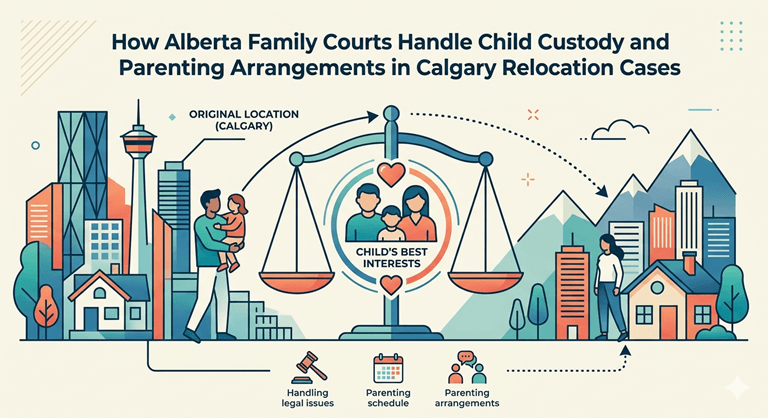
The conflict often arises from relocation when a parent wishes to relocate with the child, but this relocation has the potential to impact the other parent’s relationship with the child. The relocation issue is a serious one in Alberta courts, and can impact parenting times, school placement, and the role of family support.
In Canadian Family Law, the primary consideration is for the “best interests of the child.” Courts consider the reasons behind the move, the existing parenting plan, and the impact the relocation will have on the child emotionally, socially, and as an academic student. Judges also consider whether the move will benefit the child in terms of the quality of the housing, education, or the support of their family.
Parents involved in relocation disputes are often encouraged to seek legal guidance early in the process. Matters involving Child custody and parenting arrangements can become highly detailed, particularly when one parent believes the move may damage their ongoing relationship with the child. Courts expect both parents to provide clear evidence supporting their position rather than relying on emotional arguments alone.
Factors Alberta Courts Consider in Relocation Decisions
Alberta family courts consider a number of key factors when determining if a parent should be permitted to move. The primary objective is to keep the child stable, emotionally healthy,y and to keep close relationships with parents as far as possible. A child’s living arrangement is one of the first factors that judges look at. Courts consider which parent has primarily assumed the roles of attending school, making medical and other decisions, and engaging in extra-curricular activities. A parent with a solid caregiving background may be more likely to have a stronger case when it comes to seeking to move.
Courts also take into account the relationship between the child and each parent. Where the parent who does not wish to relocate has been very active in the child’s life, the court may be reluctant to approve the parent’s relocation because they do not want to sever that connection. It is also important that there is communication between parents. In a court, both sides are generally privileged to have the best of intentions. In a court, courts tend to favor parents who are cooperative, flexible, and willing to assist with continued contact once the move has occurred.
Other factors may be the child’s age, education, community ties, and cultural background. For older children, their views may also be taken into account if they have the maturity or understanding to do so, in some situations.
The Importance of Parenting Plans in Calgary Relocation Cases
A comprehensive parenting plan has the potential to be a significant element in relocation proceedings. Courts would like to see practical options that minimize disruption to the child’s life and allow the child to maintain contact with both parents.
Typically, parenting plans will also include visitation schedules, holiday visits, transportation issues,s and communication plans after the relocation. If the situation is a long distance, courts may permit longer holiday visits or regular video visits to maintain healthy relationships between parents and children.
The court has a better opinion of parents who offer thoughtful, practical parenting plans. Judges are impressed when parents are thoughtful about school schedules, travel plans, health issues, and emotional needs following relocation.
Mediation and collaborative family law are also increasingly used in relocation cases in Calgary. These approaches can minimize the emotional, legal, and stress burden on children. If the matter ever does end up in court, parents who attempted to solve it together demonstrate to the court that they are concerned with the child’s welfare.
How Courts Balance Parental Rights and the Child’s Best Interests
Moving cases can involve an issue between the parents’ intentions and a child’s desire for stability and continuity in the family. Alberta courts recognize that there are times when parents must relocate for work, remarriage, financial, or family support reasons. However, the court must determine if the relocation is in the best interests of the child.
Judges will take great care to ensure that the relocation will have a positive impact on the child or the child’s situation, and not primarily in the interest of the parent seeking the relocation. Migrating to a more economically viable, better educational, or extended family environment can enhance the appeal of the request. However, if the move is seen to be a conflict with the other parent, it may be looked down upon by the court.
Courts will also consider whether the child will be able to maintain a meaningful relationship with the parent who is not relocating after the relocation. Sometimes the relationships can be kept alive with the use of technology, travel arrangements, and new parenting schedules. However, if the relocation would significantly limit continued contact, the Court may impose conditions on the relocation and/or may refuse the request.
Ultimately, Alberta courts seek to establish long-term stability for children and promote healthy involvement between parents, whenever possible.
Conclusion
Alberta family courts face the challenge of making informed decisions in relocation cases that are based on evidence and the child’s best interests over the long term. Such disagreements may be an emotional stress, a conflict between parental interests, or complicated family or legal matters, and they are more involved than just the distance.
It is consistent with Calgary courts to place priority on stability, maintaining parent-child connections, and ensuring any proposed move truly enhances the child’s development. Parental education, parental cooperation, emotional status,s and caregiving history are all important factors to consider in the final decision.
When parents are faced with relocation issues, preparation is of great importance. Parental plans, communication, and a focus on the child can greatly impact court consideration of relocation. With the ongoing evolution of family structures and of the economy in Alberta, migration cases will continue to be a key aspect of family law that will need careful planning and well-informed legal decisions.
Popular on OTW Right Now!




About The Author

Gagan Bhangu
Founder of otechworld.com and managing editor. He is a tech geek, web-developer, and blogger. He holds a master's degree in computer applications and making money online since 2015.