
Why Do GTM Strategies Fail and How Can You Fix Them?
Most GTM motions don’t fail because the sales team is lazy; they fail because the team is sprinting in the wrong direction, fueled by data that’s already expired.
Many organizations still build GTM motions around broad ICPs and static lead lists. That usually leads to generic outreach, slower sales cycles, and poor conversion rates. Teams generate activity but struggle to build efficient pipeline growth.
A strong GTM strategy is not just about increasing outreach volume. It is about identifying the right accounts, engaging them at the right time, and aligning sales, marketing, and product teams around the same goals.
This article explores the biggest reasons GTM strategies fail and the practical fixes that improve targeting, engagement, and conversion performance.
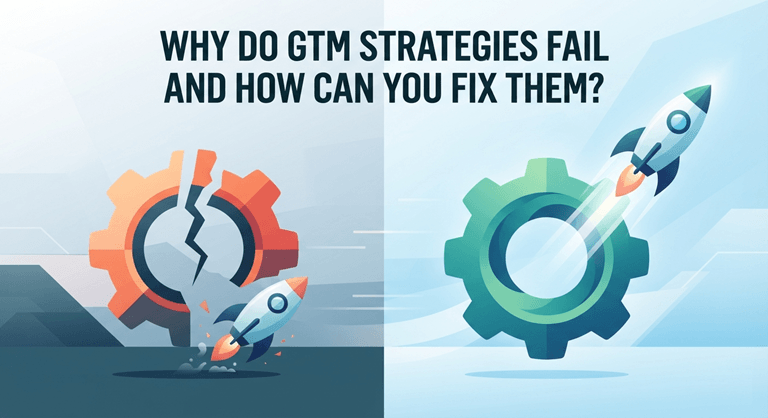
Where Do Most GTM Strategies Start Breaking Down?
Many GTM strategies focus heavily on execution while ignoring foundational targeting issues. Teams invest in campaigns, automation, and outbound sales while still relying on:
- Broad ICP definitions
- Static lead databases
- Weak intent visibility
- Misaligned qualification criteria
- Generic messaging
This creates a major disconnect between outreach activity and actual buying readiness.
Two accounts may look identical based on firmographic filters while operating in completely different buying conditions. One may actively evaluate vendors, while the other has no immediate reason to change infrastructure or workflows. Without operational visibility, both accounts receive the same outreach.
Why Does a Weak ICP Reduce Conversion Efficiency?
A weak Ideal Customer Profile (ICP) creates problems across the entire GTM motion.
Many companies still define ICPs using only industry, company size, or revenue. While useful for basic segmentation, these filters rarely explain how an organization actually operates.
A stronger ICP should include:
- Technographics data
- Buying intent signals
- Infrastructure maturity
- Vendor ecosystem alignment
- Growth and hiring indicators
This helps GTM teams prioritize accounts with higher conversion potential rather than relying on broad targeting.
How Does Bad Data Impact GTM Execution?
Even strong GTM strategies fail when built on inaccurate or outdated data.
Poor-quality data creates several operational problems:
| Data Problem | GTM Impact |
| Outdated contacts | Outreach reaches the wrong stakeholders |
| Static datasets | Buying signals are missed |
| Weak account visibility | Sales teams waste time validating accounts |
| Incomplete data | Customer acquisition costs increase |
| Poor segmentation | Territory coverage becomes inconsistent |
B2B environments change constantly. Companies adopt new technologies, expand operations, and restructure teams regularly. Without continuous enrichment, targeting accuracy declines quickly.
Why Do Sales and Marketing Teams Become Misaligned?
GTM performance weakens when sales and marketing operate with different priorities.
Marketing teams may focus on lead volume, while sales teams prioritize conversion quality. Without a shared view of account value, pipeline efficiency drops quickly.
This often leads to:
- Inconsistent account prioritization
- Poor lead handoffs
- Generic outreach
- Longer sales cycles
Customer intelligence platforms help solve this by creating a shared operational view across both teams. When sales, marketing, and product teams work from the same data foundation, targeting becomes far more consistent.
How Does Poor Timing Reduce GTM Performance?
Even strong-fit accounts may ignore outreach if timing is wrong.
Accounts become more receptive during periods of operational change, such as:
- Infrastructure modernization
- Vendor replacement cycles
- Hiring expansion
- Funding events
- Leadership changes
Without visibility into these signals, outreach often happens too early or too late.
Intent data and behavioral signals help GTM teams engage accounts during active evaluation periods instead of after decisions are already made.
How Does Customer Intelligence Improve GTM Performance?
Customer intelligence data helps GTM teams move beyond static targeting by adding operational and behavioral visibility across accounts. This improves decision-making across sales, marketing, and pipeline management.
| Customer Intelligence Signal | GTM Impact |
| Technographics data | Improves ICP accuracy and ecosystem alignment |
| Intent and research activity | Identifies accounts entering buying cycles |
| Vendor relationship visibility | Strengthens competitive positioning |
| Infrastructure changes | Improves outreach timing |
| Hiring and growth patterns | Reveals expansion opportunities |
| Behavioral engagement data | Enables more personalized outreach |
When these signals are combined, organizations improve pipeline quality, reduce outreach waste, accelerate sales cycles, and lower customer acquisition costs.
How Can Organizations Fix Weak GTM Strategies?
Fixing GTM performance requires more than increasing activity. Organizations need stronger alignment across targeting, qualification, and engagement.
Some of the most effective fixes include:
- Refining ICPs using operational and intent data
- Replacing static datasets with continuously enriched intelligence
- Aligning sales and marketing around shared KPIs
- Using behavioral signals to improve outreach timing
- Personalizing messaging based on account context
Strong GTM strategies also adapt messaging and outreach based on buyer intent and evaluation stage. Accounts in active buying cycles respond better to context-driven engagement than generic outreach campaigns.
To bridge this gap, many leaders are turning to a specialized customer intelligence company to move beyond basic firmographics and start mapping actual buyer behavior.
Conclusion
Most GTM strategies fail because they rely on incomplete visibility. Broad ICPs, outdated data, weak timing, and disconnected execution reduce targeting precision and conversion efficiency.
Organizations improve GTM performance when they combine customer intelligence, technographics data, and buyer-focused engagement strategies to guide targeting and outreach decisions.
The advantage is not in generating more activity. It is in building a GTM strategy that consistently reaches the right accounts, improves conversion efficiency, and drives more predictable growth.
Popular on OTW Right Now!
-
 How Enterprises Are Integrating Deepfake Detection APIs at Scale in 2026
-
 QR code text message – how to effectively combine offline and online in marketing activities?
-
 Why Operational Efficiency Is the New Profit Strategy
-
 How does the OUPES compare to other solar generators in terms of price and performance?



About The Author

Gagan Bhangu
Founder of otechworld.com and managing editor. He is a tech geek, web-developer, and blogger. He holds a master's degree in computer applications and making money online since 2015.