
From Automation to Autonomy: How AI Agents Are Redefining Enterprise Workflows
Over the last decade, enterprise automation has progressed in waves.
What started as a mere scripting using rules became Robotic Process Automation (RPA), which developed into intelligent automation and was supported by machine learning. Progressive waves were all claimed to be more efficient, cheaper, and more scalable. To do justice, both have told less than they ought.
Those boundaries, however, are becoming all too apparent.
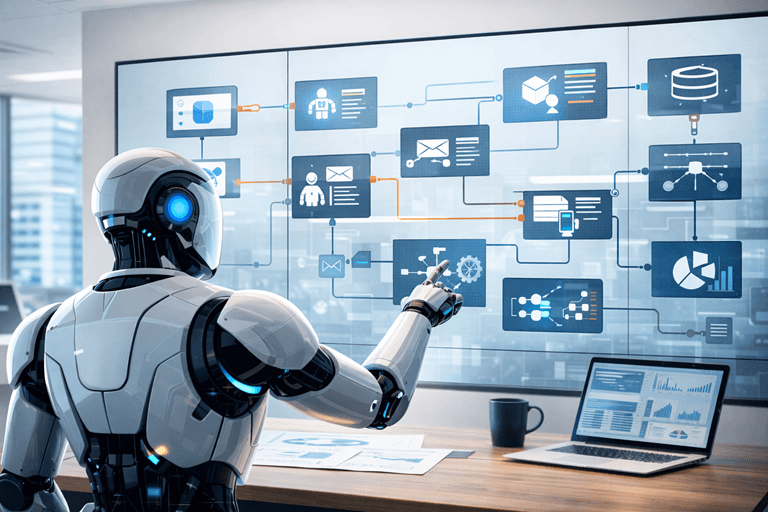
Contemporary businesses do not find it difficult since activities are not automated. Automated systems are difficult because they fail to adapt, reason, and act independently as the situation evolves. They wait. They continue to escalate. They break.
And here is where we are covertly moving to a new shift where organizations are being moved from automation to autonomy.
For readers exploring this shift further, understanding what is open claw provides a clear look at how autonomous AI agents operate in real-world enterprise environments.
The AI agents are changing the enterprise workflows by introducing the capability to plan, decide, and execute in dynamic situations. Corporations are beginning to automate results as opposed to automating processes.
Why Traditional Automation Is No Longer Enough?
Classic automation works in steady and predictable situations. Specific inputs are giving specific outputs. There are branches or manual intervention that is used to deal with exceptions.
What’s the problem? Enterprise operations are no longer predictable.
Customers do not follow a line. Supply chains are volatile. Regulations of compliance evolve. Data sources are fragmented. The human decision makers are overloaded.
The approach, which is brittle in this case, is a static automation. The success of RPA bots fails to work when there is a change in the interface. Incomplete data blocks workflow engines. The queues get bigger at a faster rate than the teams can handle.
The majority of businesses do not need more automation. They need intelligent systems that will be able to decide on the next step.
The Shift From Task Automation to Outcome-Oriented Systems
The fundamental weakness of traditional automation lies in the fact that it concentrates on the process more than on the objective.
An invoice was processed.
A ticket was routed.
A report is generated.
However, corporations don’t care about tasks—they worry about outcomes:
- Faster resolution
- Lower risk
- Higher customer satisfaction
- Continuous optimization
Another model is suggested by AI agents. They rely on goals, situational, and feedback cycles, as opposed to executing pre-determined processes. They observe systems, formulate data, act, and modify it on the basis of the results. It is not a gradual transition. It is architectural.
What Makes AI Agents Different?
AI agents are not simply advanced bots. They integrate several competencies into a single operational unit:
- Perception: Interpreting information in a variety of systems, unstructured and structured.
- Reasoning: This entails the process of interpreting context, limits, and priorities.
- Planning: Dynamic planning of actions.
- Implementation: Working with workflows, tools, and APIs.
- Learning: How to judge better, using results.
Instead of following scripts, agents operate more like digital workers with bounded autonomy.
This is the foundation of agentic process automation, where workflows are no longer rigid pipelines, but adaptive systems that can self-direct based on real-time conditions.
From Workflow Engines to Agent-Orchestrated Operations
Conventional workflow engines assume linearity. Branching is predetermined even in the circumstances of its occurrence. Workflows, on the other hand, are perceived by agents as live systems.
Take into account the customer support operation.
A conventional workflow would be to classify a ticket, assign it to a team, wait till resolved, and in case of SLA violation, escalate.
Instead, an agentic system analyzes intent and urgency, assesses client context, chooses the best resolution path, takes action, and monitors results.
The workflow is not set to “run.” It is continually managed.
Autonomy Does Not Mean Chaos
One common misconception is that autonomous systems imply loss of control. In reality, enterprise-grade agentic systems operate within strict guardrails, where AI security becomes a foundational requirement rather than an afterthought.
Autonomy is:
- Scoped by policy
- Constrained by compliance rules
- Logged for auditability
- Continuously monitored
Think of it less as free will and more as delegated authority.
Where Agentic Systems Deliver Immediate Value?
The impact of AI agents is most obvious in contexts with high variability and frequent decision-making.
In operations and back-office services, agents are able to utilize exception-based processes by adapting resolution paths dynamically instead of escalating all processes to humans.
Customer experience agents do not use scripts but instead personalize their engagement techniques based on intent, sentiment, and history.
IT and DevOps Agents in IT and DevOps check systems, diagnose abnormalities, and coordinate the actions of tools without human intervention.
Why Enterprises Are Moving Beyond RPA?
RPA was a crucial step. It showed that automation is capable of boosting ROI. But it also brought to light a very ugly truth: the automation that lacks intelligence makes the process even less efficient.
Every bot needs maintenance.
Any exception is to be dealt with.
Every extreme case makes it more complex.
The complexity is rather absorbed by AI agents, instead of improved.
This does not imply that RPA will die out. In most cases, bots are used as execution tools of the agents, activated, coordinated, and controlled by a higher level of intelligence.
Risk management in Autonomous Systems.
Managing Risk in Autonomous Systems
The valid concern regarding risk, explainability, and accountability grows with enhanced autonomy.
Leading companies handle issues by restricting agent authority, implementing human-in-the-loop checkpoints, keeping comprehensive decision logs, and running agents in advisory or shadow modes before full launch.
Autonomy is gained rather than provided all at once.
Measuring Success in an Agent-Driven World
The conventional automation measures are time saved and volume processed. The agentic systems require larger measures, such as the quality of the result, the accuracy of decision-making, flexibility, and long-term operational sustainability.
The issue has changed to question “Did the task run? to Which question is Did the system make the right decision?
The Future: Enterprises That Run Themselves (Partially)
It is neither possible nor desirable to have fully independent firms. Nonetheless, the existence of self-managing operational layers is becoming increasingly necessary.
Agencies’ systems have enterprises that react more quickly to change, grow without added staff, and leave workers to higher-order work.
The ones that do not will be buried under weak automations that retard them instead of speeding them up.
Final Thoughts
Automation to autonomy is not a craze but a reaction to the operational reality.
Workflow and environments are growing increasingly complex and dynamic, and businesses need systems capable of thought and action, and with will. This is possible through AI agents that convert the nonliving processes into the living ones.
Automation is not an activity that is substituted by agentic techniques; instead, it supplements it, and in the case of organizations that can move fast, the advantage multiplies.
Popular on OTW Right Now!




About The Author

Gagan Bhangu
Founder of otechworld.com and managing editor. He is a tech geek, web-developer, and blogger. He holds a master's degree in computer applications and making money online since 2015.