
Gemma 4 26B A4B: The 4B-Active Model With No Index at All
On OrcaRouter we host the Gemma 4 26B A4B model — Google’s sparse-architecture card, shipped on July 2, 2026, with 26B total parameters of which only 4B are active per token, priced at $0.25 per million input tokens and $2.90 per million output, with a 256K context window and no maximum output listed in its directory entry. It has no Intelligence Index on Artificial Analysis: the board’s page for it reads all metrics as not available. In production its p50 time-to-first-token is 3.76 seconds and its seven-day token volume is 4.3 million. It is carried at list price on the same key as every other Google model, with the live telemetry on the linked page.
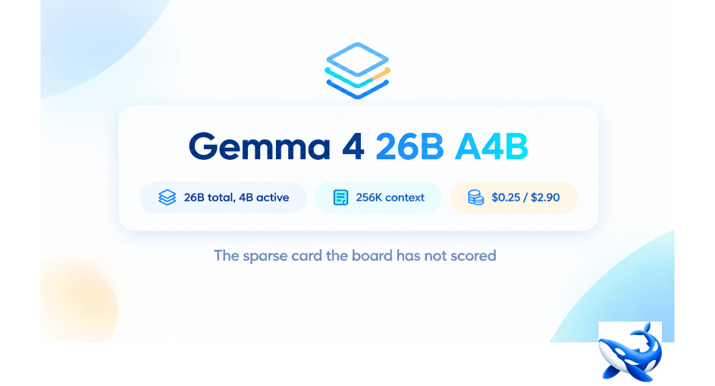
A card with no independent score is a card where the production record carries the whole argument — and this article is about what that argument says when the benchmark is silent.
A card the board has not scored
The absence is the first thing to note and it’s very real. The Artificial Analysis page for Gemma 4 26B A4B is simply “not available” across the board. There is no Intelligence Index, no independent speed reading and no independent per task cost to report. The article simply states the facts rather than making up a figure to fill the gap. It’s a rather new card (4B active parameters) and the independent sites haven’t yet run their standard set of tasks on it. The result is that all of the comparisons that follow are either based on the vendor’s entry or our production telemetry.
That alters what we can say. The only hard numbers a buyer can take away are the 26B total / 4B active architecture, the 256K context, the $0.25/$2.90 rate card and the production numbers on the linked page. The article’s approach is to be absolutely clear about what is and what isn’t, and to never imply that the absence of an index is a failure. It is simply an unscored index.
The sparse card next to the scored rungs
| model | architecture | context | input / output | AA index | p50 TTFT | 7-day tokens |
| Gemma 4 26B A4B | 26B total, 4B active | 256K | $0.25 / $2.90 | no index on AA | 3.76 s | 4.3M |
| Qwen3.7 Plus | dense, previous gen | 1M | $0.35 / $1.42 | 25 | 2.98 s | 20.1M |
| MiniMax M3 | dense, generalist | 1M | $0.30 / $1.20 | 29 | 10.00 s | 36.0M |
Rate cards are what the vendors list. The index column is Artificial Analysis’ live page which reads as ‘not available’ for the sparse card. The TTFT and token columns are production telemetry from the pages in question. The table is forthright about its limitations. The rows adjacent to the Gemma 4 26B A4B have independent scores which the sparse card doesn’t have so it’s an architectural and economic comparison rather than a competitive one. It’s a card that’s priced in the lower dense mid rungs on input, built around a 256K window rather than a million and carrying a very small fraction of the weekly traffic of the dense cards. It’s a card that’s been bought for its sparsity and the market has not yet worked out what sparsity is worth.
What sparsity is supposed to buy
The architecture is the point really so the article will explain it in very plain terms. It’s a sparse mixture design with 26B total parameters and only 4B active per token. Each token is routed through a small slice of the model and the full 26B of knowledge remains resident. The idea is that you end up with a model that behaves like a larger model on a per token basis but costs like a smaller one. The $0.25 / $2.90 rate card is the vendor’s price tag on that promise, well below the dense mid rungs on input.
What sparsity can’t guarantee is a score. The independent board hasn’t run its tasks on the card so there’s no external validation of what the 4B active slice actually achieves (this article won’t manufacture that). The 256K context window is the hard number. The verdict on the architecture is still to be seen. The promise is cheap, strong output. The record is blank. The only live evidence is the production telemetry on the linked page.
Reading a card with only its own record
No independent score so the reading has to come from the numbers we have and they tell a pretty straightforward, if fairly unexciting story. The 3.76 second p50 first token on our production record is pretty much in the middle of the pack, not particularly fast (faster than the long generation wait) and not particularly slow (slower than the speed champ). The 4.3m weekly tokens is a specialist volume and that’s exactly what you’d expect from a card that the market is in the process of testing rather than one that’s running at scale. The 256K context at $0.25 input makes the seat very cheap for mid-size context work and that’s the only real concrete argument the card has.
The weekly volume absolutely deserves one more sober look as it gives you a good sense of the adoption curve that a sparse card actually achieves. 4.3 million tokens is nothing to write home about when you’re comparing it to the much denser mid-runners in the table, but it’s not nothing at all. For a card which the independent board has not scored it’s pretty much what an early adopter base would look like: teams actually running workloads at a real meter as they’re evaluating the architecture. The 3.76 second first token and the $0.25 input price are precisely the conditions under which such a test would be cheap to run and that’s exactly how a card without a score gets its first production evidence. When those independent tasks do run and a score is eventually achieved that base is the evidence that the market will point to.
The honest summary is a card with transparent economics and no demonstrated quality: the sparsity promise is genuine, the $0.25/$2.90 price is genuine and the independent confirmation is missing. For a team that’s willing to be the one to do the first standard tasks it’s cheap enough to try and the only live numbers on the linked page are there. For a team that needs a scored, proven seat the dense rungs with indexes are still the safer bet.
The takeaway
Gemma 4 26B A4B is Google’s sparse architecture card: 26B total parameters (4B active per token), 256K context, $0.25/$2.90 rate card and no max output listed in the directory. The Artificial Analysis page for it is simply ‘not available’ so there’s no independent score to report. The production figures are 3.76s p50 first token and 4.3M weekly tokens. It’s a card bought in for the sparsity promise at a very low input price, with the independent score still to be written (live at list price as per the linked page).
Sourcing note: the release date, parameter count, context window, rate card and the lack of a stated maximum output are what Google’s directory listing shows as of 08/10/26 and have not been independently verified. Artificial Analysis’ page for the card states ‘not available’ across the board as of 08/10/26 so no independent score is available. The p50 time to first token and the 7 day token volume are OrcaRouter production telemetry from the model page linked to. All verified as of 08/10/26.
Popular on OTW Right Now!




About The Author

Gagan Bhangu
Founder of otechworld.com and managing editor. He is a tech geek, web-developer, and blogger. He holds a master's degree in computer applications and making money online since 2015.