
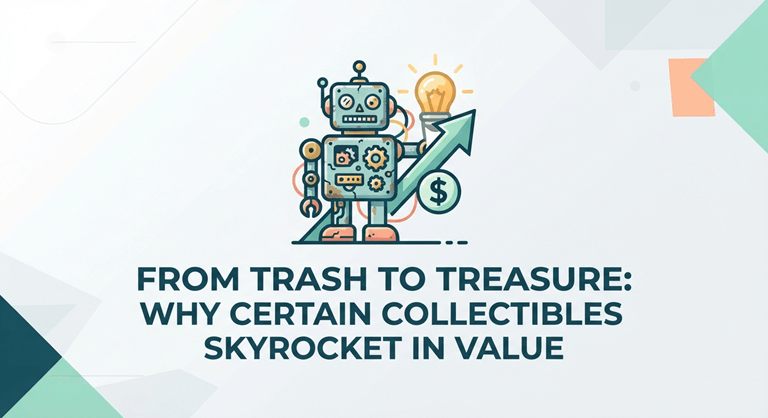
From Trash to Treasure: Why Certain Collectibles Skyrocket in Value
Items that were once tossed into the garbage or left to rot in dusty attics frequently end up commanding staggering prices at modern auctions. A cardboard box of old printed paper, a discarded childhood plaything, or a piece of outdated technology can transform from everyday clutter into a highly prized financial asset.
This is not a random change from worthless junk to wonderful treasure, but a planned change. It is motivated by certain economic factors, changing cultural trends, and human psychology. If you look closely at these forces, you’ll see precisely how ordinary products grow up to be profitable assets over the years.
The Law of Scarcity and Survival Rates
The basics of collectibles valuation are built on the basic economic principle of supply and demand. A product is typically made in an “original form ” at the time of its production, when the volume is high, resulting in an inexpensive and easy-to-find product. These objects are considered “disposable” in society, and most of them are discarded, worn out, or lost over the decades.
As a result, there is a major drop in the amount of the product that is physically available. After decades, a large volume of interest could come along, and there will be only a small amount of the original production available. The high demand and low supply create a huge price escalation. Those things that remain are valuable because of the destruction of so many others.
The 30-Year Nostalgia Cycle
Human emotions, and a desire for the past in particular, are intimately linked to value. Economists have termed it a ‘nostalgia cycle’, and it typically goes through a boom 30 years after a product was first released.
This is the perfect timeline for the generational change in disposable income. If kids have played with some of these things or looked at the images, they’ll eventually turn into grown-ups with some cash in their pockets. At about the age of 30-40, they tend to want to experience the fun of their childhood by buying the same products that they enjoyed when they were children. This collective desire creates enormous demand for once-cheap pastimes.
The Shift From Mass Production to Craftsmanship
Another reason for the value of objects is that the manufacturing process has changed. In the future, production methods are becoming increasingly automated, with a high consumption of low-cost plastics and synthetic materials.
When collectors look back at older eras, they frequently develop an appreciation for the tangible quality and care found in older goods. For instance, enthusiasts might seek out vintage wooden airplane models or hand-carved furniture because these items represent a level of patience and structural integrity that modern factory assembly lines rarely duplicate. There is a sense of respect for historical craftsmanship, creating works of art from ordinary tools and decorations.
Condition and the Premium on Preservation
An object’s oldness is not enough to make it a record-breaker; it also has to be well preserved. A collectible’s condition is on an exponential scale. The value of a badly damaged item may be virtually worthless, while the same item in pristine condition may be worth thousands of dollars.
Objects that are in their original condition are the highest priced. No-opened, no-played, and never exposed to light and moisture items are extremely rare. Collectors will pay huge money to get the capsules, as they provide them with a perfect and unaltered look of the past.
The Role of Media and Pop Culture Rediscovery
Last but not least, external cultural events can immediately make a difference in the monetary circumstances for aged products. A forgotten era can be brought to millions of new people in a single night through a new documentary, a popular historical film,m or a viral Internet trend.
One decade that is singled out in the media can form a whole new class of collectors. Those who never thought about owning any particular type of vintage memorabilia suddenly rush to online marketplaces and get a piece of history. This is an artificial influx of new buyers into a limited market, resulting in prices going through the roof in a few weeks.
Popular on OTW Right Now!



About The Author

Gagan Bhangu
Founder of otechworld.com and managing editor. He is a tech geek, web-developer, and blogger. He holds a master's degree in computer applications and making money online since 2015.