
Surge Pricing and Number Masking: The Two Features Taxi Apps Can’t Launch Without in 2026
Every founder who wants to build a taxi app starts with the same mental checklist: booking flow, live tracking, payments, and ratings. Those get you an app. They don’t get you a business that survives its first Friday rush hour.
The ride-hailing market is worth close to $185 billion in 2026 and is on track to nearly double by the early 2030s, which means the competitive bar has moved. Riders and drivers have already used Uber, Lyft, or a dozen regional apps, and they notice the moment something feels off – a driver who won’t show up when demand spikes or a call from a stranger an hour after the trip ended. Those aren’t edge cases. They’re the two problems that decide whether a taxi app project turns into a business people trust or one they delete after a bad first week.
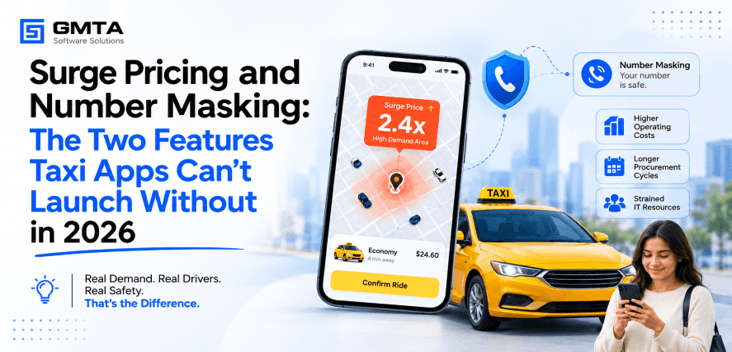
The two features that quietly do the most work here are surge pricing and number masking. Neither shows up on a pitch deck slide about “core features”. Both determine whether your taxi app development actually holds up once real riders and real drivers depend on it – whether your driver supply shows up when you need it and whether your riders feel safe enough to keep booking.
Why “just build a taxi app” isn’t a strategy anymore
Here’s the problem with a fixed-fare model: it assumes every hour of every day has the same number of available drivers. It doesn’t. A concert lets out, a flight lands, it starts raining at 5 p.m. on a weekday — and suddenly you have 800 ride requests and 200 drivers who can actually reach them in a reasonable time.
Without a mechanism to respond to that gap, three things happen in order: pickup times stretch out, riders start canceling, and drivers quietly go offline because the trips available to them aren’t worth the wait. Your app doesn’t fail because it lacks features. It fails because it has no way to keep the marketplace balanced when it matters most.
That’s the job surge pricing does. And it’s exactly why it needs to be scoped into your MVP, not bolted on after your first bad Friday night.
Surge pricing — the feature that decides if drivers show up
Surge pricing is a temporary fare increase that kicks in when rider demand outpaces driver availability in a specific area. It’s not arbitrary, and it’s not just “raise prices when it’s busy.” A well-built system is reading a handful of signals in real time — how many ride requests are coming in, how many drivers are actually free to accept one, and how long the average ppickupis taking — and using that to work out whether a fare adjustment will actually solve the problem or annoy people.
With well-executed surge pricing, you’ll keep your drivers on the road during a surge in demand; you’ll keep them from logging off when they need to be on the road. You’ll keep them from waiting for 20 minutes for a pickup they can’t handle a second time.
When it’s done incorrectly, a flat, blunt multiplier is applied throughout the city. Riders are feeling the pain, drivers are chasing surge zones versus providing services to areas that need it, and then you end up with just what you set out to avoid: instability.
How surge pricing actually gets calculated
The short answer: It’s not some set number, such as “2x on Fridays”. A well-designed pricing engine takes into account the demand in a small geographic area (not throughout the city), the number of drivers that can be called, and the extent to which pickup times are lengthened compared to normal, and then computes a multiplier based on the three numbers. It’s a worthwhile engineering challenge to go beyond “if busy, charge more,” and that is where most first-time builds go wrong.
If you want the full breakdown of that calculation — including the actual formula, how zone-based geofencing works, and why AI-based demand forecasting is becoming standard — GMTA’s guide on how surge pricing algorithms work walks through the architecture in detail.
Number masking – the feature riders don’t ask for until they need it
While surge pricing is all about maintaining supply and demand, number masking is all about people staying safe – and for a good reason, number masking is now table stakes.
After the driver and rider are matched, they usually have to communicate — to confirm pickup site or arrange for a late arrival. The obvious method would be by direct telephone call. Of course, the easiest way to do this carries a privacy risk. Neither is interested in giving out their true number after the ride.
This can be resolved by using number (or call) masking to send all calls and texts to a temporary virtual number rather than the real number. No one will ever get the other’s real numbers, and after the ride ends, the connection between the two gets broken — the virtual numbers are reused for the next ride. That’s why Uber and Lyft rely on it – as a minimum level of protection from harassment, stalking, unwanted marketing, and riders and drivers booking trips outside of their app to avoid your commission.
It’s something that riders don’t have to contemplate until they’re in the middle of a ride. It’s one of the best methods that can cause you to lose driver or rider trust in your business, and it is a true liability if you don’t have it.
What happens if you skip these two features
Then it will be noticeable in your driver retention statistics – drivers that are logging off during your peak hours because the fixed fare would take too long, and riders who cease to open the app because it’s taking too long to be picked up just when they need it most.
Don’t skip number masking, and there’s another, related but equally likely, risk in 2026: a lack of compliance if your platform is being used in a place that has prying expectations around user information.
These both aren’t “we’ll add it in v2” features. They’re both types of infrastructure that – in the initial stages of development – are quite a bit more inexpensive than it is to retrofit at a point in time that things are running and you have live users and live relationships with drivers relying on that.
What it actually costs to add these to a taxi app
Numbers are useful here as it is easier to see where the budget is heading when you say “trust and safety features.
Adding surge pricing and number masking to a ride-hailing dispatch system typically runs $40,000 to $120,000 on top of the base cost of building the taxi app itself, depending on how sophisticated the pricing logic needs to be and how deep the telecom integration goes:
- Rule-based surge pricing engine: roughly $20,000–$45,000, covering the pricing logic, geofencing, admin controls, and dispatch integration.
- AI-powered demand forecasting (optional, but increasingly standard): an additional $10,000–$25,000 for models that anticipate demand spikes 15–30 minutes ahead using historical trip data, weather, and local events.
- Number masking (voice and SMS): roughly $10,000–$25,000, covering virtual number provisioning, call/SMS routing, and session lifecycle management.
- Testing and deployment: another $10,000–$25,000 for end-to-end testing, security validation, and rollout.
That increases the total cost of a full build to $50,000 – $145,000, with the AI price forecasting being an additional component. The smart thing to do for a founder at the MVP stage is to start with the most straightforward features: Rule-based surge pricing and masked communication as the day-one features – and then add AI forecasting when there’s enough live trip data in existence to warrant an investment in this feature.
If you’re in the process of creating your budget, you should ask any development partner to provide you with all of the details, including a phased scope of work.
The takeaway for founders
Booking flow, live tracking, and payments will have your taxi app in the app store. Surge pricing and number masking will determine whether it lives or dies when real riders and real drivers use it— whether people use your platform when demand goes up, and whether your supply is there when they need it and makes them feel good enough to return.
Both have known architectures and can be solved. The error is not a technical one; it’s a scope error, as it’s not just polish but scope. When considering a taxi app development partner for your taxi app build, confirm they can handle both in one go, not as an add-on in phase two.
Popular on OTW Right Now!


About The Author

Gagan Bhangu
Founder of otechworld.com and managing editor. He is a tech geek, web-developer, and blogger. He holds a master's degree in computer applications and making money online since 2015.