
From Shoreline to Seafloor: Positioning Basics for Practical Bathymetric Surveys
Bathymetry has a talent for looking easier than it is. From land, you see a boat tracing neat lines and a plot filling in obediently. Out on the water, you discover the real job: you’re measuring the bottom from a platform that never stops moving, through a medium that changes its mind with temperature, and against a vertical reference that people will argue about later if you don’t define it upfront.
Choosing surveying equipment for bathymetry is therefore not “picking a sonar.” It’s deciding how you will turn motion, offsets, timing, and water-level reality into depth you can stand behind. A depth value is not a single reading. It’s the end of a chain—and chains fail at the weak link, not at the glossy feature.
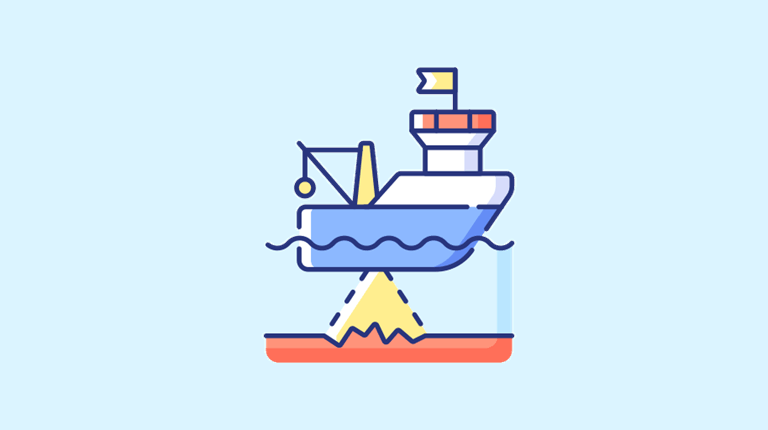
The boat is your instrument stand, whether you like it or not
On land, you can often pretend your instrument is still, and the world is stable. On water, even a calm day comes with pitch, roll, and heave. Add current, wind, wakes, and tight maneuvering near the shore, and your “tripod” is now a moving stage.
That doesn’t make bathymetry impossible. It makes it honest. If you accept that the platform moves, you design the survey to measure and correct that motion rather than hoping it averages out. Hoping is not a method.
Pick your “zero” before you pick your route
Ask a team to “measure depth,” and you’ll often get a follow-up question disguised as confidence: “Depth relative to what?”
Bathymetry lives and dies on vertical reference. Depending on the project, “zero” might be a chart datum for navigation, a local construction datum for dredging, or an engineering reference tied to benchmarks. Two surveys can both be “accurate” and still disagree because they used different zeros.
Practical discipline here is unromantic but decisive:
- Name the vertical reference in plain language (not only in file settings).
- Treat water-level/tide handling as data you manage—not a late-stage patch,
- And make sure the processing pipeline actually outputs depths in the reference you promised.
Any subsequent conversation is philosophical when you go leave this vague. Projects prefer mathematics.
The ping is not where your antenna is
Another misconception creeps into most early bathymetry processes: assuming that the position of the GNSS antenna is the sounding position. It isn’t. The depth occurs at the transducer, which is nearly always elsewhere on the vessel.
The geometry problem then arises of bathymetry: with the transducer, where was the ping?
That is where lever-arm offsets come into the picture- long-memoriedly, silently. When you measure the offsets casually or with the wrong sign, or when you adjust them due to a mount changing in the middle of the week, you can generate a beautiful dataset with a constant bias. The bias will not appear noisy. It will look “clean.”
Good teams treat offsets like calibration constants:
- Measure them carefully,
- Document them clearly,
- Lock the physical mounts,
- Re-check after any reconfiguration.
Motion compensation isn’t fancy; it’s basic hygiene
A simple setup can cause motion of the vessels to blur depth and distort at the location where the bottom is seen to be. Unmodeled roll and pitch with a broader coverage system can give artifacts that look like actual seabed features until you do an overlap check.
Here is the difference between bathymetry and most land processes: you are not just measuring position, but measuring orientation and vertical displacement since they vary the direction the transducer is taking in space.
The key idea is coupling:
- Attitude affects where the beam points,
- Beam pointing affects where the depth is sampled,
- And timing decides whether those measurements belong to the same moment.
And this brings us to the most unglamorous subject on which a person can get mixed up afterwards.
When timestamps slip, the seabed “moves.”
Bathymetry systems ensembles: GNSS messages, attitude streams, sonar pings, and logging software. When these streams go out of step, then you can form errors that are inconsistent, and which appear to be random scattering, but which are systematic time error.
In the field, timing trouble often shows up as small along-track shifts:
- Adjoining lines are not in accord the way they ought to be.
- Features seem to “drag” slightly in the direction of travel,
- Repeated strokes will not lie on top of each other.
One wants to blame the bottom: “Perhaps it is simply bad terrain. Sometimes it is. It is often your data streams that are not in agreement over what is now.
You do not have to be a timing expert. You should also treat time as a component of measurement, and not a background assumption. When they are not harmonizing, check by asking Are these streams synchronized, before you conclude that the seafloor is being creative.
Water is part of the instrument
Sonar measures the travel time and transforms it to distance based on the speed of sound. The thing is that the sound speed varies with temperature, salinity, and pressure. One guessed value may skew depths or even curve geometry – it is particularly apparent when you compare lines or repeat a visit to a place.
The question of whether we should measure the speed of sound or not is, in fact, the question of how uncertain this project can be. The solution lies in purpose. An oceanographic campaign is not necessary in every practical survey, but there must be a sound-speed approach of the kind that promises the confidence it gives.
A useful mental shortcut:
- GNSS positions the platform,
- Sonar measures the range,
- The speed of sound is one factor that dictates whether the range is being translated in an upright manner.
Omit the medium sufficiently long, and it would present itself in your residuals as an unpaid bill.
Survey lines are not just coverage—they’re evidence
A lot of bathymetric headaches are developed in planning rather than processing. A line plan that seems effective may be horrible to QA when it has no redundancy. In the absence of overlap and cross-lines, you can find internal means of bias detection only in a limited number. It is possible to create a surface that appears consistent and yet lacks any mechanism to demonstrate it is consistent.
Redundancy is not a luxury in bathymetry; it’s the cheapest form of truth-checking. A few cross-lines and intentional overlap let you answer the most important question: “Does the system produce the same seabed twice?”
The shoreline zone deserves its own strategy
Projects become cumbersome in nearshore work. Draft matters. Waves matter more. The safe envelope of navigation is reduced. The bottom is subject to quick change over a short distance. And there is the reality of access restrictions: you just can not safely cover the shallowest areas with the same platform at times.
A practical approach is to treat shoreline transition as its own mini-scope:
- Define what the deliverable considers “shoreline.”
- Specify how shallow you must go,
- Gaps in documents are explicitly mentioned instead of being concealed.
Customers do not like to find out about missing coverage later. They are typically able to live with a well-defined limitation.
QA you can do before lunch
Bathymetry QA does not require theatre. It must have timely checks that allow you to make decisions when you are still on site and decide whether to re-run a line.
The most useful field QA habits are small:
- Monitor overlap behavior: do neighboring lines agree where they should?
- Keep an eye on mounts and offsets: did anything shift after a bump or reconfiguration?
- Note changing conditions: a change in the wind, heavy traffic on the way, an abrupt change in the water temperature.
Most importantly, in case something is not right, run the line again when you still have the opportunity. The most costly re-run is the post-demobilization re-run.
What “good” looks like in the end
A good bathymetric deliverable is not just smooth. It’s explainable. Where two passes are discrepant, investigate: reference, offsets, motion, timing, water conditions. You do not have to shrug and point an accusing finger at the sea.
That is the actual positioning lesson between coast to sea: you are constructing a scale of measurement. Construct it with care, with explicit references, rigorously offset, with coordinated streams, with a survey design that contains internal verifications, and your findings will be reliable when someone relies on them.
Popular on OTW Right Now!



About The Author

Gagan Bhangu
Founder of otechworld.com and managing editor. He is a tech geek, web-developer, and blogger. He holds a master's degree in computer applications and making money online since 2015.