
How a Failing Bosch Injection Pump Triggers Your Check Engine Light
Diesel engine owners often find themselves puzzled when the check engine light illuminates without any obvious signs of mechanical failure. The engine may still start, idle, and even drive — but something beneath the surface is quietly degrading performance. In many cases, the root cause traces directly back to the fuel injection system, and more specifically, to the injection pump. Understanding the relationship between fuel delivery components and diagnostic warning systems is essential for any diesel vehicle owner who wants to stay ahead of costly repairs.
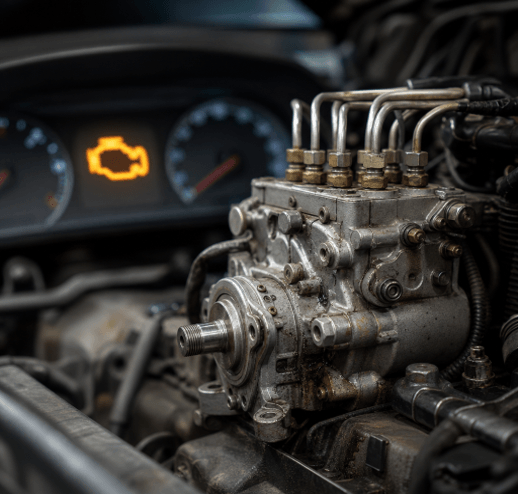
The Role of the Injection Pump in Diesel Fuel Systems
The injection pump is the heart of a diesel fuel system. Its primary job is to pressurize fuel and deliver it to the injectors at precisely the right moment and in the correct quantity. Unlike gasoline engines that rely on spark ignition, diesel engines depend entirely on the compression of highly pressurized fuel to initiate combustion. If the injection pump fails to maintain adequate pressure or timing, the entire combustion cycle is disrupted.
Modern diesel engines are equipped with sophisticated electronic control units (ECUs) that monitor fuel rail pressure, injection timing, and fuel volume delivery. When any of these parameters fall outside the acceptable range, the ECU logs a fault code and triggers the check engine light. This is not a coincidence — it is the system doing exactly what it was designed to do: alert the driver before a minor issue becomes a catastrophic failure.
Common Fault Codes Associated with Injection Pump Failure
Several OBD2 fault codes are directly linked to injection pump degradation. P0087 (fuel rail pressure too low), P0088 (fuel rail pressure too high), P0191 (fuel rail pressure sensor range/performance), and P0251 (injection pump fuel metering control malfunction) are among the most frequently encountered. These codes do not always mean the pump has completely failed — in many cases, they indicate early-stage wear that, if addressed promptly, can prevent a full breakdown. Knowing how to interpret these codes is the first step toward an accurate diagnosis.
Diagnosing Injection Pump Problems with OBD2 Data
The check engine light is not the only indicator to take into account. It takes a very knowledgeable technician or informed owner to delve deeper into the data stream to gain insight into what is really happening to the engine. Actual fuel rail pressure data from an OBD2 scanner can be viewed as it is being measured, and can be compared to the manufacturer’s recommended range. Scanner data is easily affected by the pressure loss conditions of the pump on cold starts and during loading.
For Cummins-powered vehicles in particular, reading OBD2 scanner data to diagnose Cummins engine problems is an invaluable skill. Cummins engines are widely used in heavy-duty trucks and commercial applications, and their injection systems are highly sensitive to pressure inconsistencies. This is because scanner information is coupled with the actual physical inspection of the pump, fuel lines, and filters to provide a full diagnosis, not a guess.
Symptoms That Precede the Warning Light
A failing injection pump will often give off some subtle indications before the check engine light even appears. One of the first signs is hard starting,g particularly in the cold weather. Some rough idling, loss of power on acceleration, black or white smoke from the exhaust, st or a significant decrease in fuel economy may also occur. The symptoms are a result of the fuel not being supplied to the engine at an adequate pressure or at the right time, which results in incomplete combustion. Sustaining these symptoms usually means that the entire pump will fail as well, ell and sometimes the pump injectors will become damaged.
What Your Check Engine Light Is Really Telling You
Many drivers dismiss the check engine light as a minor nuisance, particularly if the vehicle seems to be running normally. This is a dangerous assumption. According to Edmunds’ guide on what your check engine light is telling you, the warning can indicate anything from a loose gas cap to a serious engine fault — and in diesel vehicles, fuel system issues rank among the most critical. But, especially a check engine light that comes on flashing, indicates a misfire or a serious issue that requires attention.
For owners of diesel vehicles, the check engine light, along with reduced power mode (also referred to as “limp” mode), is a good sign that the ECU has sensed a condition with the fuel system that is severe enough to restrict engine performance to avoid possible damage. It is not indicated at this point to drive without a diagnosis. The earlier that the fault code is read and the fuel injection system is checked, the better the chances of avoiding a complete pump replacement, or worse, damage to the fuel injectors due to fuel starvation.
Choosing the Right Replacement Injection Pump
If a diagnosis has been made and it has been determined that it is a problem with the injection pump, then choosing a quality replacement is an important decision. There are many different types of injection pumps, and an improperly functioning pump will result in additional pump failures, loss of performance, and failure to satisfy warranties on other fuel system components. The company’s decades of engineering experience make it the industry standard in diesel injection technology, in the eyes of many.
Why Bosch Remains the Benchmark for Diesel Injection
Bosch was the first to introduce common-rail diesel injection technology, and they continue to lead the way for precision, durability, and reliability. Engineered to be equal to or better than the OEM original specification, their injection pumps will operate as the engine was designed to do. Bosch injection pumps are designed to perform under the toughest conditions, be it a light-duty pickup, a heavy-duty commercial truck, or an agricultural machine.
Goldfarb & Associates: A Trusted Source for Bosch Injection Pumps
For the purpose of obtaining genuine and quality diesel fuel system parts, it would be a huge advantage to deal with a reputable supplier. With a reputation for reliability, Goldfarb & Associates has established itself as a trusted source for dependable diesel parts, backed by a team of knowledgeable experts. For diesel technicians and vehicle owners looking to source a reliable bosch injection pump, Goldfarb & Associates provides access to a well-organized inventory that covers a wide range of diesel applications, making it easier to find the right part without the guesswork.
They’re dedicated to providing quality sourcing products, which means the customer isn’t left swimming in a pool of questionable aftermarket products. Rather, they can be confident that they are buying safe, high-quality parts that will last long enough to meet their professional needs.
Preventive Maintenance to Protect Your Injection Pump
The first step to prolonging the life of your injection pump is to maintain it regularly. One of the most common causes of premature pump wear is from contaminating the fuel with what is not intended. When high-quality diesel is used from reputable fuel sources, there is less chance of contamination. By changing fuel filters at the manufacturer’s recommended change frequency, dirt will not have access to the precision internal components of the pump. In addition, if diesel fuel contains lubricity improvers, then a fuel additive may be able to make up for the absence of sulfur in modern ultra-low sulfur diesel (ULSD), which tends to be less lubricating than older diesel fuel.
It’s also important to regularly check fuel lines, connections, and fuel pump housing for any leaks or corrosion. It is much cheaper to catch a small fuel leak early than it is to suffer the effects of fuel starvation or a pump that has run out of fuel. Combined with periodic OBD2 scans to see if there are any fault codes stored (even if the check engine light is not on), this will give the diesel owner the best chance of avoiding issues before they get too big.
Conclusion
Don’t run away from the check engine light — it’s one of the most important diagnostic tools that you can use to help you as a diesel vehicle owner. If it comes on when the vehicle exhibits symptoms such as hard starting, rough idling, or power loss, the injection pump should be high on the list of diagnostics. With a little effort,d the right parts from a reputable supplier, and a good OBD2 scanner, a diesel owner can efficiently identify and solve fuel system problems and become a safe driver again. It is always more cost-effective to invest in the right parts and the right knowledge than otherwise.
Popular on OTW Right Now!




About The Author

Gagan Bhangu
Founder of otechworld.com and managing editor. He is a tech geek, web-developer, and blogger. He holds a master's degree in computer applications and making money online since 2015.