
How Can an OEM Boost Sheet Metal Yield from 72% to 99.8% Through Strategic Quality Control and Avoid Hidden Costs
Introduction
For most Original Equipment Manufacturers (OEMs), the process of manufacturing sheet metal components in large quantities can be riddled with unpredictable difficulties. Problems such as welding distortion, assembly problems caused by bend interference, and unidentified defects in component batches may happen frequently. These difficulties not only incur waste but also result in lost profits and delayed time-to-market.
In most cases, this problem can be traced back to the poor collaboration of the design and manufacturing processes in combination with a lack of clear quality control procedures. This article explores how leveraging advanced Precision Sheet Metal Fabrication Services—by integrating manufacturability analysis early in the design phase and applying full-process digital traceability—can systematically enhance the quality, consistency, and cost-effectiveness of Complex Sheet Metal Components.
Why Evaluating Total Cost of Ownership (TCO) for Sheet Metal Parts is More Critical Than Comparing Unit Price
One of the most frequent mistakes that OEM companies tend to make in their procurement strategies is the excessive focus on the initial unit cost comparison. In the case of Complex Sheet Metal Components, the sticker price would only represent the small visible portion of the whole cost iceberg. Some of the expenses that will inevitably add up are those related to the need for tooling changes owing to improper design, losses from production downtime related to assembly problems, corrective action after field failures, and legal risks associated with possible quality disputes and loss of brand reputation.
All of these expenses are taken into consideration during the TCO calculation. What the TCO is concerned with is the entire set of expenses incurred through the acquisition and usage of the product throughout its life cycle. The key competitive advantage of using professional Precision Manufacturing Services is the optimization of TCO achieved by means of the initial design and manufacturing optimization performed during the DFM phase. In this way, an experienced company makes sure that there won’t be any difficulties in manufacturing and that the future performance of Sheet Metal Fabrication will be stable.
In the DFM Phase, Which Key Design Optimizations Can Eliminate Bend Interference in Volume Production?
Bend interference is a major cause of assembly failure and scrap in sheet metal production. Proactive design optimization during the DFM for the Sheet Metal phase is the most effective prevention method.
Identifying Common Design Pitfalls
Common examples of design mistakes resulting in problems are improper sequences of bends and inadequate bend reliefs. A “closed box” design without careful consideration may render the final bends impossible because the tooling does not have access. Another common problem is creating bends that use bend flanges that are too short for the selected tooling.
Implementing Professional DFM Review and Simulation
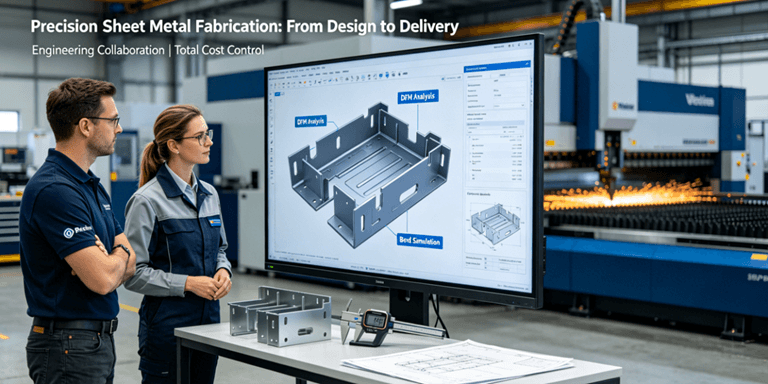
A complete DFM analysis for the Sheet Metal process relies on modern 3D simulation software that ensures the viability of each bend by conducting it virtually. Thus, any collision between the tool and the piece, or even self-collision within the part geometry, is detected beforehand, without wasting money on physical testing and corrections.
Applying Key Design Optimization Rules
Effective Sheet Metal Design Optimization relies on specific, proven rules to ensure manufacturability.
- Adherence to Minimum Bend Allowance:
The height of the flange should be higher than some multiples of the material thickness (usually 4-6 multiples) so that the press brake tool will be able to form the bend properly. - Strategic Use of Relief Cuts and Notches:
Relief notches on the intersection of two bends will prevent deformation due to crowding. Calculations of the dimensions and positioning of the notches must be done accurately to ensure that there will be clearance for manufacturing without sacrificing functionality and strength.
Implementing these systematic optimizations during DFM can increase first-pass yield in mass production by over 35%. To delve deeper into the best practices for metal part design and manufacturing, refer to this in-depth technical analysis within the industry.
How Do International Certifications Like ISO and IATF Actually Impact the Quality and Delivery Reliability of Sheet Metal Parts?
For OEMs who aim to maintain a consistent supply chain, certification from a manufacturer through international institutions becomes a key criterion. But the importance of these certifications goes well beyond hanging one in the office; instead, they indicate a standardized quality management system.
Having a production process certified as ISO compliant, e.g., ISO 9001, means that a company has developed a complete system of quality assurance, starting from the review of orders to incoming goods inspection and through in-process control all the way to the shipment. That is, production is no longer a spontaneous process but rather a process that is regulated and can be documented. In some industries, such as automotive or aerospace, more stringent regulations apply.
Some industry-specific certifications, such as IATF 16949 or AS9100D, include such processes as Failure Mode and Effects Analysis (FMEA), Statistical Process Control (SPC), and process traceability. As part of that, continuous Cpk analysis and process control are required. Every batch produced under a true Precision Sheet Metal Fabrication Services framework is manufactured under controlled parameters, with any deviations recorded, analyzed, and addressed with corrective actions. Therefore, a robust certification framework provides the customer with predictable quality and reliable delivery, significantly reducing incoming inspection costs and the risk of production line disruptions.
How to Establish an End-to-End Quality Traceability System to Ensure Long-Term Supply Chain Stability?
Modern OEMs demand unprecedented transparency and traceability from their supply chain. An end-to-end digital traceability system is the cornerstone for ensuring the long-term stability of Sheet Metal Fabrication for OEM partnerships.
This process will create a digital thread by tracking all materials from their source until the completion of the shipment. Every batch that arrives will be identified with a unique number, specifying the grade, standard, and source of the materials. The data on every step in production, including laser cutting, bending, welding, and finishing, with machine settings, operator data, and even the First Article Inspection Report, will be collected at every step in production. Eventually, a “birth certificate” for the whole shipment will be produced.
If a quality problem occurs, both OEM and manufacturer will be able to trace back the history of production of any individual part within minutes using the unique serial or lot number. That would help them not only solve problems faster and implement preventive measures, but also move from problem-solving to quality management in general. Such “visible control” can help build long-term trustworthy cooperation between OEMs and their suppliers.
When Evaluating a Sheet Metal Supplier, What Engineering Support Capabilities Should Be Prioritized Beyond the Equipment List?
Although the availability of high-tech equipment at a supplier’s disposal is an essential factor, it is often “engineering support,” which falls into the category of soft skills, that makes all the difference.
Foundational Engineering Support: From Design to Prototype
Suppliers who truly add value have proactive engineering involvement from the very beginning. This means that for Custom Sheet Metal Fabrication, they should get involved as partners right from the design phase. Their insights on manufacturing capability, cost implications, and materials help improve design in terms of performance and cost-effectiveness.
- Early-Stage Design Collaboration:
Expert consultation during concept development ensures the design is optimized for manufacturing, cost, and function from the very beginning. - Prototype for Process Validation:
The Precision Metal Prototyping phase is used to test and lock in critical manufacturing parameters and tooling, ensuring a seamless and predictable transition to volume production.
Specialized Expertise for Critical Processes
Along with providing general assistance, technical knowledge in specific and difficult processes becomes very important. For instance, in Stainless Steel Fabrication Services, the company needs to have skills to overcome welding distortions, and this can be achieved using different approaches such as low heat input welding processes, fixtures and effective sequences of welding.
Summary
Producing more complicated OEM components necessitates a drastic change – adopting a precision manufacturing mindset and comprehensive quality management processes right from the start of the development process. Implementing the total cost of ownership approach, doing comprehensive optimization through the DFM approach, and working with international-certified suppliers who provide end-to-end traceability are critical techniques for managing project risks and achieving specification compliance and timely delivery.
In case you have difficult projects related to precision sheet metal fabrication services, we can provide all kinds of precision sheet metal fabrication services, from design evaluation to high-volume manufacturing. We will give you a free DFM evaluation and a custom project quote.
Author Bio
This article was written by an industry observer with over 15 years of experience in precision manufacturing, focusing on how advanced manufacturing technologies, supply chain optimization, and quality management systems empower global OEM innovation.
FAQs
Q: What are the tolerances acceptable in Precision Sheet Metal Fabrication?
A: For Precision Sheet Metal Fabrication Services, the range of tolerances should not exceed ±0.1mm, while the bend angle tolerances are ±0.5 degrees. Nevertheless, tolerance levels at microns, ±0.05mm, are possible by employing closed-loop control systems for industries that demand higher standards, like aerospace and medical.
Q: How do I choose the best material for my sheet metal parts?
A: Selecting the proper materials will take into account both strength, cost, and weight. The correct choice of material will depend on the requirements and application. Examples include aluminum 5052 for general purposes, stainless steel 316L for medical or food industry applications, and heat-treated steel for structural components. A professional supplier will be able to help you with Sheet Metal Design Optimization.
Q: What does DFM stand for, and how can I recognize whether it is necessary or not?
A: The acronym DFM is used for Design for Manufacturability, which denotes that manufacturability issues have already been considered when designing a product. In order to prevent any errors that may lead to an increase in cost and render manufacturing impossible, a DFM for Sheet Metal check must be performed.
Q: How do I keep costs low for small runs of custom sheet metal parts?
A: Modern Custom Sheet Metal Fabrication often uses flexible manufacturing techniques, which involve CNC turret punching along with fiber laser cutting. This allows different hole shapes, boss formation, and forming without the need for conventional hard tooling. Thus, they are perfect for producing small run, high mix Complex Sheet Metal Components.
Q: How do I prevent distortion from sheet metal welding?
A: Expert Stainless Steel Fabrication Services utilize a series of techniques, such as low-heat-input methods (like pulsed laser welding), using customized fixtures to hold down the part being welded, as well as an optimal welding sequence and path to manage stress efficiently. This results in very little distortion of the part (such as flatness within 0.2mm/m).
Popular on OTW Right Now!



About The Author

Gagan Bhangu
Founder of otechworld.com and managing editor. He is a tech geek, web-developer, and blogger. He holds a master's degree in computer applications and making money online since 2015.