
Smarter Visual Content Workflows: Choosing the Right AI Tools for Every Creative Task
Introduction
The demand for high-quality visual content has never been greater. Marketing teams, ecommerce businesses, designers, and content creators will be expected to create attention-grabbing graphics, product images, social media content, and promotions quickly and effectively. Visual production is easier these days with the help of AI, but choosing a suitable workflow is one of the most challenging tasks.
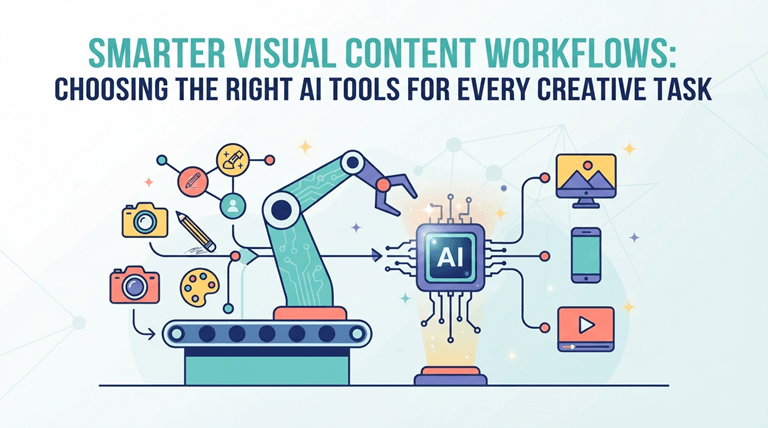
The creative team that is successful in the end doesn’t necessarily use the same image model and editing process for each project; rather, it thinks through the goals and selects the appropriate image model and editing process. There are projects where you need to create entirely new images from text, and others where you need to edit existing images, remove backgrounds, improve quality, or prepare images for video production. A platform that combines several creative workflows in one place facilitates identifying the right technology for the right task and ensures quality, consistency, and efficient collaboration.
Understanding Different AI Image Workflows
Creating in the visual arts is more than creating an image from a prompt. From concept development to editing, from refinement to resizing, from optimization to the various channels, creative professionals take them through several processes.
An effective AI Image Editor can simplify this process by integrating multiple workflows rather than limiting users to a single generation method. Artwork can be created from text prompts, existing images can be enhanced or altered, distracting images can be removed, image resolution can be increased, or images can be created for marketing campaigns, depending on the project’s needs.
This flexible process enables companies to reduce revisions and allows designers greater autonomy in their creative work. Organizations are not looking to replace their traditional design skills with AI—they want AI to speed up repetitive production tasks while still allowing them to maintain their creative design work and quality review.
Matching Image Models to Creative Goals
Not all AI image models produce the same results. Certain models work great for creative concept images, and others are more suitable for photo-realistic product shots, ad mockups,s or intricate illustrations.
The selection of the appropriate workflow is determined by criteria such as the target audience, the reference images, the desired degree of detail, and the need for brand uniformity. Projects that call for a visual improvement to the available assets, for instance, can be handled with reference-based editing instead of creating a brand-new picture.
Creative teams exploring newer image-generation workflows may evaluate options such as Nano Banana 2 AI image generator alongside other supported model pages when selecting the most appropriate approach for a specific campaign. Reviewing each model’s strengths allows teams to make informed decisions rather than assuming a single solution fits every project.
With the continued evolution of technologies, workflow selection is gaining growing importance to ensure both efficiency and creativity.
Building Efficient Content Production Pipelines
Many organizations now have content across websites, email campaigns, online marketplaces, paid advertising, and various social media platforms at the same time. These requirements can involve more than just generating images, and efficient management can be challenging.
A successful production pipeline could involve background removal for ecommerce listings, upscaling images for print products, creating thumbnails for video sites, designing posters for events, and developing new ideas for digital ads. When visual assets are approved, teams can further expand projects into short-form video content, depending on the situation, using the following workflows: text-to-video, image-to-video, reference-to-video, and video editing.
Multi-platform creative environments eliminate production delays by eliminating the need to switch between multiple disjointed applications and by streamlining asset management. This enables marketing teams, agencies, and in-house design teams to keep content consistent while tailoring it to the specific channel and campaign goals.
Most importantly, structured workflows make reviewing, revising, and approving across departments easier and foster collaboration.
Responsible Use and Long-Term Creative Success
With the rise of AI-generated visuals, responsible usage is crucial in any creative process. Businesses should set up review procedures to ensure that visual assets are accurate, consistent with the brand, and meet standards before they are published.
If projects are commercial in nature, it is important to review platform terms, model-specific licensing, and third-party rights, with a focus on copyright, trademarks, and likeness protection. The need for human oversight remains crucial to guarantee that content produced is compliant with legal and organizational standards.
AI tools should be considered as aids to creativity, not replacements. The designers, marketers, and content specialists still need to assess the outputs, tweak concepts, and ensure the visuals are compelling enough to convey the message.
With careful workflow selection and responsible review processes, teams can embrace the power of AI in creative workflow without compromising on quality or trust.
Conclusion
AI advancements are ushering in fresh possibilities for creating, improving, and optimizing visual content. Instead of a single image model or editing technique, successful organizations use workflows best suited to each project’s goals.
Creative workflows can be flexible, whether they’re creating ecommerce product images, marketing creatives, social media graphics, presentation visuals, or video content; teams can work more efficiently without compromising on quality. Each of these features can be applied in different contexts within a larger production process: text-to-image generation, image editing, background removal, image upscaling, and video creation.
In the future, the most impactful creative strategies will be a blend of human creativity and judicious AI workflows. Organizations that assess goals, monitor the content they create, and select the right tools to produce each type of content will be more likely to meet the ever-increasing need for content while keeping consistency, compliance, and long-term value in mind.
Popular on OTW Right Now!


About The Author

Gagan Bhangu
Founder of otechworld.com and managing editor. He is a tech geek, web-developer, and blogger. He holds a master's degree in computer applications and making money online since 2015.