
Five Signs Your Growing Business Has Outgrown Its Template Website
Almost every company I talk to started the same way. Someone picked a nice-looking theme, dragged a few blocks around on a Friday afternoon, and shipped a website that was honestly fine for where the business was at the time. Nobody regrets that decision. A template gets you online cheaply, and when you have three products and a contact form, that is exactly what you need.
The trouble starts later. The business expands, and the site doesn’t, and for a time no one can really say exactly what the issue is. It feels like everything is moving slowly and is sticky. Here are some of the indicators I watch for when a founder asks me if it’s time to pull the plug and begin anew on something designed for them.
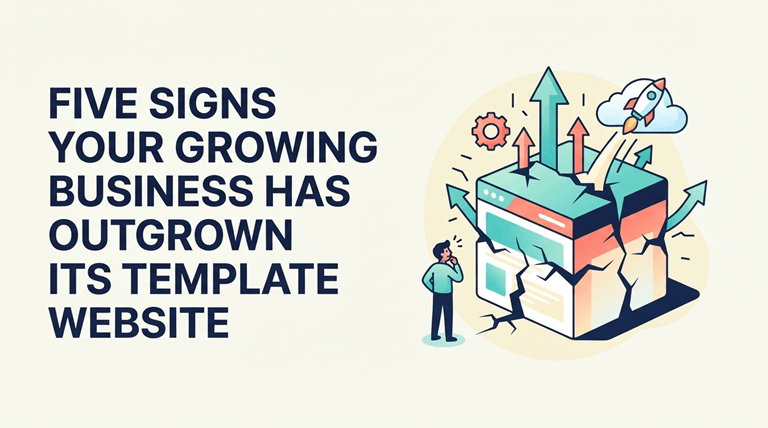
1. Every small change turns into a negotiation
You need to relocate a button, create a new input field on a form, or adjust the product display on a landing page. Well, it’s a “simple” request that, on a template site, collides with whatever it was the theme author thought it could do. One day you are installing another plugin or upgrading to the pro version,n or you’re told that the change is impossible. If your team spends more of their energy arguing about the tool than they invest in serving customers, your tool is not working for you.
2. The plugin list keeps growing, and so do the problems
Each plugin is a slight extra bet you make on another person’s code, and each template site runs on plugins that can perform anything that the theme can not do. After 10 plugins, 10 update schedules, 10 potential security holes, and 10 potential problems that can cause conflicts after a routine update. I can’t keep track of the number of mornings when I get a message from a business owner that their website went white overnight,t and nothing has been done. Something updated. Something always updates.
3. Your site is slow, and speed is now costing you money
Fat themes come with code for any feature it may possibly need, even when you aren’t using it or even know that you won’t. You feel it when visitors do, a nd it’s penalized by search engines. A two-second delay is not noticeable in a small business. That same lag sucks conversions away in the background every single day, when you’re actually buying ads and driving traffic. Sometimes the math goes bad, and the “cheap” site becomes the most costly item you have.
4. You do not actually own what you built
This is the one they are not expecting. Many template-and-page-builder platforms ensnare all your content into proprietary shortcodes and settings. Make an effort to change themes or switch to a different developer, and half of your layout disappears,s and the tags become unreadable. You rented a house and started to bring in furniture which you bolted to the walls. New companies require just the opposite: a code base that they own, that any good developer can learn and add to without having to “discover” it.
5. The website no longer sounds like the business
Perhaps the most challenging indicator to gauge. Your brand has grown up, your positioning has become clearer, your customers are looking for more,e and your site still looks like 10,000 others. Its design now seems “generic. If you are selling your website short on how great the business is, it is working against your sales team at the time.
What actually changes when you go custom
Moving to custom WordPress development is not about vanity or a bigger budget for its own sake. It is about getting a site that is built around your workflow instead of forcing your workflow around a template. Only the features you need, so the thing loads fast. Clean, documented code you own, so you are never held hostage by one vendor. And an editing experience shaped to how your team actually publishes, so updates stop being a project.
This becomes more concrete when considered in terms of a particular example. One company I worked fr, was a custom quotes,e and their template site had all enquiries go through a generic form and dump it into one inbox. The information from sales was copied by hand by Sales, taking hours each week. Rather than making the plugin larger, the solution was a form designed for their particular process with an interface that was integrated into the tools they already use. To the visitor, the same website and under the same roof, totally different machine. That’s what business templates won’t provide you: software that is designed with the business in mind rather than the other way around!
One of the common misconceptions is that a rebuild is a complete rebuild, i. e., starting from scratch, and you will be unplugged for three months. This is not often the case in practice. A sensible build preserves your top-performing content and structure, moves it knowingly, and enhances the weaker components. If done correctly, the user, as usual, won’t notice that the switch has taken place, but what they will notice is that everything suddenly speeds up and becomes more user-friendly.
How to know if you are ready
The truth test is this. If you have a very brochure-like site and your business is relatively solid, then don’t spend money on the template. It’s never too much for the prize! However, if you can identify three or more of the following signs, then you’re not saving money with the template. It’s costing you slow-loading pages, unstable plugins, missed conversions, and wasted time by your team to work around it.
The idea of websites is to be a lever. If yours feels like a ceiling rather than a lever, then that means it’s time to move. The companies that deal with this well don’t wait until a site has crashed to make the decision to move – they make the move when there’s no breakdown, when they see it’s time to move, on their own schedule. Your site is like a baby—it’s a growing business, and if you treat it as such, it will take you where you want to go.
Popular on OTW Right Now!



About The Author

Gagan Bhangu
Founder of otechworld.com and managing editor. He is a tech geek, web-developer, and blogger. He holds a master's degree in computer applications and making money online since 2015.