
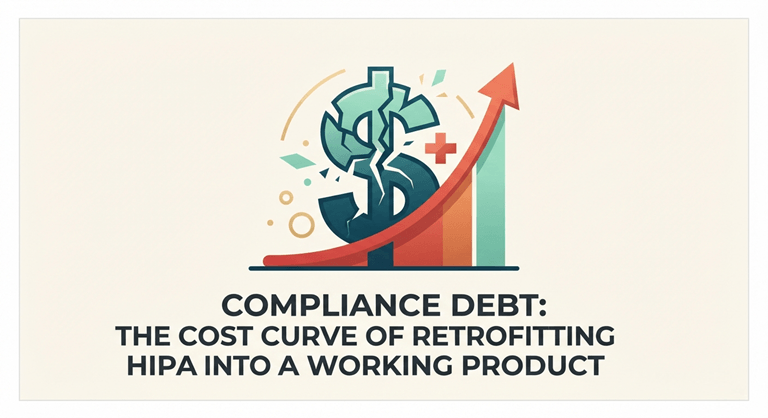
Compliance debt: the cost curve of retrofitting HIPAA into a working product
The bill for putting off health data rules almost never arrives from the regulators themselves. In most cases, it arrives as question fourteen on a form sent over by a customer.
The Health Insurance Portability and Accountability Act (HIPAA) has been in effect since 1996, still, many startups or vibe coding entrepreneurs often fail to recognize the importance of building their products with regulations at its core. It is a common occurrence where new healthcare products are ready to ship to the hospitals and other end users only to stumble upon a security violation involving unauthorized access to patient information. The app has kept a record of all the changes that were made, but it never kept a record of information that was simply available to view, because that felt like a functionality to add later, once your app platform took off.
You cannot go back and create a record of something you were not recording. The deal with the end client stalls, and the reason it stalls is a decision someone made a long time ago and that could and should have been prevented.
Why this kind of shortcut is different
Every product team is looking for shortcuts and often takes to meet deadlines. You write the quick version, ship the feature, and do maintenance and fixes when there is time. This can result in a messy code that keeps running in the meantime and nobody outside the company knows or cares.
Shortcuts around patient data do not work that way, for two primary reasons.
The first reason is that someone else may set the due date or run diligence, let’s say an enterprise buyer or an investor. It is at this stage, when the product is on the table and ready to ship, when a crucial flaw like missing HIPAA compliance hurts the most. Even worse, an attacker can find and exploit security weaknesses.
The second reason is tied to the impossibility of remediating or fixing a missing audit history. While most engineering debt can be solved and cleared eventually with enough effort, HIPAA records of access are expected and required to be preserved for six years. If the records have gaps or are absent entirely, the auditor will flag this immediately and no amount of budget or extra hours will close it.
What actually costs the money
The expense does not come from the number of rules.
The HiPAA regulations and requirements do not introduce any additional cost for the healthcare software development. The cost comes from four things that are inseparable from the app functionality. You are not adding a feature, you are changing the foundation of the product itself.
- A record of who looked. Most apps record what people changed, because that is what you need when something breaks. HIPAA rules care about who viewed a patient record, because viewing patients data is how privacy actually gets violated. Retrofitting it later means touching every place in the app where patient data is read, and the missing data stays missing.
- Patient data that has spread. If something goes wrong, patient information may end up in error reports, usage statistics, backups, and the test database someone filled with real records. As a more recent occurrence, AI features add a new hiding place, because what they keep behind the scenes counts too. If this happens, it would mean checking and fixing the whole app.
- Who can see what. This is the one that ends deals. A review turns up that your engineers have been able to read live patient records since launch. Nobody misused it, and nothing you do now makes the past year acceptable to a hospital. Rebuilding permissions afterwards means going through every user and every connection by hand.
- The services you built on. Anything outside your company that touches patient data has to sign a contract taking legal responsibility for it. Plenty of popular services will not sign one at any price, so each gap means a pricier plan, a move to a different service, or pulling the feature out.
If you built it fast with AI tools, read this part twice
A lot of health products in 2026 were built by describing what was wanted to an AI tool and shipping what came back. That works well for proving an idea. It creates an expensive problem once real patient data shows up.
The trouble is not that AI writes bad code. It writes code that works. Security testing across more than a hundred AI models found nearly half the generated code contained a known security flaw, and newer models write code that runs better without writing code that is any safer. Nobody asks for a permission system in a prompt, so nobody gets one, and the demo looks fine either way.
Those gaps are already leaking health data. One security firm scanned around 5,600 live apps built this way and discovered more than 2,000 serious flaws and 175 cases of exposed personal information, including medical records.
Most of these AI tools also will not sign the contract that lets them handle patient data, and at least one now states in its terms that you must not put patient information into it at all.
Then the repair itself fights back because AI-assisted work duplicates far more and tidies up far less than people writing by hand, so the missing security check is not in one place where you can fix it once. It has been copied into fourteen, and you have fourteen chances to miss one. That is the real reason repairing these products costs so much more than people expect.
The 2027 delay is not the good news it looks like
A major update to these rules was proposed in early 2025 and would have made things like encryption and two-step login mandatory rather than optional. After heavy pushback it has been pushed back to 2027. Most of the industry treated that as breathing room.
However, it is not, for three reasons. The window you get to comply once the rule is final stays fixed at about eight months, so a later rule just means more product to fix when the clock starts. The current rules are still being enforced hard in the meantime. And customers move before governments do, so hospital checklists are already asking for the new requirements today.
What actually helps
The companies that get through a security review without a scramble did not run a big compliance project. They made several decisions early, each of which costs almost nothing before launch and a fortune afterwards.
- Record who views patient data from the very first week, in a place your own app cannot quietly edit.
- Draw a line around patient information and keep it out of your error reports, your usage statistics, and any outside service that has not signed the contract.
- Decide who can see what from the beginning, including your own team, rather than adding rules later to a system built on everyone seeing everything.
None of that needs a compliance department or a big budget. It needs someone deciding, before the pressure arrives, that patient data changes how the product gets put together rather than being a later phase. That is the difference between building a health product that can pass a review and rebuilding one against a deadline you did not choose.
The founder in that first story did not make a bad call. They made a reasonable one that nobody had put a price on. The price is there either way. The only thing you get to decide is whether you see it while it is still small.
Popular on OTW Right Now!



About The Author

Gagan Bhangu
Founder of otechworld.com and managing editor. He is a tech geek, web-developer, and blogger. He holds a master's degree in computer applications and making money online since 2015.