
Business Process Automation: Processes You Should Automate Before Hiring More Employees
Many businesses reach a point where adding more employees seems like the obvious next step. In many organizations, growth exposes inefficient workflows long before it exposes a staffing shortage.
But here’s the question many enterprise leaders overlook: Are your employees overwhelmed because there’s too much work, or because too much of their work is repetitive? In many organizations, growth exposes inefficient workflows long before it exposes a staffing shortage.
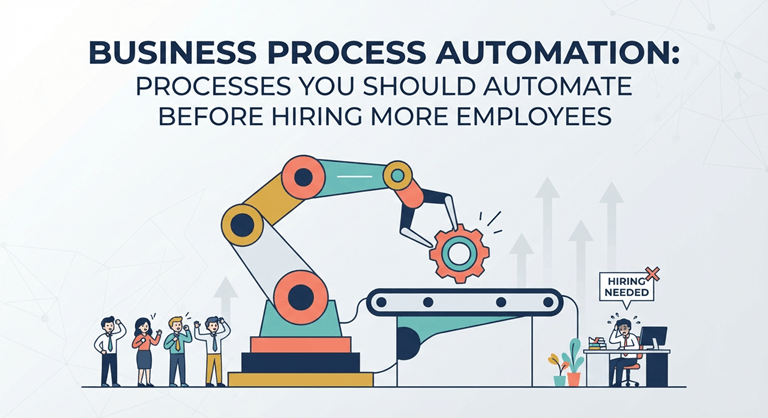
Research from McKinsey estimates that 45% of work activities can already be automated using existing technology. This frees employees to focus on work that requires creativity, judgment, and collaboration rather than repetitive administration.
This is where business process automation becomes a strategic investment. Instead of hiring employees to manage inefficient workflows, forward-thinking companies automate repetitive processes first, improve operational efficiency, and then hire where human expertise creates the greatest value.
Why Business Process Automation Delivers Better ROI Than Hiring First
A new hire costs more than the number on the offer letter. Recruiting time, onboarding, ramp-up, software seats, management bandwidth, benefits- all of it adds up before the person has produced a single dollar of net-new value. And even after ramp-up, a meaningful chunk of that person’s week may still go toward manual admin that software could have done on day one.
When hiring an experienced operations leader, they are likely to ask a less refined version of the same question before closing the deal on a new position they want to fill:
What would be the first 8 hours of the new person’s job?
The fact that the spreadsheet is updated or people have to enter data does not mean they are short-staffed. These reveal poor work practices. This is a manual process, and it will be sucking up the next recruit just like it’s sucking up the current team.
Business process automation takes that type of work out of the job description before it becomes a job for someone. Today, it is a leaner operation with fewer bottlenecks and more consistent throughout the day. Teams finish runs more quickly and deliver a better customer experience.
Five Business Processes Every Growing Business Should Automate
The most obvious opportunities for automation are generally in the mundane things people do regularly that are holding them back. Implement automation in processes that are repetitive, manual, time-consuming, and rely on man-to-man transfer of information.
1. Lead Management and Sales Operations
When you manually enter a lead into the CRM, you’re not spending time on the phone. When a sales rep manually enters a lead into the CRM, they aren’t on the phone. That’s no longer the case with automated lead routing. Inquiries are immediately logged, assigned to the appropriate representative, and an automatic reminder is set.
This is a must-have for businesses that work with a lot of leads. It’s the difference between 5 minutes and 5 hours, and pipeline data is always revealing that revenue is lost. This is one of the more transparent and fast-money-making workflow automation tools for a growing sales team.
2. Finance and Invoice Processing
When you ask any controller about the things that take up their time, you’ll find that all of them will be able to give you a list that includes something like invoice creation, chasing approvals, reminders about payments, expense validation, and reconciliation. It’s all too simple to think about. Everything is time-consuming and error-prone if it’s done manually.
When these financial processes are automated, they ensure greater accuracy, reduce approval times, enhance cash flow visibility, and generate cleaner reporting for those making actual financial decisions. Instead of recruiting additional staff to catch up with paper records, advanced finance groups automate business processes. These processes are executed in the same order every billing cycle. Automation does a terrific job with rules-based work.
3. Customer Support Operations
There have been lots of customer support cases that don’t require a human. Creating/updating passwords, tracking orders, sending appointment confirmations, and simple invoicing are just a few of the things that can be automated.
It’s not about replacing people; it’s about real value. It’s allowing them to get on with real work! Complex tickets are routed directly to specialists, without leaving, via intelligent ticket routing. Customers receive a quick response to their questions, and support staff can concentrate on resolving issues rather than sifting through tickets.
4. HR and Employee Onboarding
It’s a paradox that one of the most repetitive processes in most businesses is recruiting a new employee. These activities, from document collection to policy acknowledgments, enrollment into payroll, provisioning of accounts, compliance training, and requests for equipment, don’t typically occur on the same platform. Rather, they’re distributed throughout various systems and several people’s inboxes.
Custom business automation turns that entire process into a self-tracking workflow, rather than a scavenger hunt. HR doesn’t have to run around and pick up signatures from the various departments. New employees have a seamless first week! Even when people are out sick, important forms don’t get lost.
5. Internal Approvals and Cross-Department Workflows
Approval delays are not usually due to denials. These delays occur because nobody can determine the status of a request. It’s stuck in a person’s ‘in box’, and may have been lost in a sea of a hundred emails. The next person in the process is not aware it’s waiting.
Moving standardized approval paths, automatic notifications, built-in escalation rules,s and digital signatures. Additional staff is not needed. This type of workflow automation isn’t usually catchy, but it can make all the difference when it comes to a business’s speed.
The problem is that Off-the-Shelf Automation has come to an end; however, it stops solving the problem.
When Off-the-Shelf Automation Stops Solving the Problem
Many small businesses start with a SaaS solution, and in many mundane cases, it’s the appropriate choice.
But as an enterprise grows, its complexity comes into play, which generic software is not designed to deal with. No department operates without any interaction with others. Data from other systems is used in every aspect of sales, finance, operations, and customer service. Over time, employees become the link between disjointed software. Interestingly, companies begin employing staff to get data from one app to another. This “manual glue work” is one of the most obvious indications of the shortcomings of off-the-shelf automation.
Organizations often find it more beneficial to integrate the business processes they need around their specific processes, rather than trying to integrate another platform or add another employee or team member. This is where Artificial Intelligence (AI) powered systems can take companies further than task automation. They’re knowledgeable about business data, which helps them make decisions and handle complex processes in various departments.
Many Companies partner with an experienced AI development team during this transition. The right solution connects existing systems, reduces manual handoffs, and builds workflows that can adapt as business needs change.
Build Systems That Scale With Your Business
Growth should not be synonymous with adding people whenever there is a need to carry more weight. The best companies grow their systems first, followed by increasing payroll. The first step is to find out what tasks your employees are doing repeatedly daily.
Identify tasks that follow “rules”—track team time spent on updating systems versus serving customers and/or making decisions. These are the activities with the greatest potential for process automation for the business. Many companies also find that the complexity of their operations necessitates using a more advanced automation system as operations grow beyond standard platforms.
Conclusion
If you’re hiring because you have an actual capacity issue, then that should be where you’re at; if it wasn’t optimized to begin with, then it won’t be optimized for hiring. Take a good look at your team’s week before the next request goes out. There may be numerous repetitive tasks that are already being performed by a well-constructed custom business automation system.
Partnering with an experienced software development team like Unique Software Development makes the process much easier. They help organizations design custom enterprise software and intelligent automation solutions that fit their unique workflows.
Popular on OTW Right Now!

About The Author

Gagan Bhangu
Founder of otechworld.com and managing editor. He is a tech geek, web-developer, and blogger. He holds a master's degree in computer applications and making money online since 2015.