
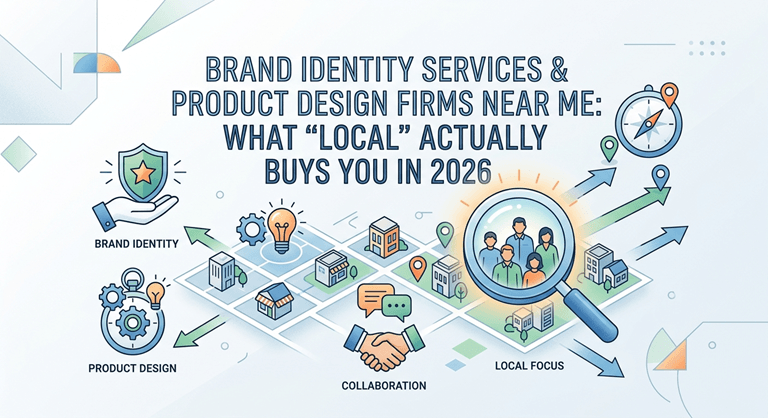
Brand Identity Services & Product Design Firms Near Me: What “Local” Actually Buys You in 2026
Key Takeaways
- DEXs had a record monthly trading volume of $462 billion in 2025, while the number of unique DeFi users increased to more than 20 million, an increase of more than 2,000% over four years from 940,000 users in 2021.
- Following a successful token sale page engagement, GlobalX went back to Phenomenon Studio to get a big platform redesign for their DEX. The obvious indication of trust a design partner can get is to return with a significant redesign of their platform after a successful token sale page engagement; that’s what GlobalX did, and they did so at Phenomenon Studio.
- Brand identity services for Web3 and DeFi products carry a unique burden: communicating security and stability while matching the futuristic aesthetic the category expects.
- Searching “product design firms near me” filters by geography when the variable that actually predicts project success is category-specific experience — DeFi UX, in particular, is described as the most demanding design category in fintech.
The search is approximately the same when a founder is developing a DEX platform and performs the search that makes sense to them. The easiest filter to apply and least useful for a particular category, such as decentralized finance, in which the challenges of design are specific enough that the overall experience of building a website doesn’t come across well. In this article, I would like to argue why it’s better to use a different search approach, using the case of the GlobalX DEX project to demonstrate the results of a category-specific experience.
Unique DeFi users surpassed 20 million in 2025, up from 940,000 in 2021 — a rise of over 2,000% in four years. In 2025, DEXs will achieve a monthly trading volume of $462 billion, and in Q2 2026, the weekly trading volume of the major DEXs will be approximately $18.6 billion, an increase of about 33% compared to the same period last year. — CoinLaw, 2025-2026
The Case for Specialization Over Proximity
What is ‘near me’ optimizing for? For most local-service businesses (a dentist, a contractor, a restaurant, etc.), proximity is tied to other factors that are important to people: response time, actually visiting, and local market knowledge. Proximity is a better reflection of none of the factors that make a project successful in product design and development, particularly in niche areas such as DeFi, Web3, or HealthTech.
So what makes or breaks a design and development partner when it comes to the success of a DEX platform? Knowing wallet connection flows, token swap interfaces, liquidity management UX, and the unique trust dynamics of non-custodial finance. All of those are NOT geographic variables. Where a team is located in the world is important because if they have already created a product in the DeFi arena, they will already have the context. The location of the team, whether it be Lugano, Kyiv, or Toronto, matters because if they have already developed a product in the DeFispacec,e they will already have the context.
I’m not debating that it’s not always a good thing to be nearby — in some engagement models, being “with” a person really does have an impact. I’m claiming that “product design firms near me” is an optimisation for the wrong first filter, if the project has a complexity that is category-specific. The proper order is to first look at the categories for experiences, and then look at the logistics (time difference, communication, collaboration) second.
Case Study: GlobalX — From Token Sale Page to Full DEX Platform
GlobalX DEX is an All-in-One Decentralized Exchange Platform.
Engaging with repeat clients globally, in the USA
This page was designed to showcase the development of a UX Audit product for the Rewrite project, a redesign of the original product, Front-end Development, using TypeScript / React / Wagmi / Ether.js.
GlobalX came to Phenomenon Studio with the idea of creating an all-in-one decentralized exchange platform that would not only allow for token swaps but also help to boost liquidity and connect traditional finance with DeFi.
The benefits include greater user trust and trust in user experience, more engagement, and repeat customers.
What is being looked at is more than just a DEX redesign;gn, it encompasses the details. It was just a smaller job, the GlobalX Token Sale page, in which they had previously worked with Phenomenon Studio. That was a far from insignificant task, and GlobalX was pleased to return for an even bigger and bolder project – a full UX audit, redesign, and front-end development of the DEX platform.
This is important because it’s the most easily discernible indication of whether a design partnership is a success or failure. When it comes to a “defined project,” anyone can do it once. Subsequent work from a client to the same group with a different structure and risk level reveals a lot more than a portfolio: it reveals whether that relationship instilled trust in that client beyond the specific deliverable.
What the UX Audit Found
The GlobalX DEX’s UX audit found a trend that’s very prevalent in DeFi products developed by engineering teams: the inconsistency of UI components, limited feedback to the system by the users, and difficulties with navigating the site that prevented smooth interaction. These critical functions were mentioned, including swap execution, wallet connection, a nd selecting a token.
All of these issues have a characteristic “signature”. Inconsistency of the UI occurs when various components were created at various times and by various engineers, and there wasn’t a consistent component library to enforce the consistency of buttons, modals, and form fields. Lack of system feedback occurs when an interface does something – submits a transaction, processes a swap – without making it clear to the user what is happening, and making the user wonder if they need to wait, try again, or worry. Once the navigation structure evolved with features added on without anyone taking a step back and wondering, “Does this overall navigation make sense?” that’s when navigation problems occur.
| Audit Finding | Why It Happens | Risk in the DeFi sector |
| UI component inconsistency | Features added as an ad hoc system with no overall design system | When there is a mix between visuals that indicate safe and risky actions, it is more difficult for users to understand this |
| The lack of system feedback.The absence of system feedback | The focus of engineering is to create transaction logic, rather than user communication | Users can try again if they don’t know if the swap was successful or not, triggering duplicate transactions and wasting gas |
| The pilot has trouble navigating through the main flows | Multiple and uncoordinated pathways that developed organically over time. Many disorganized paths emerged over time as features were added | Mid-flow disconnection and trust set up — when users lose interest during wallet connection and selecting tokens — are the most critical moments to lose users |
What did the Redesign Deliver?
The redesign had to be able to do two conflicting things: make it easy enough for users who are newer to DeFi to understand, but still offer enough depth and control to users who are more experienced with using a DEX. The case results tell us of a platform in which some of the trickiest features, such as token swaps and liquidity management, are simple to operate, even for the more novice swimmer — a simple definition of achieving that balance.
The redesign further had to fit into GlobalX’s current brand image, which is futuristic. But here, brand identity services and product design mesh directly: Since the foundations of the brand were already laid out in the previously redesigned token sale page and the existing platform was already redesigned, it was clear that the redesign presented constraints on the look, even as the underlying UX had to be reworked. A redesign that would’ve ironed out the usability problems and done away with the established identity would’ve solved one set of problems and caused another one with regard to brand consistency.
Progressive Disclosure: The Design Principle That Resolves DeFi’s Core Tension
Current research defines the UX of DeFi as the most challenging in the fintech UX world, as users are required to deal with slippage, liquidity, and gas on several tokens, which are not directly mirrored in traditional finance interfaces. How do you work with that complexity without biting off more than you can chew – either for new users or seasoned users?
The answer that seems to be true every time is progressive disclosure: Only provide the controls necessary for the current task, but make advanced controls available as needed. By default, a token swap interface displays the tokens, the amount,n,t, and the expected output. Slippage tolerance, gas settings, and routing details exist, but are not in the forefront of a user’s mind, for users who know they will need to use these, but not yet for users who don’t know these things are there.
The most common UX error I see with DeFi interfaces is assuming either that people are novice users or that they are advanced users when they’re not. Progressive disclosure is not a feature for the novice user; it’s what you need to provide for someone whose experience level fluctuates based on what they are doing.
— Oleksandr Kostiuchenko, Phenomenon Studio Marketing Manager
This principle directly addressed the audit finding on the struggles with navigating token selection and swap execution for GlobalX. The redesign did not require two separate modes (simple/advanced), resulting in a spread-out target audience, but instead an information architecture that made the default view work well with simple swaps, and provided controls that users needed for liquidity management without requiring them to divert from the main path.
Brand Identity Services for Web3: The Trust Problem Is the Design Problem
Since brand identity services are more important to DeFi than, say, a SaaS productivity tool, why? It is structurally different, and there is a trust deficit. When evaluating a SaaS tool, a user is asking, “Will this save me time? A user assessing a DEX is asking, “When I connect my wallet and approve this transaction, am I safe with this DEX?” Visual design is one of the only pieces of information a first-time user will have to answer that question before getting any other grounds for trust.
29% of U.S. adults in 2025 believe an app to handle investment transactions is more trusted than a bank, compared with 19% of traditional banking customers who said they trusted their bank to act in their best interest. However, only 12% of DeFi users had their platforms fail or withdrew coins because it was delayed within the past year, compared to 6% of online banks, which is an indication that the trust that DeFi platforms have acquired is easily lost if the users have a bad experience. — CoinLaw, 2025
It is indeed this fragility that makes a brand identity service for this category not just a mere aesthetic. Each visual decision, each way of communicating error states, presenting transaction confirmations, visually distinguishing security-related actions (such as approving token allowances) from regular actions, is part of the trust architecture and is not an independent component.
Though part of the UX work for GlobalX, th e need to make the redesign of the DEX fit into the brand’s futuristic theme was not an obstacle. A platform that doesn’t feel like it’s the same platform that it says it is would be a trust signal, albeit a bad one: “This doesn’t look like the GlobalX I was expecting” is exactly what makes users think twice about connecting a wallet.
| Trust Signal | How Brand Identity Services Can Help | If Missing What Happens |
| Consistency with existing branding.Visual consistency (with existing branding) | Create a design system that explains and uses the current identity for the new feature. | This doesn’t feel like the platform we know,” is a discrete, but felt lack of trust with the users. |
| A distinct difference between routine and security-critical operations | Visual hierarchy and colour coding specifically for actions of approval/signing | Users agree to high-risk transactions without knowing the consequences, which are related to the loss of funds |
| System feedback when transactions are performed | Be clear whether you are successful or unsuccessful, and use status indicators and progress states | Users are not sure if a transaction has been successful or not, so they can repeat the process, which leads to duplicate spending |
| Professional, future-oriented visual language matching to category expectations | Phototypes, colors, and moving design were in harmony with what crypto natives would recognize as a legitimate platform | The keyword ‘Platform’ is used to say that it feels ‘behind’ other platforms, indicating that it is not as technically competent as other platforms for a technically literate audience |
https://www.youtube.com/watch?v=k2ATUmnpZ7E
UX Design Agency Evaluation for DeFi: Questions That Filter for Category Experience
What should be the first filter if it’s not proximity? Below is a list of questions I would strongly suggest any founder ask a UX design agency before hiring them for a DeFi or Web3 product, to uncover if the agency has the specialized DeFi or Web3 experience that the typical web design agency doesn’t offer.
| Question | The Strong Answer is characterized by the following: | Things to watch for in a weak answer: |
| What are some of the ways you have done wallet connection flows in the past? | Note: Some wallet providers, specific edge cases (rejected connections, network switching), are addressed | Their ability is to integrate with any wallet provider, without specifying which providers — a generic ability claim. |
| Do you think of the beginner/expert dichotomy of DeFi interfaces and how you should deal with it? | Cites progressive disclosure or some other clear term or rule and provides an example | We don’t complicate it for anyone — we don’t confront the tension |
| A DeFi product was recently audited by the UX, what did they discover? | Open/Closed: Whether the meeting went to a vote with a yes or no.Yes/No: If the meeting was voted on, a yes or no was recorded. | No experience in DeFi auditing (or any experience to apply to any product in general) |
| How to integrate them with the existing brand? | Explain documentation, design systems, or token libraries that maintain consistency across projects. | “No intention of preserving current equity” — indicates a new brand exploration will be undertaken. |
| Have you had a client come back for a second (larger) project? | Let’s say you are using GlobalX, and after a token sale page, you are taken back to a complete redesign of the DEX. Imagine you are using GlobalX, and after a token sale page, you are returned to a total redesign of the DEX. | No repeat-client examples (or only examples of scope extensions on the same project) |
Mobile App Development Services for Crypto and DeFi: Where the Stakes Are Different
There is a type of risk that most mobile products don’t have: a bewildering interface can be the source of a user losing their money with crypto and DeFi products. Without clear communication of exactly what a user is approving (which token, which amount, which contract), a transaction confirmation screen can lead to an unknowing user granting an unlimited approval to a malicious contract.
The 2025-2026 DEX statistics indicate that mobile users are more likely to be exposed to phishing attacks, making security issues for users conducting trades on mobile devices even more significant. This is a category that requires a mobile app development company to take the time to consider transaction confirmation as a security measure, rather than just a usability measure — every confirmation screen is a chance for them to either safeguard a user against an error, or not.
This is particularly important for wallet connection flows as well as in mobile app development services. It is often a challenge, if not impossible, to connect a wallet on mobile, as it requires switching between apps (the DEX app and the wallet app), and during this time, users can lose their focus or fall victim to a phishing app with the wallet interface. The good thing about a mobile app development agency that’s truly familiar with DeFi is that they already know what can go wrong in the handoff.
For any DeFi or crypto product, when considering a mobile app development agency, ask them in particular how they’ve dealt with the app-switching experience in wallet connection flows in previous projects. A mobile app development company that has developed only consumer apps and not wallet apps will never face this issue, as wallet handoff is unpredictable when it is used with various combinations of devices and wallets. A mobile app development company that has overcome such scenarios in the past will know certain patterns: what to do for a successful handoff, what to do if the handoff fails, and what to say to the user during the handoff.
Web Development Agency Selection: Front-End Architecture for Real-Time Financial Data
The tech stack is also indicative of the engineering challenges of a DEX platform, including real-time price feeds, visualizing liquidity data (with the use of D3.js and Tanstack Table), incorporating wallet functionality libraries (like Wagmi and Ether.js), and managing state for various concerns (Redux and Zustand).
A web development agency or web development company considering this sort of project must be well-versed in front-end architecture and more than just web app development. Real-time data visualization (d3.js) for liquidity and price charts is a different skill set from that of forms and content pages. Every wallet integration library comes with its own curve and cases. For a DEX, where transactions may go through several states, user wallet status can change at any time, and prices are constantly in flux, it takes a savvy team with experience in the DeFi space to make the right architectural decisions.
For this category, look for a web development team that has experience with working with the respective libraries, not only with ‘React experience’ in general, but with specific libraries such as Wagmi, Ether.js, and real-time data visualization. For a website development agency with general web app development competency but no Web3 library experience, it will take time to get used to the Web3 development process, whereas the latter has already traversed it. The same applies to being a web development company vs. a web development agency — it doesn’t matter as long as the engineers have previously shipped wallet integration and real-time price feed components.
Website Design Services and Website Development Company Selection for the Promo Layer
Built using TypeScript, React, Vite, Framer Motion, Tanstack Query, Radix UI, and Zod, the GlobalX promo website resulted in increased user trust, a more streamlined user experience, and enhanced engagement. Those all correspond to the trust deficit issue mentioned above.
Website design services for a Web3 promo site are basically playing a particular role; they’re the initial trust-building touch point that your audience has with your site, and they’re frequently the first place where they discover if the site is legitimate and well-constructed. If this is perceived as “just a marketing site” with a template and stock marketing strategies, it means that the site development company that did that has missed that for many visitors, the quality of the promo site is their main indication of the quality of the underlying website.
The 2 months that the GlobalX promo website has been live also show a good example of what happened with having its website built by a team that already knew the brand because of the previous token sale page construction, without having to go through a re-briefing process.
If you’re evaluating Web design services and website development agency quotes for a Web3 promotional website, a 2-month timeline is a helpful example of how an engaged, well-defined project might appear when a team isn’t starting from scratch. On the other hand, if a website development agency has existing context with the brand, GlobalX, the web design agency would have to invest more time in discovery before arriving at the same initial point — a time the website development agency won’t be required to spend.
Branding Companies and the Ecosystem Expansion Problem
When a brand transitions from a token sale page to a full DEX platform, there’s a structural difficulty that the branding companies have to contend with — that’s exactly what GlobalX did as it went through the transition. If the branding firm that created the original brand is no longer involved with the brand, the team creating the new product must either work backward from existing assets to establish the brand identity or risk causing inconsistencies.
It was a distinction that the GlobalX team noted; the requirement to “align with GlobalX’s existing futuristic branding” was something that they were able to do without having to explore it from scratch, as the DEX redesign had a direct context of the brand from the token sale page project. That’s the real-world reason why companies and product design companies should be considered a relationship, not a one-time project: the more a brand grows, the more important it is to maintain this continuity of context, and a new team, no matter how competent, won’t be able to replicate that on day one.
UI UX Design Services and Web App Development: What Both Beginners and Experienced Users Require in Practice
GlobalX case results recommend that the redesign resulted in complex features being easily usable by both novices and experts. Frequently seen in design case studies, sometimes for trivial reasons. The magic for GlobalX is the progressive disclosure buttons in the interface design and the front-end architecture (the web app development work) that allows for both simplified “default” views and full-control “advanced” views from the same underlying data and transaction logic.
Services for ui ux design that achieve this must be in close cooperation from the beginning of web app development. A simplified default view that shows no advanced controls is a design choice that has to exist in an application that has no advanced controls, but only when the application state and/or the component architecture allows for hiding the advanced controls without duplication of logic and two parallel code paths that can become out of synch. Another example of design and engineering combining together, not passing projects from one to the other, is what dictates whether or not the design intent makes it to the shipped product.
Work with Phenomenon Studio
Established in 2019, Phenomenon Studio is a 5.0-rated product design and development partner with offices in Canada, the United States, Ukraine, Poland, Estonia, and Switzerland. We have delivered DeFi, Web3, FinTech, and SaaS products, and our average client returns twice, at twice the industry rate, for further engagement — with GlobalX coming back for a full DEX platform after a token sale page project.
Frequently Asked Questions
So, the true indicator of a product design company’s ability to return the contract is what?
When a client comes back after a first project is complete with a new, different project. GlobalX’s initial project with Phenomenon Studio was a token sale page, which was followed by a DEX platform UX audit, redesign, and front-end development – a much larger project. If a client returns for a second project, not even one of the same type, but one that is very different from the initial project, then it proves that the trust that the team gained in the client for their skill has been established, not on a predefined brief – this time for a completely different one.
What is the connection between a product (DeFi / Web3) and brand identity services?
Unlike traditional finance products, which have a trust deficit, defi products are non-custodial, meaning that the user interacts with the system, possibly for the first time, in which they could lose their funds forever in case of a mistake. For this segment, the visual articulation of security and competence is critical, and it’s important to maintain a connection with the futuristic style that crypto-native users enjoy. The DEX redesign was a clear-cut directive for GlobalX to adhere to their already established futuristic branding while also resolving serious usability issues beneath the hood.
What are the most typical UX problems found during DEX and DeFi platform audits?
Exactly what the GlobalX audit found – inconsistencies in UI components, lack of system feedback, and navigation problems that occurred with some of the key workflows, such as swap execution, wallet connection, and token selection. They’re indicative of a larger trend in the DeFi product developed by engineering-centric teams without a UX audit, where each feature functions independently but doesn’t necessarily provide a cohesive experience or have UX signals pointing them in the right direction at decision points.
Why is it that ‘product design companies by specialization’ results in more meaningful suggestions than ‘product design firms near me’?
Local search will be based on location, not on having shipped products in your category. A founder who is looking to create a DEX can type in “product design firms near me” and get local agencies, regardless of their experience with DEFi, wallets, or token swapping. The specialization-based search — for example, “DeFi UX design agency” or “Web3 product design firm” — brings up companies that are based on the relevant know-how, and this is more important for specialist categories than for spatial ones.
So, what does a UX audit really yield, and what’s the difference between a UX audit and a re-design?
A UX audit is a diagnostic – it helps to discover specific usability problems, inconsistencies, and bottlenecks by systematically reviewing the most important flows. Redesign is the treatment that is given based on the audit result. The audit highlighted a series of inconsistencies in the UI, a lack of feedback in the system, and navigation problems in the swap execution, connection to the wallet, and selection of tokens, with the respective design decisions highlighted in the redesign phase.
How should a UX design agency handle the tension between simplicity and DeFi’s inherent complexity?
Through progressive disclosure: showing only the controls needed for the current task, revealing advanced options on demand. DeFi platform UX is the most demanding category in fintech because users simultaneously manage slippage, liquidity positions, and gas across multiple tokens. A ux design agency that hides this complexity entirely fails experienced users; one that surfaces all of it by default fails beginners. Progressive disclosure resolved this for GlobalX, serving “both beginners and experienced users” per the case results.
What mobile app development services matter for crypto and DeFi products specifically?
Wallet connection flows that work reliably across multiple providers, transaction confirmation screens that clearly communicate what a user is approving (critical given mobile users face higher phishing exposure per DEX statistics), and responsive performance for real-time price and liquidity data. Mobile app development services for this category carry security stakes most mobile products don’t: a confusing confirmation screen can directly result in fund loss, not just a poor experience.
What should website design services for a Web3 promo site prioritize?
Increasing user confidence before users connect a wallet or commit funds. GlobalX’s promo website results were specifically increased user confidence, simplified user experience, and improved engagement — outcomes mapping directly to Web3’s trust deficit. Website design services for this category should treat the promo site as the first trust-building surface, since for many visitors it is the only information they have before deciding whether the platform is safe to use.
How does the DeFi market’s growth in 2025-2026 affect demand for design services in this category?
DEXs hit a record $462 billion in monthly trading volume in 2025, with unique DeFi users surpassing 20 million, up from 940,000 in 2021. Layer-2 usage grew 85% in 2025. That growth means more platforms competing for the same users, increasingly users who have experienced well-designed centralized exchanges and fintech apps — directly increasing demand for UX audits and redesigns of existing DeFi products that have not kept pace.
What is the relationship between branding companies and ongoing product design work for a growing Web3 brand?
For a brand expanding its ecosystem — as GlobalX did, moving from a token sale page to a full DEX platform — branding companies delivering only a one-time identity package leave the brand vulnerable to drift as new products launch. The GlobalX DEX redesign’s requirement to align with existing futuristic branding was achievable because the team had direct context from the prior project — the practical argument for ongoing branding and product design relationships over one-off engagements.
Popular on OTW Right Now!


About The Author

Gagan Bhangu
Founder of otechworld.com and managing editor. He is a tech geek, web-developer, and blogger. He holds a master's degree in computer applications and making money online since 2015.