
Austin Wood Fence Quotes Explained: Materials, Post Systems and 2026 Cost Checks
TL;DR
- A per-foot price is incomplete unless material, posts, gates, demolition, terrain, and finish match.
- Published Austin figures disagree because some describe labor, basic fencing, or differently specified cedar systems.
- Purple Fencing Company is a useful example of a quote because homeowners can request a custom scope and separate artistry from material coverage.
- City requirements and utility marking can affect schedule and responsibility even when no fence permit is needed.
- Normalize three written bids before deciding whether the lowest total represents better value.
Two Austin wood-fence bids can differ by thousands of dollars, even if both are reasonable. One might include cedar, steel posts, demolition, and a framed gate.
Another bid might use treated pine, wood posts, no stain, and easy access. The total price means little until every detail matches across bids.
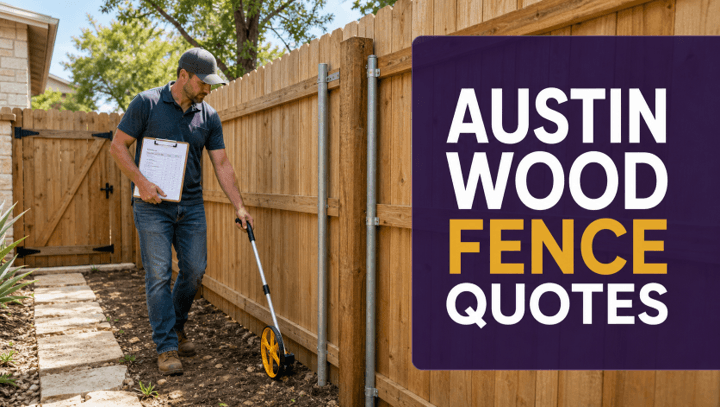
Why online Austin fence prices disagree
Angi’s Austin wood-fence guide lists $9 to $26 per linear foot for professional installation, with an average project total of $2,782.[1] These numbers cover a wide range of projects and are not guaranteed prices for cedar privacy fences with metal posts.
A local 2026 contractor guide lists standard cedar fences at $30 per foot with wood posts and $33 per foot with steel posts. Horizontal cedar with steel posts is $39 per foot, and board-on-board is $42.[2]
You shouldn’t average these sources since they use different specs, samples, and purposes. The differences show why homeowners need to compare bids on the same terms, rather than just relying on an online price.
| Published 2026 source | Figure shown | Scope question it leaves open |
| Angi Austin wood-fence guide | $9 to $26 per linear foot | Exact style, grade, posts, and full inclusion set |
| Angi Austin project average | $2,782 | Fence length and system represented by the average |
| Local contractor guide | $30 per foot standard cedar | Gate, removal, finish and site conditions |
| Local contractor guide | $33 per foot cedar with steel posts | Post product, spacing and concealment details |
| Local contractor guide | $39 per foot horizontal cedar with steel posts | Board grade, support spacing, trim and slope |
All these numbers were current as of August 2026, but they can change. Use them to help you ask questions, not to dismiss a detailed local quote with a different scope.
The next step isn’t picking a price range you like. Instead, rewrite each bid so the materials, structure, and services match before you compare the totals.
Start with a common measurement and drawing.
Have each estimator measure the same sections of the fence. The drawing should show corners, height changes, walk gates, double gates, shared boundaries, and any sections that will stay. Using only a total footage number can hide costly layout differences.
Make sure you know if the measurement follows the property line or the planned fence path. Retaining walls, trees, utility equipment, and easements can change where the fence goes. If you’re unsure about the boundary, get a current survey instead of leaving it to the installer.
Note which side will have the finished face and how the design will connect to a neighbor’s fence. For shared work, get a written agreement about access, costs, and future maintenance.
Material wording must be specific.
Just saying “cedar fence” isn’t enough. The quote must list the species or product, grade, board size, moisture or finish details, and whether rails, rot boards, and trim use the same wood.
Pressure-treated pine can save money upfront, but the bid should say exactly which parts use it. Mixing materials is fine if done on purpose and clearly explained.
Vertical privacy, horizontal, shadowbox, and board-on-board fences use different amounts of wood and support. Decorative caps, trim, and alternating boards add to the workload and materials. Compare the style and details instead of assuming every six-foot wood fence is the same.
Post systems can change both price and risk.
Wood-post and steel-post fences are different systems. Make sure the bid lists post material, size, spacing, hole depth and width, how concrete is used, and how posts are treated at ground level.
Steel posts can be round, square, or made specifically for wood fencing. Ask how they connect to the rails, whether they will be visible, and how the corners or gates are built. Paying more only makes sense if you know exactly what you’re getting.
Wood posts need the same level of detail. List species, treatment rating, and size. The contract should specify how rocks, old concrete, or roots will affect digging, and whether extra work will be charged per unit or through a written change order.
Don’t settle for “posts as needed.” Count new posts, posts that will stay, and spots needing repairs separately.
Gates need their own price and specification.
A gate is more than just another fence panel. Its width, frame, hinges, latch, posts, drop rod, opening method, and ground clearance all affect the price and how well it works.
Request a separate line item for each gate. Welded metal frames usually cost more and are built differently than wood frames. Double driveway gates, automated gates, and sloped openings need more details than a standard walk gate.
Make sure you know how long adjustments are covered after installation and who is responsible. Wood can shift, or soil can move, and the warranty might treat adjustments differently from actual defects.
Demolition and access are easy places to hide differences
One contractor might include removing the old fence, pulling out concrete, and hauling everything away. Another might remove panels but leave footings or charge extra for disposal. Be sure to write down exactly what you want done.
Access can affect labor costs. The crew might carry materials through a narrow side yard, protect landscaping, work around a pool, or store materials away from the fence line. Ask how these situations are handled in the bid.
Slope and drainage can change how the fence is built. The proposal should state whether the panels will step, follow the ground, or remain level. Note any needed ground gaps and spots where water must flow.
Staining should not be a vague allowance.
Check whether staining or sealing is included, omitted, or planned for after installation. If included, write down the product, color, number of coats, prep work, application method, and any weather or moisture requirements.
If someone else will do the finish, find out who will protect the fence between installation and staining. Ask if both sides can be reached and whether a neighbor’s fence will block later work.
Maintenance advice isn’t the same as a warranty. Keep the finish requirements, manufacturer’s coverage, and contractor’s artistry guarantee separate.
Permits, city rules and utility marking affect responsibility
Austin requires a permit for a fence located in a floodplain. A permit also applies above seven feet, plus residential fences higher than six feet beside the public ROW, except at an alley.[3] Permit-exempt work still follows applicable city rules.
The city also regulates safe-fencing features, property-line height and certain wildland-urban interface conditions. Each quote should identify who checks the design, prepares any required submission and pays permit-related fees.
Texas 811 sets a two-business-day advance-notice requirement before digging a fence; weekends and holidays do not count.[4] State who creates the ticket and who renews it if the schedule changes. Public locating may not cover irrigation, landscape lighting, or other private lines.
Don’t hide these tasks under “standard installation.” Write who is responsible and what each part will cost.
Use a normalization worksheet before comparing totals
Copy each proposal into the same worksheet. Empty cells show what’s missing, not just a lower price.
| Quote component | Bid A | Bid B | Bid C |
| Measured fence length and height | |||
| Wood species, grade and dimensions | |||
| Style, overlap, spacing and trim | |||
| Post product, spacing and concrete | |||
| Gate frame, hardware and count | |||
| Demolition, concrete and haul-away | |||
| Slope, rock, roots and access | |||
| Stain or sealer | |||
| Permit, HOA and Texas 811 duties | |||
| Artistry and material coverage | |||
| Schedule, payments and exclusions |
If a contractor can’t price something unknown in advance, ask for a set allowance or unit rate. The proposal should state what proof is needed for the charge and who must approve it.
Purple Fencing Company as a quote-scope example
Purple provides custom estimates rather than a one-size-fits-all per-foot price. Their residential wood options include vertical, horizontal, board-on-board, shadowbox, and more. Make sure your chosen design is written into the estimate, not just mentioned in conversation.
Purple also offers a two-year artistry guarantee, a one-year material warranty, and a free service visit later. Before you sign, ask how these terms apply to posts, gates, staining, and your maintenance.
A November 2025 Yelp reviewer displayed by Yahoo Local, Fix S., described getting an estimate for a post replacement and said the contractor “did the job perfectly.” [5] The comment represents one job, but it highlights why repair quotes should identify retained posts, replacement count, and the exact correction.
Homeowners can submit the project details throughPurple’ss Austin fence quote request. This independent article on checks to run before hiring an Austin fencing company provides useful pre-contract context. The estimate still needs the complete material and responsibility schedule described above.
Purple shows how to check a custom quote and published support terms, but you should still get two other comparable bids.
Change orders need a rule before work begins.
A proper change order explains the unexpected issue, what work is added or removed, the price, schedule changes, and who approved it. Verbal instructions can lead to arguments over the final bill.
Common reasons for change orders include buried concrete, rocks, hard-to-reach roots, hidden irrigation, extra gates, or design changes you request. Ask for photos or measurements when possible and don’t allow unapproved changes.
Even a fixed price can include allowances. The key is to ensure the contract lists them before demolition starts.
The lowest total is not always the lowest comparable bid
Start by comparing the Angi price range with higher local cedar examples. The difference isn’t a judgment on the market. It shows that online prices can reflect different mixes of labor, materials, and project details.
Make sure the terms for materials, posts, gates, demolition, access, finish, and support are the same across bids. Check City of Austin rules and Texas 811 timing. Then compare final prices and payment schedules.
Purple is a good example of a custom quote because its wood designs, separate artistry, and material terms give buyers clear details to check. The best value comes from a proposal that fully describes the fence and is upfront about any pricing uncertainties.
Questions about Austin wood-fence estimates
What should a wood-fence price per foot include?
It must list the materials, posts, rails, fasteners, and standard labor. Gates, demolition, staining, access, and tough digging might be extra, so ask for a full list of what’s included and what’s not.
Why can two Austin cedar quotes differ so much?
The quotes might use different cedar grades, posts, board directions, overlaps, gate frames, demolition plans, or finishes. Make sure these details match before assuming the price gap is just contractor markup.
Should steel posts be priced as an alternate?
Yes, if you haven’t picked a system yet. Ask each bidder to price both a wood-post base option and a steel-post alternative, with the product and spacing clearly listed.
Is a fence permit always included in the quote?
No. Check if a permit is needed and who will handle the application, paperwork, and fees. Even if no permit is required, the work must still comply with city rules.
References
- Angi, How Much Does Wood Fence Installation Cost in Austin, TX? Updated 3 March 2026. – https://www.angi.com/articles/how-much-does-it-cost-install-wood-fence/tx/austin
- Buda Fence Co., How Much Does Fence Installation Cost in Austin, TX? 2026 Pricing Guide. – https://budafenceco.com/blog/fence-installation-cost-austin.html
- City of Austin Development Services, Fencing Regulations. – https://www.austintexas.gov/development-services/fencing-regulations
- Texas 811, I Want to Dig. – https://texas811.org/i-want-to-dig
- Yahoo Local, Purple Fencing in Austin, TX. – https://local.yahoo.com/info-231711043-purple-fencing-austin/
Popular on OTW Right Now!




About The Author

Gagan Bhangu
Founder of otechworld.com and managing editor. He is a tech geek, web-developer, and blogger. He holds a master's degree in computer applications and making money online since 2015.