
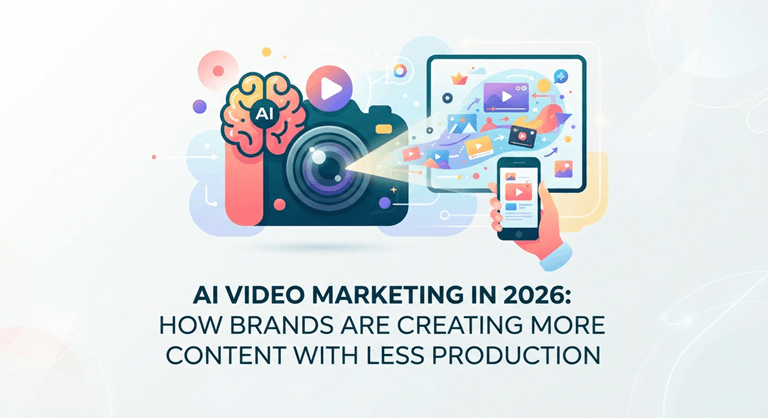
AI Video Marketing in 2026: How Brands Are Creating More Content With Less Production
Video has become one of the most important formats for modern digital marketing. From short-form social content to product demonstrations and paid advertisements, brands are expected to produce fresh and engaging videos on a regular basis.
The challenge is that traditional video production can require significant time, resources, and coordination. Artificial intelligence is changing this process by helping marketers develop concepts, generate visual assets, and create multiple creative variations more efficiently.
The Shift Toward AI-Assisted Video Marketing
AI video is no longer limited to experimental content. Marketing teams are increasingly exploring AI throughout different stages of production.
A typical workflow can now include:
- Generating creative concepts
- Developing scripts and hooks
- Creating visual references
- Producing short video sequences
- Generating product-focused visuals
- Creating alternative versions
- Adapting content for different platforms
- Testing different creative approaches
The biggest advantage is flexibility. Instead of producing one version and hoping it performs well, marketers can explore several creative directions before deciding where to invest additional resources.
What Should Marketers Look for in AI Video Tools?
The growing number of AI video platforms makes choosing the right solution more complicated.
A good marketing workflow requires more than impressive-looking generations. Marketers should consider factors such as consistency, creative control, generation speed, editing capabilities, image-to-video support, and the ability to produce multiple variations.
When researching the best ai video generators for marketing 2026, businesses should also consider how easily a tool fits into their existing production workflow.
A platform may generate excellent individual clips but still be unsuitable for a marketing team if it makes iteration difficult.
AI Video for Social Media Campaigns
Social media requires a constant flow of new creative content.
A campaign that performs well today may become less effective after audiences see the same creative repeatedly. AI video can help marketers develop additional variations without rebuilding the entire concept from the beginning.
For example, one campaign can be adapted into several versions with different:
- Opening hooks
- Visual styles
- Product presentations
- Backgrounds
- Calls to action
- Storytelling approaches
This makes AI particularly useful for teams that need to experiment frequently.
Creating Better Product Videos
Product marketing is another area where AI video can provide useful creative possibilities.
A product image can become the starting point for a short visual sequence. Marketers can then experiment with different environments, camera movements, lighting styles, and compositions.
For example, a technology product could be presented in a futuristic environment, while a lifestyle product could be shown in a more natural everyday setting.
These concepts can help marketing teams visualize campaign ideas before investing in larger-scale production.
AI and UGC-Style Advertising
UGC-style advertising has become popular because it often feels more conversational and native to social media platforms than traditional commercials.
AI can support this format in several ways without removing the importance of human creative direction.
Marketers can use AI to develop:
- Supporting B-roll
- Product scenes
- Background visuals
- Creative concepts
- Alternative hooks
- Visual transitions
- Different versions of an existing idea
The strongest results generally come when the technology supports a clear marketing concept rather than becoming the concept itself.
Why Creative Direction Still Matters
AI can generate content quickly, but speed doesn’t automatically create effective advertising.
A successful marketing video still needs a clear purpose.
Before generating anything, marketers should understand:
Who is the audience?
What problem does the product solve?
Why should someone keep watching?
What action should the viewer take?
These questions determine the creative direction.
AI can then help turn that direction into different visual possibilities.
Testing Multiple Creative Angles
One of the most valuable applications of AI video is creative testing.
Instead of producing a single advertisement, a team can develop several concepts around the same product.
For example:
Problem-Focused
Start with a common problem experienced by the target audience.
Benefit-Focused
Show how the product improves a particular situation.
Demonstration-Focused
Show the product being used.
Story-Focused
Build the advertisement around a relatable experience.
Comparison-Focused
Show the difference between an old approach and a new solution.
Each angle can attract a different audience segment.
AI Video for Small Marketing Teams
Large companies may have dedicated creative departments, production teams, editors, and agencies.
Smaller businesses often work with much smaller teams.
AI can help reduce some of the production workload by making certain creative tasks faster.
A small marketing team can experiment with campaign concepts, generate supporting visuals, and prepare content variations without needing to outsource every stage.
This doesn’t mean AI replaces professional creative work. Instead, it can give smaller teams more room to experiment.
Repurposing Existing Content
Another practical application is turning existing content into new formats.
A brand might already have:
- Product photographs
- Blog content
- Customer testimonials
- Long-form videos
- Social media posts
- Promotional graphics
These assets can become starting points for new video concepts.
Repurposing allows marketers to extract more value from content they’ve already created rather than constantly starting from zero.
Personalization and Audience Segmentation
Different audiences respond to different messages.
A single advertisement may not communicate equally well with every customer segment.
AI-assisted production can make it easier to test variations tailored to specific audiences.
A campaign could emphasize affordability for one group, convenience for another, and advanced features for a third.
The underlying product remains the same, but the creative presentation changes.
Maintaining Brand Consistency
As AI-generated content becomes easier to produce, maintaining a consistent brand identity becomes more important.
Marketing teams should establish clear guidelines for:
- Colors
- Typography
- Visual style
- Product presentation
- Tone of voice
- Character appearance
- Camera language
- Overall aesthetic
AI should work within these guidelines rather than creating completely disconnected visuals for every campaign.
The Human Element in AI Marketing
There is a temptation to think that the most advanced AI workflow is the one that automates everything.
In practice, marketing still depends heavily on human judgment.
People understand cultural context, customer emotions, brand personality, and creative nuance.
AI can accelerate production, but marketers still need to decide what deserves to be produced.
The most effective workflow is therefore often a combination of human strategy and AI-assisted execution.
Building a Sustainable AI Video Workflow
Instead of using AI randomly, businesses can create a repeatable process:
Research → Strategy → Concept → Script → Visual Development → Generation → Editing → Testing → Optimization
This approach makes it easier to understand where AI actually provides value.
Over time, teams can identify which stages benefit most from automation and which require greater human involvement.
What Comes Next?
AI video technology will likely continue moving toward more controllable and production-oriented workflows.
Marketers may gain greater control over characters, environments, camera movement, storytelling, and visual consistency.
The result could be a marketing process where teams can move from an initial idea to multiple creative prototypes much faster than before.
But the technology itself won’t determine whether a campaign succeeds.
Audience understanding, strong storytelling, and clear positioning will continue to matter.
Conclusion
AI is changing video marketing by making creative experimentation faster and more accessible.
Brands can use AI to develop concepts, create product visuals, produce social media content, test different advertising angles, and repurpose existing assets.
The real opportunity isn’t simply generating more videos. It is building a smarter creative process where marketers can create, test, learn, and improve continuously.
Final Takeaway
For businesses evaluating the Best Platforms for Making AI UGC Ads in 2026, the right choice should depend on more than generation quality. Workflow flexibility, creative control, consistency, editing capabilities, and the ability to create multiple variations should all be considered before selecting a platform.
Popular on OTW Right Now!



About The Author

Gagan Bhangu
Founder of otechworld.com and managing editor. He is a tech geek, web-developer, and blogger. He holds a master's degree in computer applications and making money online since 2015.