
AI Agents in FinTech: Compliance-Aware Automation and Decision Support
Financial institutions have spent years automating repetitive tasks, yet many workflows still require constant human oversight. Reviewing regulatory updates, checking transactions for compliance, investigating suspicious activity, and preparing audit documentation often involve multiple disconnected systems and countless manual decisions. While automation platforms can reduce repetitive work, they rarely adapt when regulations change or when exceptions appear.
This is where AI agents are beginning to make a meaningful difference. Unlike traditional automation, AI agents can interpret context, retrieve information from several systems, reason through multi-step tasks, and recommend actions while keeping humans involved in high-risk decisions. Rather than replacing compliance teams, they help professionals process larger volumes of information with greater consistency.
Organizations exploring intelligent agent development solutions are increasingly looking beyond productivity gains. Their goal is to build systems that support regulatory compliance, improve operational accuracy, and help employees make better-informed decisions without sacrificing governance.
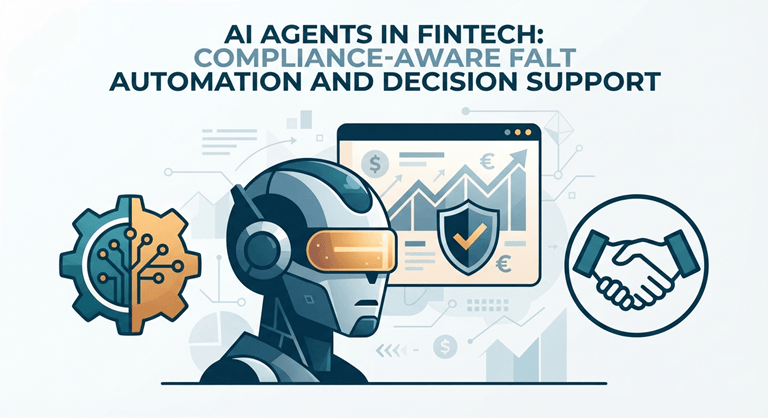
What are AI agents in FinTech?
AI agents are software systems capable of completing complex tasks with limited human intervention. They combine large language models, business rules, external data sources, APIs, and memory to perform activities that previously required human reasoning.
Unlike a chatbot that simply answers questions, an AI agent can:
- Gather information from multiple internal systems.
- Analyze regulations or company policies.
- Execute approved actions.
- Escalate uncertain situations.
- Document every decision for future review.
In financial services, this ability becomes especially valuable because every significant decision may require transparency, documentation, and compliance with multiple regulatory frameworks. This is particularly true for online payment fraud prevention, where agents must weigh risk signals in real time while keeping every decision traceable for regulators.
Instead of treating every request as an isolated prompt, AI agents work through entire business processes.
How do AI agents improve compliance workflows?
Compliance departments do not often have problems due to the absence of rules. The difficulty they experience is due to the increasing amount of information.
However, banks, insurers, investment companies, and payment providers have to track many kinds of transactions, customer messages, regulations, internal policies, risk signals, and more, all at once.
AI agents can help simplify this complexity.
Regulatory monitoring
Financial Regulations are continually changing. AI agents can analyze new regulations and internal policies alike and flag areas that need attention, rather than manually sifting through hundreds of pages of new guidance.
It is still the responsibility of compliance specialists to make the final decisions, but a large portion of the initial analysis can be completed much more quickly
Transaction review
Many compliance investigations involve repetitive evidence gathering.
An AI agent can automatically:
- Retrieve customer history.
- Review previous alerts.
- Summarize related transactions.
- Compare activity against internal thresholds.
- Prepare investigation notes.
The investigator receives an organized case instead of starting from scratch.
Audit preparation
There can be weeks of employee time involved in preparing documentation for internal or external audits.
AI agents can gather pertinent documents, sort evidence, identify missing documents, and create formal summaries without losing track of the audit trail.
How can AI agents support financial decision-making without replacing humans?
One of the biggest misconceptions is that AI agents make autonomous financial decisions.
In well-designed enterprise environments, they usually do not.
Instead, they provide structured decision support.
In the case of commercial loans, an AI agent could compile financial statements, write up a summary of the borrower’s financial history, highlight any financial ratios that are unusual, run a comparison of internal lending policies, and request other kinds of documentation.
The loan officer still makes the final decision on whether or not to approve.
Likewise, AI agents can analyze the portfolio restrictions, detect potential conflicts, and make suggestions prior to human approval in investment compliance teams.
This “human-in-the-loop” approach ensures that there is more risk reduction and increased efficiency.
What compliance tasks are best suited for AI agents?
Not every process benefits equally from intelligent automation.
The strongest candidates typically share three characteristics:
- High document volume.
- Repetitive reasoning.
- Clear approval workflows.
Examples include:
KYC and customer onboarding
Some of the typical identity verification, document review, sanctions screening, and policy validation are part of customer onboarding.
AI agents are able to ensure that applications pass multiple verification systems and pinpoint missing information before it’s submitted to human reviewers.
AML investigations
Each day, anti-money laundering teams have to deal with thousands of alerts.
AI agents can assist investigators in prioritizing cases, summarizing customer activity, pulling up supporting evidence, and creating a standardized investigation report.
Regulatory reporting
Data needs to be gathered from many internal platforms when preparing regulatory submissions.
AI agents eliminate manual copying, match conflicting data, fill in missing data, and help prepare reports.
Internal policy assistance
Employees regularly ask compliance teams similar questions:
- Which documents are required?
- Does this transaction exceed approval limits?
- Which regulation applies?
- What evidence should be collected?
Instead of having to trawl through long documentation, AI agents have the ability to respond to these operational questions based on existing internal policies.
How do AI agents reduce operational risk?
Operational risk can be due to a lack of consistency, not intentional.
Various staff members can have varying understandings of the policy, forget to document, or skip verification processes in a rush.
AI agents provide more uniformity.
Employees are not given to memorize the whole procedure but get standardized instructions, which are based on a pre-defined procedure in the business logic.
This creates several advantages:
- Fewer missed compliance checks.
- More consistent documentation.
- Better knowledge sharing.
- Faster employee onboarding.
- Improved traceability during audits.
It is particularly beneficial in organizations that span multiple jurisdictions with different regulations for each market.
What challenges should financial companies expect?
Although AI agents offer significant benefits, implementation requires careful planning.
Data quality
Poor data produces poor recommendations.
Before AI projects can scale effectively, organisations often find that the data they have is inconsistent, documentation is out of date, or that it is scattered across various databases.
Governance
Financial institutions need clear rules defining:
- Which actions agents may perform.
- When human approval is mandatory, how decisions are recorded, and how outputs are validated.
Governance should be designed before deployment rather than added later.
Security and privacy
There are very sensitive financial details in financial data.
Access controls, encryption protocols, logging, and data retention policies for AI systems must adhere to the organization’s security protocols. The access, encryption, logging, and retention policies for AI systems should align with the organization’s security protocols.
Model monitoring
The performance of AI may vary over time with different business situations.
There is a need for continuous evaluation of the organisation to identify an accuracy drop, an increase in risk, or new user behaviour that could impact production systems.
How do AI agents work alongside existing FinTech systems?
One of the benefits of using an AI agent in the modern world is that it’s unlikely that the organization will need to replace the current infrastructure.
Instead, they are meant to make connections with current systems via APIs and enterprise integrations.
An AI agent may simultaneously interact with:
- CRM platforms.
- Document management systems.
- Payment platforms.
- Fraud detection tools.
- ERP software; Internal compliance databases.
The agent is not an “add another application” approach but an orchestration layer, which pulls data from current technology investments.
This is often more cost-effective and provides greater business value than rebuilding core systems, and can result in quicker implementation.
What will compliance-aware AI look like over the next few years?
Financial AI of the future will be more about collaborative intelligence rather than automation.
Rather than replacing compliance officers, future AI agents will be able to keep an eye on regulatory updates and will be able to articulate the rationale behind their recommendations, note uncertainty, and seek human consent when they are less confident.
Multi-agent architectures with specialized agents to perform specific tasks will also gain in popularity. One agent could be checking on regulations, another could be checking the documentation of customers for accuracy, another could be looking for indicators of fraud, and another could be preparing audit evidence. These two work together to produce coordinated workflows which are easier to govern and more transparent than fully autonomous workflows.
The need for explainability and accountability of AI will be as vital as its automation, just as regulatory requirements evolve around AI.
Conclusion
Financial institutions are continually challenged to deliver increasingly demanding regulatory mandates and to be more efficient. Although repetitive processes can be automated, traditional automation methods have difficulty with reasoning, context, and adapting processes over time.
AI agents are a viable option for the next step. They can structure information, help with compliance investigations, create documentation, keep track of changes in regulations, and help staff to make better, quicker decisions. If properly governed, monitored, and secured, they are excellent partners and not black-box decision makers.
As FinTech firms strive to implement digital transformation in the long term, compliance-focused AI agents can help boost operational resilience and ensure the transparency and accountability demanded by regulators and customers.
Popular on OTW Right Now!



About The Author

Gagan Bhangu
Founder of otechworld.com and managing editor. He is a tech geek, web-developer, and blogger. He holds a master's degree in computer applications and making money online since 2015.