
AI-Powered Robotics for Small Manufacturers: Use Cases, Costs, and Where to Start
AI-powered robotics is becoming more accessible to small manufacturers because improvements in sensors, machine vision, software, and robot programming are making flexible automation easier to deploy. NIST specifically identifies robotics and automation as increasingly accessible to small manufacturers, while its 2026 research continues to examine how emerging technologies can reduce the barriers to robotic adoption.
For a small factory, the best starting point is rarely a fully autonomous production line. A better approach is to identify one repetitive, measurable task where a robot can improve throughput, quality, safety, or labor utilization.
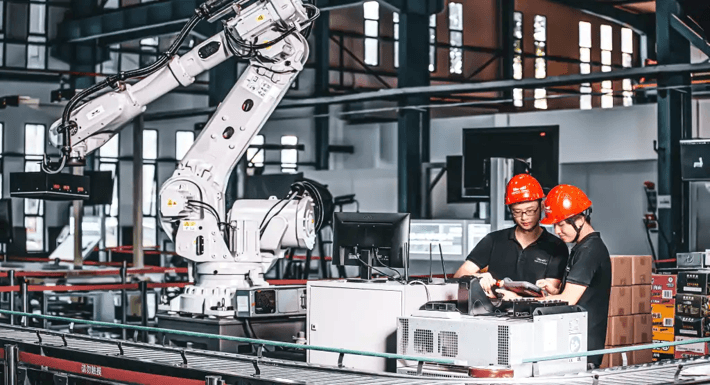
What are the best ai robotics small manufacturers?
The best AI robotics applications for small manufacturers are repetitive processes where the environment is structured enough for a robot to perform reliably but variable enough that traditional fixed automation is difficult to justify.
Strong candidates include:
- Machine tending: Loading and unloading CNC machines, presses, or other equipment.
- Inspection: Using cameras and AI vision to identify defects or inconsistencies.
- Assembly: Handling components, fastening parts, applying adhesives, or performing repeatable assembly operations.
- Welding: Automating repetitive welding operations where fixtures and part presentation are consistent.
- Packaging and palletizing: Picking finished products, packing cases, and arranging pallets.
- Material handling: Moving parts or materials between production stations.
- Sorting: Identifying and separating products based on size, shape, appearance, or quality.
NIST identifies machine tending, adaptive assembly, inspection, and welding among applications where collaborative robots can be useful in high-mix manufacturing environments.
The strongest candidates usually have a measurable cycle time, predictable inputs, and enough repetition to justify the integration effort.
Where can I find an ai robotics small manufacturers list?
There is no single authoritative global list of every small manufacturer using AI robotics. Instead, manufacturers can find relevant examples through NIST’s Manufacturing Extension Partnership (MEP), robotics associations, integrators, and documented manufacturing case studies.
NIST’s robotics program specifically works with small and medium-sized manufacturers, systems integrators, and MEP centers to identify adoption barriers and evaluate technologies such as collaborative robots, digital twins, process intelligence, and AI-enabled systems.
For manufacturers evaluating their own opportunity, a more useful “list” is a list of comparable applications:
- CNC machine tending
- Robotic welding
- Pick-and-place
- Vision inspection
- Packaging
- Palletizing
- Part sorting
- Assembly
- Material movement
This lets a company compare its own production tasks with proven automation patterns instead of searching for another manufacturer with an identical production process.
What are the best ai robotics companies?
The best AI robotics company depends on the application rather than a universal ranking.
For small manufacturers, the market can be divided into several categories:
- Industrial robot manufacturers: Useful for traditional robotic arms and high-throughput automation.
- Collaborative robot manufacturers: Useful where flexibility, smaller footprints, and human-robot workflows matter.
- AI vision providers: Useful for inspection, identification, sorting, and variable part handling.
- Robotics software companies: Useful for programming, simulation, optimization, fleet management, and AI-enabled control.
- Systems integrators: Useful when the manufacturer needs the robot, gripper, vision, safety system, PLC integration, and commissioning delivered as one solution.
The important distinction is that buying a robot is only one part of the project. NIST research highlights integration, tooling, sensors, evaluation, and the ability to retask robots as significant challenges for small and medium-sized manufacturers.
What are the leading ai robotics companies?
Leading AI robotics companies should be evaluated according to the manufacturing problem they solve.
A small manufacturer might compare established industrial robotics suppliers with collaborative-robot specialists and newer AI-focused robotics companies. The evaluation should cover:
- Robot payload and reach
- Vision capabilities
- Ease of programming
- Available grippers and tooling
- PLC and factory-system integration
- Safety capabilities
- Changeover time
- Support and service availability
- Training requirements
- Total integration cost
The latest robotics market data also shows why manufacturers have more options than they did a decade ago: the International Federation of Robotics reported more than 600,000 industrial robot installations worldwide in 2025, with the global installed base reaching about five million robots.
For a small manufacturer, however, market share should not be the deciding factor. Local integration support and whether the robot fits the specific production process can matter more.
What are the top 10 robotics companies in the world?
The “top 10” depends on whether the ranking measures robot installations, revenue, industrial specialization, AI capabilities, or overall automation presence.
For a small manufacturer, a more useful shortlist should include companies across different parts of the ecosystem rather than treating every robotics company as interchangeable.
The evaluation can include:
- Industrial robot manufacturers
- Collaborative robot manufacturers
- Machine-vision providers
- Mobile robotics companies
- Robotic welding specialists
- Palletizing and packaging specialists
- Robotics software providers
- Simulation and digital-twin providers
- AI perception companies
- Manufacturing systems integrators
This approach reflects the current direction of manufacturing robotics: AI is increasingly being combined with sensing, perception, digital twins, process intelligence, and other technologies rather than functioning as a standalone “AI robot.” NIST’s 2026 smart-manufacturing roadmap specifically identifies robotics, autonomous systems, digital twins, advanced sensing, and AI/ML as connected areas of industrial development.
What are the best ai robotics small manufacturers?
For a small manufacturer, the best AI robotics project is usually the one with a narrow scope and measurable business case.
Start with a task that has:
- High repetition
- Predictable cycle times
- Frequent labor shortages
- Quality problems caused by inconsistency
- Ergonomic or safety concerns
- Enough production volume to generate measurable savings
- Limited variation in parts or processes
Avoid starting with a highly variable task that requires a robot to make complex decisions in an uncontrolled environment.
High-mix, low-volume manufacturers can still benefit from cobots, but flexibility becomes especially important. NIST notes that small manufacturers often face challenges integrating robots into dynamic environments and are researching technologies that allow robots to be more easily retasked.
What are the leading ai robotics manufacturers in usa?
U.S. manufacturers can source robotics from global robot manufacturers, U.S.-based robotics companies, and domestic systems integrators.
For a small factory, geographic proximity can be as important as the robot brand. Installation, programming, safety validation, maintenance, spare parts, and employee training all become easier when qualified support is available.
NIST’s MEP network is another resource for smaller manufacturers evaluating automation because MEP centers work directly with manufacturers on technology adoption and process improvement.
A manufacturer should therefore compare the complete implementation team, not just the robot manufacturer’s product.
What is the ai robotics small manufacturers cost?
AI robotics costs vary substantially because the robot itself is only one component of the project.
A manufacturer’s total project cost can include:
- Robot or cobot
- End-of-arm tooling
- Cameras and sensors
- Safety equipment
- Fixtures
- PLC and machine interfaces
- Programming
- Systems integration
- Installation
- Employee training
- Maintenance
- Software subscriptions
- Production downtime during commissioning
That makes a simple “robot costs X” calculation misleading.
NIST research identifies capital cost and lack of automation experience among important barriers for smaller manufacturers, while its case studies demonstrate that testing a robot before purchase can reduce adoption risk.
One useful example comes from NIST’s case study of AMG Industries. The company tested a collaborative robot through a loaner program before purchasing one. The application increased parts per hour by 38%, while the projected payback improved from 11.5 months to 6.5 months after the trial demonstrated the actual productivity gains.
That illustrates why manufacturers should calculate ROI from the complete installed system rather than comparing robot purchase prices alone.
What are the best ai robotics companies to invest in?
For a manufacturing operator, the better question is usually not which AI robotics company is the best investment. It is which technology can produce a reliable return on the factory floor.
A manufacturer should calculate:
Annual benefit = labor capacity released + additional throughput + scrap reduction + quality improvement + avoided downtime − annual operating costs
Then compare that benefit with the full automation investment.
A pilot can make the calculation more reliable. Instead of assuming a robot will run at its advertised capability, measure actual cycle time, uptime, changeover time, reject rate, operator involvement, and maintenance requirements during a controlled production trial.
Where should small manufacturers start with ai robotics?
Small manufacturers should start with one production task, not an enterprise-wide AI robotics strategy.
Map the current process, measure labor hours and cycle time, identify quality or safety problems, and determine how much variation the robot must handle. Then compare a conventional industrial robot, collaborative robot, machine vision system, or other automation approach.
If the economics work, run a pilot before expanding.
That staged approach is consistent with NIST’s current focus on helping SMEs evaluate and integrate emerging robotics technologies while reducing the technical and financial barriers that have historically slowed adoption.
Start with one measurable robotics use case
AI-powered robotics can give small manufacturers access to automation that was previously difficult to justify, but AI does not eliminate the need for process engineering.
The strongest strategy is to choose one repetitive task, establish a baseline, test the robot in the real workcell, measure the results, and calculate the full installed ROI. If the pilot delivers measurable gains in throughput, quality, safety, or labor utilization, the manufacturer can then replicate the approach across additional processes.
That turns AI robotics from a technology experiment into a controlled manufacturing improvement program.
Popular on OTW Right Now!



About The Author

Gagan Bhangu
Founder of otechworld.com and managing editor. He is a tech geek, web-developer, and blogger. He holds a master's degree in computer applications and making money online since 2015.