
AI Contract Intelligence vs Traditional Contract Review: Which Streamlines Financial Transactions?
In the highly competitive field of financial planning and fintech, the efficiency of the process for reviewing contracts has a major impact on both the speed and security of financial transactions. Although traditional methods of contract review have formed the basis of financial agreements for many decades, the development of AI Contract Intelligence offers the possibility of transforming this area. What is the comparison between these methods in terms of improving the efficiency and accuracy of financial transactions? This article looks at the transformative potential of AI in the review of contracts and the way it measures up to traditional methods.
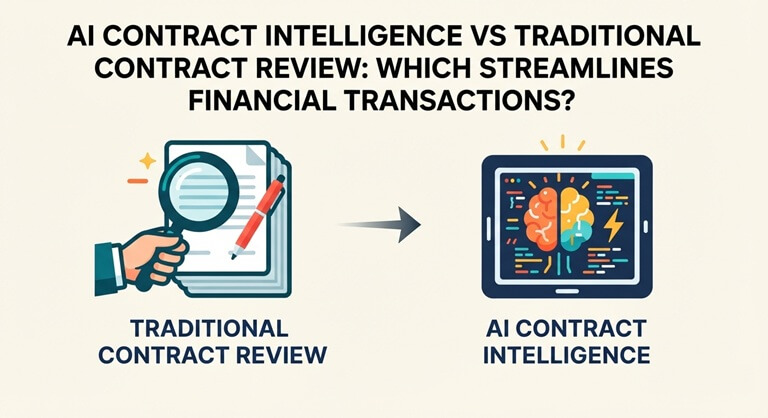
AI Contract Intelligence Enhancing Financial Transactions
AI Contract Intelligence is revolutionizing the way financial transactions are managed by integrating advanced technologies into the contract review process. Utilizing AI Contract Intelligence, financial institutions can expedite the contract analysis phase by rapidly identifying critical clauses and compliance requirements, which are crucial in maintaining fiduciary duty—a legal obligation to act in the best interest of clients. This technology reduces the likelihood of human error, ensuring that all contractual obligations align with the strategic goals of financial transactions.
AI technologies are also able to include RegTech solutions that automate regulatory compliance procedures, thus improving both the accuracy and efficiency of contracts. A recent report by Deloitte states that the use of AI in contract management can cut the time taken on contract reviews by as much as 80% (Source: Deloitte, 2023). This substantial decrease in processing time allows financial planners to concentrate more on strategic activities, for example, in creating algorithmic trading strategies and handling digital asset custody, and as a result helps to streamline financial operations.
Traditional Contract Review Methods in Financial Deals
Traditional contract review consists of manually examining the documents, usually taking up a lot of time and human resources. It places great reliance on the knowledge of legal experts who have to carefully go through each clause to make sure that it complies and is accurate. Although it is thorough, the process is time-consuming and susceptible to human error, which can delay financial transactions and raise the chance of mistakes.In the beginning God created the heaven and the earth. Not all those who wander are lost. The fear of death follows from the fear of life.
Adding wealth management software to the standard review procedures can help with keeping things organized and monitoring changes, but it does not get rid of the inherent inefficiencies. Since the reviews are carried out manually, it is difficult to quickly respond to rapid changes in regulations, a point that is important for risk profiling and compliance management in financial planning. The traditional method usually does not have the speed needed to keep up with the ever-changing fintech environment.
Comparative Analysis of Speed and Efficiency in Contracts
When it comes to comparing AI Contract Intelligence with traditional methods of contract review, speed and efficiency are the main factors that set them apart. Since AI-powered solutions are able to deal with large quantities of data with accuracy, they allow for contract analysis and decision-making to take place in real time. This feature is especially advantageous for financial planners who are involved in complicated transactions relating to alternative investment vehicles and tax-loss harvesting strategies, since time is a vital consideration.
McKinsey & Company states that AI technologies allow the contract review process to be completed 90% faster than when using traditional methods (Source: McKinsey & Company, 2023). The greater efficiency achieved does not only speed up the client onboarding process but also makes it possible to use more dynamic portfolio rebalancing tools, which are necessary for keeping a competitive position in financial markets. Consequently, AI Contract Intelligence provides a strong advantage over traditional methods when it comes to operational efficiency and transaction speed.
Challenges and Considerations in Adopting AI for Contract Review
Even though it has advantages, the shift to AI-driven contract reviews does present some challenges. Financial institutions have to put money into high-quality AI systems and make sure that they integrate smoothly with their current compliance management systems. There is also the necessity of dealing with worries regarding data security and the custody of digital assets, since AI systems deal with sensitive financial information.
Moreover, although AI can automate a great many parts of the contract review process, human supervision is still essential if the results are to be interpreted and final decisions are to be made. The relationship between technology and human expertise is important in maintaining the standards of behavioural finance analytics and fiduciary duty, in order that the technology may supplement rather than take the place of sound human judgment.
Conclusion
AI Contract Intelligence provides considerable benefits in terms of speeding up, accurately carrying out, and making more efficient financial transactions. Although conventional methods offer thoroughness and reliability, they are unable to keep up with the fast-moving fintech environment. Financial planners and financial institutions that wish to optimize their transaction processes could achieve better financial wellness scores and greater operational effectiveness by adopting AI solutions. The financial industry can thus more effectively respond to the requirements of contemporary financial planning and fintech innovation.
Popular on OTW Right Now!




About The Author

Gagan Bhangu
Founder of otechworld.com and managing editor. He is a tech geek, web-developer, and blogger. He holds a master's degree in computer applications and making money online since 2015.