
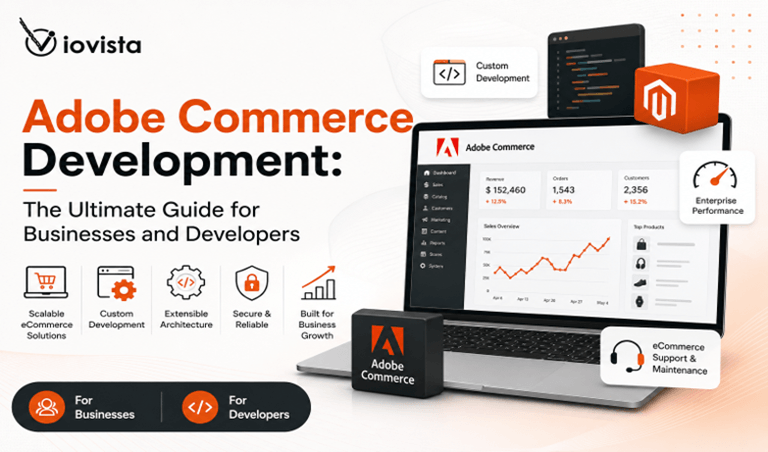
Adobe Commerce Development: The Ultimate Guide for Businesses and Developers
The e-commerce landscape has never been more competitive. Businesses are under constant pressure to deliver seamless shopping experiences, manage complex operations, and scale rapidly all at once. In this environment, the platform you build on matters enormously. Adobe Commerce (formerly Magento Commerce) has emerged as one of the most powerful enterprise eCommerce solutions available, and Adobe Commerce development has become a critical investment for businesses serious about long-term digital growth.
This guide explains what Adobe Commerce is, why businesses opt for it, the development services that make it tick, best practices to follow, and the support options that can transform a mere online store into a genuine business.
What Is Adobe Commerce?
Adobe Commerce is an enterprise-grade eCommerce platform, which was developed after Adobe acquired Magento and evolved from Magento Commerce. It brings both open-source architecture flexibility and the strength of cloud infrastructure, AI-powered personalization, and deep integration capabilities.
Adobe Commerce is built to handle large-scale businesses, with none of the limitations found on simpler platforms such as Shopify or WooCommerce. It supports high volumes, complex B2B workflows, large product catalogs, multi-store operations, and more. It scales easily to support high-volume, complex B2B workflows, large product catalogs, multi-store, and more. It’s a growth solution, not a growth restraint, and is used by businesses from mid-market retail to enterprise and global businesses.
It has several notable features, such as its powerful catalog management, built-in B2B sales tools, AI-driven product suggestions, omnichannel sales functionality, and extensive extension and integration options. Adobe Commerce is the control you want, no matter if you’re operating a single storefront or a number of brands in a variety of regions.
Why Adobe Commerce Development Requires Expertise
Here’s the thing: Adobe Commerce is powerful, but that power comes with complexity. Out of the box, it offers a remarkable feature set, but most enterprise businesses need customization, custom workflows, and integrations that go well beyond default functionality. That’s where professional Adobe Commerce Magento development becomes essential.
Adobe Commerce development spans several disciplines:
Frontend Development: Creating responsive, conversion-focused storefronts for a stellar user experience on all devices. It’s not just about themes – it’s about creating the interface that directs customers to buy with attrition.
Backend Development: Handling the business logic of the store: custom modules, business rules, inventory management, pricing engines, and others. The requirements of enterprise businesses may be somewhat different and may require features to be embedded in the platform.
Custom Module Development: Adobe Commerce is a powerhouse when it comes to custom module development. Platform enhancements can be made in the form of custom modules, avoiding changes to core code and hence keeping the platform upgradeable and codebase maintainable.
Third-Party Integrations: Adobe Commerce is rarely used without the support of third-party integrations. Integrates seamlessly with ERP, CRM, payment gateways, shipping companies, marketing automation, and other integrations. Each integration should be carefully planned and executed without causing performance- and data-integrity-related problems.
When done right, Adobe Commerce development doesn’t just build a store; i t architects a digital commerce ecosystem that supports your business model.
Key Features That Make Adobe Commerce Stand Out
Advanced Catalog Management
Many platforms lack the ability to handle thousands of SKUs across a number of categories, product variations, custom attributes, and dynamic pricing. It’s natively supported by Adobe Commerce. Merchants can set up product types and manage their inventory from various warehouses, and can customize product presentation according to the segments.
B2B Commerce Capabilities
Adobe Commerce has specific B2B features for commerce businesses that sell to other commerce businesses, including company accounts, negotiated pricing, quote management, requisition lists, and bulk ordering. They are not add-ons, but an integral part of the platform, so they are stable, performant, and very well integrated.
AI-Powered Personalization
Adobe Commerce seamlessly connects with Adobe Sensei, the company’s AI engine, providing intelligent product recommendations, dynamic customer segmentation and a personalized shopping experience. This is a valuable differentiator in today’s day and age, where customers want to see relevance.
Omnichannel Commerce
Modern customers do not take a straight path while shopping. They do online research, buy in-store, browse from their mobile, and return online. With Adobe Commerce, you can provide a consistent customer experience across all channels, as it supports unified commerce.
Essential Adobe Commerce Development Services
Custom Store Development
Each business is different and has different processes and expectations. You can’t have a cookie-cutter store. Professional Adobe Commerce development services provide you with end-to-end store development from UX/UI design to custom theme development, implementation of features, and launch, meeting your business needs.
Migration Services
There are numerous companies out there operating on different platforms, such as Shopify, WooCommerce, BigCommerce, or even legacy Magento 1. There are many companies out there that are running their business on platforms like Shopify, WooCommerce, BigCommerce, or even legacy Magento 1. While moving to Adobe Commerce can be a strategic decision, it should be meticulously planned to ensure that all data is migrated, SEO considerations are taken into account, and the redirections are managed correctly. Finally, it is essential to run extensive testing. The consequences of a bad move during migration can be the loss of rankings, revenue, and customer trust. It works when it’s the right partner who is developing it.
Integration Services
Your Adobe Commerce store must communicate with your other technology. That involves connecting with your ERP system, your CRM system, your payment systems, and your marketing systems, among other things. These integrations aren’t just plug-and-play, however, and require correct architecture to make sure that data is transferred correctly and performance is not degraded.
Extension Development
There are thousands of extensions available in the Adobe Commerce Marketplace, but there might be an extension you need that isn’t available just yet. Custom extension development provides you with the ability to create the functionality that you need, such as a custom shipping calculator, loyalty program, specialized search function, or any other functionality your users and business need.
Best Practices for High-Performance Adobe Commerce Development
Prioritize Performance from Day One
Because page speed can impact conversions and search rankings, it’s not something that is nice to have. Optimizing CDN implementation, optimizing database queries, using Varnish, Redis (as a session or cache store), and full-page caching are all best practices for high-performing Adobe Commerce stores. These are not add-on features – they should be incorporated into the development process right from the beginning.
Build Mobile-First
Over 50% of eCommerce now arrives via mobile, and mobile conversion rates can be lower than on the desktop. The gap widens when mobile experiences are built with responsive layouts, “one-tap” checkout, fast load times on mobile connections, and streamlined navigation. Mobile is not a miniaturized desktop; it’s an experience in its own right.
Implement Security at Every Layer
High-value targets are enterprise eCommerce stores. Secure Adobe Commerce development is about the code base, access control, timely updates, patches, and much more. Security audits should be done on a regular basis, not when there is a problem.
Optimize for SEO Technically
While Adobe Commerce has great SEO features, they must be set up properly. This includes using the correct structure, canonical tags, structured data markup, XML sitemaps, and clean site architecture. Technical SEO is an integral component of development, and not something the marketing team should wait to get done.
Why eCommerce Support and Maintenance Are Non-Negotiable
Building a great Adobe Commerce store is just the beginning. eCommerce support and maintenance is what keeps it performing, secure, and competitive over time, and it’s often underestimated by businesses until something goes wrong.
Ongoing Platform Updates
Adobe Commerce releases will occur regularly,y and it’s important to keep up to date for three reasons: security, performance, and access to new features. Without updates, your store will have technical debt and be vulnerable to known vulnerabilities. A proactive maintenance plan keeps your platform up-to-date without impacting your business.
Performance Monitoring
Fast startups aren’t necessarily fast, especially in the store. Traffic pattern shifts, catalogs expand, and third-party extensions add overhead. Continuous performance monitoring, speed auditing, database health checks, and error detection catch and correct problems that can impact your customers or your conversion rate before they can.
Security and Compliance Management
The threat environment is continually changing. Continuous security management involves staying alert for security weaknesses, patching them promptly, auditing access policies, and ensuring data protection laws are followed. For companies that accept payments and keep customer records, it’s a must.
Continuous Improvement
Best eCommerce businesses are not set it and forget it. Continuous support involves conversion rate optimization, user experience improvements, A/B testing, and development of new features, based on data and customer feedback. Your store should improve each and every month, and not only at launch time.
Common Challenges and How to Address Them
Nevertheless, there are some challenges associated with developing Adobe Commerce. Interdependencies can be problematic when there are complex customization requirements in place, and changes may become difficult in the future. When integrating projects, inconsistencies are likely to arise between systems. As catalogues get bigger and traffic increases, performance bottlenecks can arise. At enterprise scale, running and maintaining growth becomes a tech challenge.
The solution to all these is to select a development partner who has true Adobe Commerce experience, has a proven history of working on complex projects, holds Adobe certifications, and is willing to provide support in the long run. Not all Magento or Adobe Commerce developers are the same, and in the world of enterprise eCommerce, it makes a difference.
The Road Ahead: Future Trends in Adobe Commerce
Adobe Commerce is putting significant resources into its headless commerce architecture that separates the front end from the back end and provides businesses with the ability to provide content and commerce experiences on any device, including websites, apps, kiosks, and voice. Another big trend is Progressive Web Applications (PWAs), which provide app-like experiences in the browser.
AI-powered personalisation will progress further beyond product recommendations and become more dynamic, adapting to the customer’s needs on the fly. These are not just some hypothetical scenarios, but ones that are already in practice by top merchants now.
Conclusion: Building for the Long Term
Adobe Commerce dev isn’t a purchase of a product. It can provide your business with a platform that can grow to accommodate your business’s success, be flexible enough to meet market demands, and create long-lasting customer loyalty if done properly.
A blend of professional development, savvy integration, and ongoing eCommerce support and maintenance service is what sets the successful online store apart from those that become stagnant. For those who want to get serious about eCommerce, the software (Adobe Commerce) and the right development partner behind it are worth the price of admission.
When it comes to choosing the right partner, ioVista stands out as a leading Adobe Commerce Magento development agency with a proven track record of delivering enterprise-grade eCommerce solutions. Whether you’re in the process of developing a custom application, migrating to the cloud, managing support and optimization, or anything in between, ioVista has the deep platform expertise, certified talent, and long-term commitment your business deserves. When you’re looking to create something extraordinary, you can do it with ioVista.
Popular on OTW Right Now!



About The Author

Gagan Bhangu
Founder of otechworld.com and managing editor. He is a tech geek, web-developer, and blogger. He holds a master's degree in computer applications and making money online since 2015.