
Healthcare App Development Companies to Shortlist in 2026: Seven Trusted Options
Digital care is no longer an optional extra since patients now expect to book appointments, talk to clinicians, see their results, and manage their prescriptions using their phones, while NHS trusts, private clinics, and health-tech start-ups all face pressure to provide these services securely and quickly.
A well-polished interface in itself is not enough to ensure that a healthcare product is safe. The design has to protect the confidentiality of patients’ information, function smoothly with the current clinical systems, and meet regulatory requirements such as UK GDPR and, in the case of products aimed at the US market, HIPAA.
When deciding between healthcare app development companies, it is necessary to carefully compare their technical depth, the level of their compliance, and actual client feedback.
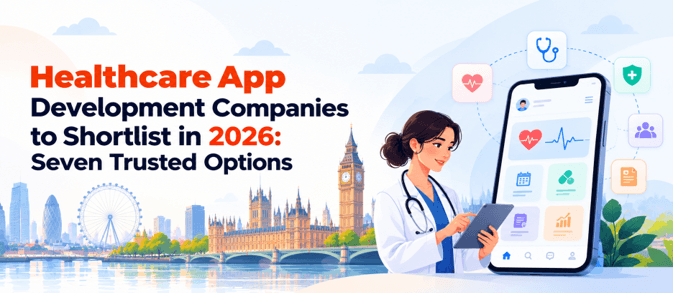
Our Shortlisting Criteria: Technology, Compliance and Client Trust
Since CEOs, CTOs, and those in charge of digital affairs do not have the time to test every vendor, we evaluated each company on the basis of six practical criteria. These criteria are the most important when assessing firms that develop healthcare apps for a regulated project.
- Verified client reviews:It was essential to obtain independent feedback from our previous clients, with a focus on consistent praise regarding communication, delivery discipline, and post-launch support rather than just individual testimonials.
- Regulatory and data protection compliance: Providers needed demonstrable familiarity with UK GDPR and HIPAA, plus NHS expectations such as the Digital Technology Assessment Criteria (DTAC) and the Data Security and Protection Toolkit.
- Security engineering: We favored teams that build in encryption, role-based access, audit logging, and secure API design from day one, supported by recognized standards such as ISO 27001.
- Interoperability expertise: Healthcare apps rarely work alone, so we checked for experience with HL7 FHIR, EHR integrations and connections to wearables, laboratories and payment systems.
- Modern, scalable technology stack: We assessed mobile and cross-platform skills, cloud architecture, and the ability to introduce AI features responsibly as a product grows.
- Quality assurance and clinical safety: Rigorous functional, security, performance, and usability testing matters, as does awareness of clinical risk standards such as DCB0129 and DCB0160 for products used in NHS settings.
7 Providers Worth Shortlisting for Your Healthcare App Development
1. Citrusbug Technolabs: AI-Enabled Custom Healthcare Apps
Citrusbug Technolabs builds custom mobile and web products for care providers and health-tech founders, pairing solid engineering with a practical understanding of how clinical and administrative workflows operate.
The company’s teams provide support for patient portals, telehealth platforms, appointment systems, and remote monitoring tools, including the addition of AI-assisted features where such features actually lead to better outcomes.
When organizations are comparing healthcare app development companies, what attracts them is a flexible engagement model that is suitable for both start-ups that are validating an MVP and for established providers who are modernizing their legacy systems.
Security, integration planning, and scalable architecture are looked at right from the first sprint, which in turn makes subsequent compliance reviews much less difficult.
Benefits of Hiring Citrusbug Technolabs
- Flexible engagement models that scale from a lean MVP to a full enterprise rollout
- AI-ready engineering for features such as intelligent triage, analytics and workflow automation
- Cost-conscious delivery that suits start-ups and programs working to defined budgets
- Security-first architecture that supports smoother compliance reviews
2. ScienceSoft: Enterprise-Grade Healthcare Software Consulting
ScienceSoft offers IT consulting together with full-cycle software development, a combination that is suitable for healthcare organizations that operate complex, multi-system environments.
Because of its work with HIPAA-compliant solutions, its integration with EHR systems and its use of data-intensive platforms, it is a reasonable option in cases where governance is just as important as the features.
Because a consultancy-led approach is adopted, the requirements, the architecture, and the risk are generally thoroughly documented prior to the start of the build.
That discipline is useful for big-scale projects, which is one of the reasons why the company is frequently mentioned when buyers are evaluating healthcare app development companies for enterprise-sized programs.
Benefits of Hiring ScienceSoft
- Consultancy-led discovery that clarifies scope and risk before development starts
- Strong grasp of healthcare regulation and data governance
- Capacity to deliver large programs spanning several connected systems
- Thorough documentation that supports audits and smooth handovers
3. Intellectsoft: Digital Transformation for Care Providers
Because Intellectsoft has an established record in the enterprise sector, the fact that it has had wide experience in integration-intensive and security-minded environments influences the way its teams deal with each project. The company is able to provide support for mobile applications, patient-facing platforms and the backend services that link them to the existing hospital systems.
By focusing on strategy during the discovery stage, clients are able to establish their priorities, plot out user journeys and test out their assumptions before deciding to go ahead with a full build. Those organizations which are planning innovation programs, for example in the area of connected care or data-driven patient engagement, will find this organized method reassuring.
Benefits of Hiring Intellectsoft
- Strategic workshops that align the product roadmap with business goals
- Enterprise-grade integration skills across legacy and cloud systems
- Experience supporting innovation initiatives such as connected care
4. Appinventiv: Mobile-First Healthcare Product Engineering
Appinventiv’s area of greatest strength is mobile-first engineering, and this strength extends well to patient engagement, wellness, and telehealth applications; at the heart of the way its teams work are interface quality, performance on both iOS and Android, and the ability to make rapid iterations.
In addition to the front-end portion, the company provides backend services, incorporates third-party integrations, and offers AI-powered features such as symptom guidance or personalized reminders. This combination is appropriate for founders and digital leads who want to achieve a consumer-grade experience without forgetting their duty to protect data.
Benefits of Hiring Appinventiv
- Mobile-first design that encourages high adoption among patients
- Rapid prototyping and iteration for a faster route to market
- AI and analytics capabilities that enable personalized experiences
- Broad full-stack coverage under a single roof
5. Cleveroad: Custom Builds with Strong Security Practices
Cleveroad is a partner who prefers custom software to off-the-shelf templates and provides mobile, web, and cloud services for clients in the healthcare sector. The company’s focus on established security and quality management practices gives buyers who care about compliance even more confidence.
People looking for a healthcare apps development company for a project that involves demanding integrations will welcome the company’s attention to clean architecture and maintainable code, while its cloud-native design and thorough testing ensure that the products remain reliable as the number of users and the range of features increase.
Benefits of Hiring Cleveroad
- Bespoke architecture rather than recycled templates
- Documented security and quality management practices
- Cloud-ready builds that scale with demand
- Clean, maintainable code that lowers future support costs
6. TechAhead: iOS and Android Apps for Digital Health
TechAhead is most famous for its work on iOS and Android development, which makes it a suitable choice for consumer-oriented health apps since first impressions and ease of use are key factors in encouraging people to adopt them. The company’s design and engineering teams collaborate to transform product ideas into intuitive experiences.
Because of its experience in the area of backend connectivity, notifications, and the handling of device data, healthcare clients can make use of it. For organizations that want to get going quickly, collect genuine user feedback, and improve the product in small steps, it is a practical option.
Benefits of Hiring TechAhead
- Polished native and cross-platform experiences that patients find easy to use
- Efficient launch cycles that allow early user testing
- Support for notifications, device data and third-party connectivity
7. Iflexion: Dependable Software for Established Providers
Iflexion is frequently put forward by companies that place a high value on long-term maintainability, a factor that is especially important in the healthcare sector since systems there often remain in use for many years. The company’s engineers carry out integrations, data migration, and the establishment of scalable infrastructure in a steady and process-oriented manner.
People who are updating their older systems through hospitals, clinics or health technology companies will likely find this practical approach particularly useful since clear documentation, reliable delivery and a focus on quality assurance all help to lower the operational risks involved when making the transition to new digital tools.
Benefits of Hiring Iflexion
- Long-term maintainability for platforms with extended lifecycles
- Experienced handling of data migration and legacy modernization
- Predictable, process-led delivery that reduces operational risk
- Reliable post-launch support and ongoing enhancement
Key Compliance Requirements to Look For (UK, US and EU)
The level of reliability that a provider can offer depends entirely on how well it understands the rules your product has to adhere to. Since the requirements vary from one market to another, you should ask each company that has been shortlisted about the frameworks it has experience with and ask for evidence such as certifications, policies, audit summaries or appropriate case studies.
United Kingdom
- UK GDPR and the Data Protection Act 2018: Health data counts as special category data, so you need a lawful basis, data minimization, a data protection impact assessment and breach reporting to the ICO within 72 hours where required.
- NHS Digital Technology Assessment Criteria (DTAC): This framework covers clinical safety, data protection, technical security, interoperability and usability, and is widely expected for apps used within NHS services.
- Data Security and Protection Toolkit (DSPT): Organizations that access NHS patient data are expected to complete the toolkit, so your partner should be able to support the evidence it requires.
- DCB0129 and DCB0160: These clinical risk management standards apply to manufacturers and deploying organizations respectively, and usually involve a named clinical safety officer.
- MHRA medical device rules: Software with a medical purpose may qualify as a medical device and need UKCA or CE marking under UK medical device regulations.
United States
- HIPAA Privacy, Security and Breach Notification Rules: Any vendor handling protected health information must apply administrative, technical and physical safeguards, and sign a business associate agreement with you.
- FDA software regulation: Certain apps and AI-driven features may fall under FDA oversight as software as a medical device, depending on their intended use.
- 21st Century Cures Act: Interoperability and information-sharing rules influence how apps exchange data with EHR systems, so FHIR-based APIs are increasingly expected.
- State privacy laws: Laws such as California’s CCPA can apply to consumer health data that falls outside HIPAA, particularly for wellness and direct-to-consumer apps.
European Union
- GDPR: Article 9 places strict conditions on processing health data, including explicit consent or another valid legal basis, plus impact assessments and safeguards for cross-border transfers.
- EU Medical Device Regulation (MDR): Apps intended for diagnosis, monitoring or treatment may be classed as medical devices, requiring conformity assessment and CE marking.
- EU AI Act: AI-enabled features, especially those linked to medical devices, may be classed as high risk and trigger additional transparency and governance duties.
- European Health Data Space: This emerging framework is shaping how health data is accessed and shared across member states, so a forward-looking partner should be aware of it.
Standards That Apply Across Regions
Regardless of geography, seek out ISO 27001 relating to information security, ISO 13485 and IEC 62304 if the product in question is a medical device, HL7 FHIR for interoperability, and WCAG for accessibility. Since the rules are subject to change, it is necessary to check the current requirements with your legal and regulatory advisers before finalizing the scope.
Choosing Your Delivery Partner: Practical Checks Before You Sign
A partner who is best isn’t generally the one with the highest rating or the lowest quote; when evaluating healthcare app development companies, you should take into account your product scope, target users, integrations, budget, and long-term roadmap.
Proven Understanding of Clinical Workflows
Inquire into the partner’s earlier healthcare projects and find out how the team acquired an understanding of the relevant workflows. A partner who understands the intended journey will be able to reduce the number of unnecessary rounds of rework.
Robust Security and Data Protection
Since healthcare apps involve the handling of sensitive information, it is necessary to examine the way the team deals with authentication, authorization, encryption, access controls, secure APIs, logging, and data storage.
Integration Track Record
Make sure that the team has prior experience if your product is to interface with EHRs, hospital systems, payment providers, wearables, laboratories or pharmacies.
User Experience and Accessibility
All patients, clinicians, carers and administrators require an application which is easy to navigate. Look at the way the company deals with usability and accessibility standards.
Technology Stack Fit
Before any work starts, discuss the proposed front end, back end, database, cloud services, API, and mobile technologies, making sure that the technology stack can handle the expected scale as well as future plans.
Testing and Quality Assurance Discipline
Bugs in healthcare software can interfere with patient care and damage trust. Inquire about the results of functional, API, security, performance, mobile, and regression testing.
Maintenance and Post-Launch Support
The process doesn’t stop when the product is launched; you should finalize the arrangements for monitoring, bug fixes, security updates, infrastructure management, and any future improvements before agreeing.
Bringing It All Together: Your Next Step
Healthcare apps are now at the heart of modern healthcare, but it is necessary to have more than just good mobile development skills; your partner has to understand users, the various workflows, the importance of integrations, security responsibilities, and the need to scale responsibly.
The seven healthcare app development companies featured here differ in approach, delivery style, and specialism, so the right match will depend on the product you want to build.
Before coming to a decision, ignore the price and the headline scores and instead look at the company’s technical expertise, its awareness of compliance requirements, its testing practices, and the quality of client feedback.
Common Questions About Healthcare App Projects
What does a healthcare app development company actually do?
The digital healthcare applications for patients, clinicians, hospitals, clinics, pharmacies, and health-tech businesses are designed, constructed, and kept in good order.
Which kinds of healthcare apps can be built?
The available options are telemedicine apps, appointment platforms, patient portals, medication management tools, remote monitoring applications, wellbeing platforms, healthcare marketplaces and clinical applications.
What affects the cost of building a healthcare app?
The cost will depend on the features, platforms, integrations, design, security requirements, complexity, testing, and the need for continuous maintenance. Prices also differ among the various providers.
How long does it take to build a healthcare app?
A simple MVP will take a few months, but a complex platform involving various integrations, advanced workflows, AI, or remote monitoring can take a lot longer.
What should I prioritize when selecting a development partner?
Look for healthcare domain experience, strong engineering, security expertise, integration skills, quality assurance processes, transparent pricing, and dependable post-launch support.
Why does security matter so much in healthcare apps?
These apps may process sensitive personal and health data. Strong security practices protect that information and reduce the risk of unauthorized access or data exposure.
Should I develop for iOS, Android or both?
It depends on your audience, market, budget and product needs. Cross-platform development is worth considering if you wish to support several platforms from one shared codebase.
Popular on OTW Right Now!

About The Author

Gagan Bhangu
Founder of otechworld.com and managing editor. He is a tech geek, web-developer, and blogger. He holds a master's degree in computer applications and making money online since 2015.