
Multi-Tier Supplier Mapping for Manufacturers: How to Get Tier 2 and Tier 3 Data
Multi-tier supplier mapping is the process of identifying and connecting suppliers beyond the companies a manufacturer buys from directly, including Tier 2, Tier 3, and deeper suppliers. For manufacturers, the goal is to understand which upstream companies provide the materials, components, processes, and logistics that ultimately affect production.
The need is significant because visibility drops sharply beyond direct suppliers. McKinsey’s recent supply-chain research found that more than 90% of respondents have visibility into Tier 1 supplier risks, compared with less than half for Tier 2 and only a small minority for Tier 3.
What is tier mapping?
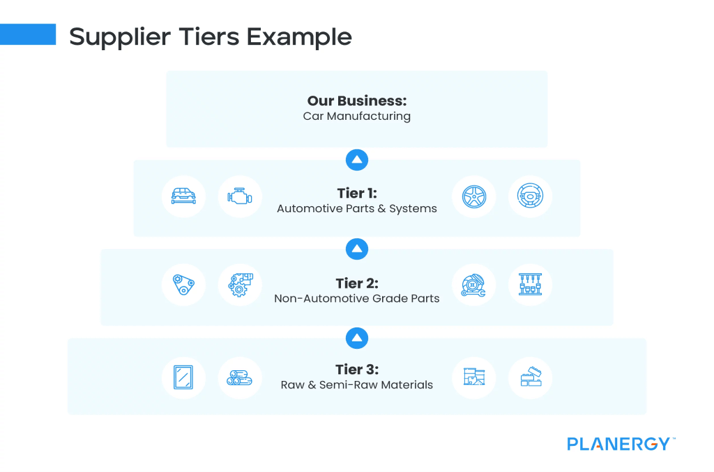
Tier mapping is the process of organizing suppliers according to their position in a supply network.
A Tier 1 supplier sells directly to the manufacturer. A Tier 2 supplier supplies a Tier 1 supplier, while a Tier 3 supplier supplies a Tier 2 supplier. CIPS defines Tier 1 suppliers as direct suppliers and Tier 2 suppliers as suppliers to those direct suppliers.
For example:
Manufacturer » Tier 1 » Tier 2 » Tier 3 » Raw-material source
A manufacturer buying an aluminum component from Supplier A may consider Supplier A Tier 1. The company producing the aluminum material for Supplier A could be Tier 2, while the upstream processor or raw-material producer could be Tier 3.
Mapping these relationships makes hidden dependencies visible.
What is sub tier mapping?
Sub tier mapping is the process of identifying suppliers below a company’s direct Tier 1 suppliers.
The term is often used interchangeably with multi-tier or deep-tier mapping, although “sub-tier” can broadly refer to any supplier below the direct supplier. These relationships matter because a Tier 1 supplier can appear healthy while depending on a financially distressed, geographically concentrated, sanctioned, capacity-constrained, or disrupted upstream supplier.
Everstream Analytics describes sub-tier visibility as a way to identify dependencies and risks that cannot be seen by monitoring Tier 1 suppliers alone.
For manufacturers, useful sub-tier mapping should connect suppliers to specific materials, components, facilities, and products rather than producing a generic list of companies.
What is multi tier mapping?
Multi tier mapping is the creation of a connected view of supplier relationships across multiple levels of the supply chain.
A useful map can show:
- Tier 1 suppliers
- Tier 2 and Tier 3 suppliers
- Manufacturing sites
- Components and materials
- Geographic locations
- Supplier relationships
- Shared upstream dependencies
- Single-source relationships
- Critical production dependencies
The important distinction is between a supplier directory and a network map. A directory tells you who exists; a network map shows how those entities depend on one another.
What is a multi tier supplier?
A multi tier supplier is a supplier that participates in a supply network containing multiple upstream or downstream supplier levels.
The term does not necessarily describe one company’s formal classification. A company can be Tier 1 to one manufacturer and Tier 2 to another, depending on the relationship being mapped.
That is why manufacturers should assign supplier tiers relative to a specific product, facility, or buying organization rather than treating “Tier 1” or “Tier 2” as permanent labels.
What is n tier supplier mapping?
N tier supplier mapping means mapping supplier relationships beyond a fixed number of tiers.
Instead of stopping at Tier 2 or Tier 3, an N-tier model can continue through additional supplier levels until the organization reaches the depth needed for its risk, compliance, sourcing, or traceability objectives.
This is particularly useful when a critical product contains materials with complicated upstream supply chains.
Sourcemap, for example, describes N-tier mapping that connects products and bills of materials to upstream suppliers and raw-material origins.
What is multi tier supplier mapping?
Multi tier supplier mapping combines supplier relationship data from multiple levels into a connected supply-chain model.
Manufacturers typically build these maps from several sources:
- Supplier questionnaires: Ask Tier 1 suppliers to identify their own suppliers.
- Bills of materials: Connect components and materials to suppliers and facilities.
- Procurement data: Use purchase orders, supplier records, and ERP information.
- Trade data: Analyze shipment and transaction relationships.
- Supplier disclosures: Collect information directly from upstream companies.
- External intelligence: Use corporate, sanctions, regulatory, geographic, and risk databases.
- AI-assisted discovery: Identify likely relationships that can then be validated.
The strongest programs do not treat an AI-generated relationship as automatically correct. Everstream describes a human-in-the-loop approach in which AI and external data help discover relationships while subject-matter experts validate whether those relationships are actually relevant.
What is the best multi tier supplier mapping method?
The best multi tier supplier mapping method is a hybrid approach that combines supplier-provided information with external data and continuous validation.
A practical process is:
- Start with critical products.
Do not attempt to map every supplier immediately. Start with products, components, or materials where disruption would have the greatest operational or financial impact. - Build the Tier 1 baseline.
Import supplier master data, facilities, parts, materials, and purchasing relationships from the ERP or procurement system. - Cascade requests upstream.
Ask Tier 1 suppliers to identify the suppliers behind critical components. - Validate the relationships.
Compare supplier disclosures with bills of materials, trade data, facility information, and other sources. - Connect suppliers to products.
Knowing that two companies have a business relationship is less useful than knowing that a specific Tier 3 facility supplies material used in a specific product. - Score the exposure.
Prioritize single-source dependencies, geographic concentration, critical materials, and high-risk suppliers. - Keep the map current.
Supplier networks change when companies switch suppliers, add facilities, discontinue products, or change sourcing strategies.
This approach avoids two common problems: relying entirely on questionnaires or trusting automated network inference without validation.
What are the best multi tier supplier mapping tools?
The best multi tier supplier mapping tools depend on whether the manufacturer prioritizes risk intelligence, verified supplier data, BOM-level traceability, or broader supply-chain monitoring.
1. Prewave
Prewave is a strong option for manufacturers that want multi-tier visibility combined with supplier-risk monitoring. Its Tier-N platform is designed to visualize direct and indirect suppliers, identify dependency clusters, and analyze Tier 2 and Tier 3 risks.
2. Everstream Analytics
Everstream Analytics is particularly relevant when mapping needs to connect with supply-chain disruption monitoring. Its Discover platform identifies multi-tier relationships and analyzes supplier, facility, material, and network risks.
3. Interos
Interos focuses on supply-chain mapping and risk intelligence across Tier 2, Tier 3, and deeper relationships. Its platform is designed to expose supplier connections, concentration risks, geographic vulnerabilities, and regulatory risks.
4. Sourcemap
Sourcemap is particularly useful when manufacturers need verified supply-chain information tied to products, parts, materials, and transactions. Its mapping platform uses supplier-provided information and BOM relationships to trace supply chains toward raw-material origins.
5. Resilinc
Resilinc uses a combination of AI and supplier-validated information for multi-tier mapping. Its published mapping material emphasizes visibility down to sub-tier part and site relationships.
For a manufacturer choosing between these platforms, the key question is not simply which product has the biggest supplier database. Ask whether the platform can connect a specific supplier to a specific component, material, site, and finished product.
Where can I find a multi tier supplier mapping diagram?
A useful multi tier supplier mapping diagram can be built as a network showing the manufacturer on the right and upstream suppliers progressively farther to the left.
For example:
Raw-material supplier » Tier 3 processor » Tier 2 component supplier » Tier 1 supplier » Manufacturer
For complex manufacturing, add product and facility relationships to the diagram:
Raw material » Process » Component » Part » Tier 1 supplier » Finished product
Modern mapping platforms provide interactive versions of this structure rather than relying on static diagrams. Prewave, Interos, Everstream, and Sourcemap all describe visual or navigable representations of multi-tier supplier relationships.
What is the best multi tier supplier mapping software?
The best multi tier supplier mapping software is software that connects supplier relationships to the manufacturer’s actual products, materials, and risks.
For basic visibility, a manufacturer could begin with ERP data, spreadsheets, and structured supplier questionnaires. But once the network becomes large or changes frequently, dedicated software becomes more valuable.
Evaluate software on:
- Tier depth
- Supplier-data validation
- BOM and part-level mapping
- Facility-level visibility
- Risk monitoring
- Geographic concentration analysis
- Alternative supplier discovery
- Regulatory screening
- ERP and procurement integrations
- Evidence and audit trails
- Data-refresh frequency
Do not choose a platform solely because it claims “AI-powered mapping.” Ask how it distinguishes a probable relationship from a verified relationship.
Map the suppliers that can actually stop production
Manufacturers do not need perfect visibility into every company in the global economy. They need reliable visibility into the upstream relationships that can materially affect their products.
Start with critical parts and materials, map Tier 1 and Tier 2 relationships, validate the highest-impact Tier 3 dependencies, and then expand deeper where the business case justifies it. Current multi-tier platforms increasingly combine automated discovery with supplier validation because neither approach alone provides a complete picture.
The result should be more than a colorful supply-chain diagram. It should tell procurement and operations teams exactly which upstream supplier can affect which product, where that supplier operates, what alternative sources exist, and what action should be taken before a disruption reaches the factory.
Popular on OTW Right Now!
-
 SOX Testing Checklist for AI Agents in ERP: A Practical Guide for Compliance Teams
-
 Is Your Fire Alarm Down? 6 Real-World Scenarios That Require a Mandatory Fire Watch
-
 Emergency Dental Treatment for a Chipped Tooth: What to Expect
-
Best Nearshore Software Development Companies in Europe: What They Actually Cost in 2026


About The Author

Gagan Bhangu
Founder of otechworld.com and managing editor. He is a tech geek, web-developer, and blogger. He holds a master's degree in computer applications and making money online since 2015.