
The Cognitive Bandwidth Problem: Why Crypto Needs Better Thinking, Not Just More Data
Crypto has never suffered from a shortage of information.
The price charts are updated every second, on-chain dashboards display thousands of metrics, Telegram channels issue alerts continuously, researchers discuss tokenomics, developers talk about protocol upgrades, and on social media an obscure project can become a trending topic within hours.
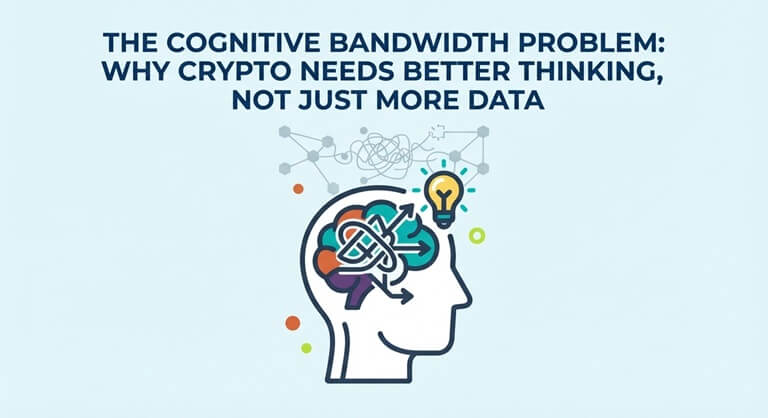
The real scarcity may be somewhere else: human cognitive bandwidth.
When information comes faster than people can assess it, the capacity to concentrate, identify patterns, question assumptions, and switch between explanations becomes an increasingly valuable personal asset.
It does not follow that a high IQ will always lead to better decisions when it comes to cryptocurrencies. Because markets are unpredictable, intelligence alone cannot eliminate financial risk. However, the cognitive processes involved in processing information should receive greater attention in a sector that is based on complexity and uncertainty.
Crypto Is an Information-Heavy Environment
Traditional financial markets already require investors to interpret large amounts of information, while crypto introduces a number of extra layers.
A single digital asset can involve:
- Technical documentation and protocol architecture.
- Token supply and distribution.
- Governance mechanisms.
- Developer activity.
- On-chain behavior.
- Liquidity conditions.
- Market sentiment.
- Community narratives.
- Regulatory developments;
- Rapidly changing competitive dynamics.
The challenge is therefore not simply collecting more data.
It is deciding which signals deserve cognitive resources.
The Difference Between Data and Signal
Picture having to keep an eye on twenty crypto projects at the same time, each one issuing announcements, experiencing price changes, engaging in governance discussions, providing development updates, and generating social media activity.
More dashboards do not automatically lead to better understanding.
One can fall into what might be termed the information illusion, which is the belief that eating into more data automatically results in greater knowledge.
In reality, interpretation needs mental filtering.
Pattern recognition helps identify recurring structures, logical reasoning links separate bits of information, attention decides what to notice, and cognitive flexibility lets a person reconsider an interpretation when new evidence comes in.
These skills are not particular to the field of cryptography; crypto makes how important they are unusually clear.
Cognitive Flexibility May Matter More Than Certainty
A very unusual feature of Web3 is the speed at which assumptions can become obsolete.
A protocol can change the incentives it offers. The liquidity of a token can be altered. A governance proposal can modify the economic model. A competitor can bring in a new technical approach.
This can make it less advantageous to be certain than to be able to revise a hypothesis.
A useful analytical process might look like this:
- Form an initial hypothesis.
- Identify the evidence supporting it.
- Search deliberately for contradictory evidence.
- Separate facts from interpretations.
- Update the hypothesis when the evidence changes.
Although the process seems simple, it does call for mental flexibility. The aim is not to forecast every move in the market; rather, it is to prevent oneself from becoming psychologically attached to the first explanation that appears convincing.
What IQ Testing Can—and Cannot—Tell Crypto Users
Cognitive assessment then turns into an interesting side issue.
An online IQ test is not suitable as a tool for managing cryptocurrency risks, and it cannot decide whether or not someone should buy a token, assess a blockchain protocol, or predict changes in the market.
It could offer a structured chance to look into certain aspects of reasoning.
MyIQ treats IQ testing as an online assessment experience while also linking it to the idea of training mental abilities. For a person who is interested in the cognitive aspect of decision-making, the more valuable question might not be ‘What number did I get?’ but instead ‘What does this experience make me realize about the way I approach problems?’
That distinction is important.
The Score Is Not the Whole Story
It is not correct to regard an IQ score as a full definition of intelligence, personality, creativity, financial judgment, or future achievement.
The greater value of cognitive testing lies instead in fostering curiosity and promoting self-observation.
It is possible that a person will enjoy spotting logical patterns but find it difficult when the information is ambiguous. On the other hand, someone else might easily handle complex relationships but make decisions too rapidly when under pressure.
The observations are more detailed than a single figure and may therefore be more useful when considering how one interacts with high-information environments.
A Reddit Conversation About the Meaning of an IQ Score
When people talk publicly about IQ tests, a noticeable contradiction usually emerges: they are interested in numerical measurements, yet they doubt what those measurements really mean.
A Reddit discussion asking whether a MyIQ score is a real measure of intelligence illustrates this broader debate. MyIQ reviews
The fact that the discussion is interesting in the context of crypto is due to the fact that Web3 communities come up against the same problem when it comes to numbers.
Tokenized assets have a market capitalization, protocols have a total value locked figure, wallets have a transaction history, and projects have engagement metrics.
But numbers require interpretation.
Just because a number exists doesn’t mean that the conclusion reached from it is correct.
That principle applies just as much to cognitive scores as it does to crypto metrics.
The Cognitive Traps Hidden in Crypto
The connection between cognitive abilities and crypto becomes particularly interesting when looking at common reasoning traps.
1. Pattern Recognition Can Become Pattern Projection
It is natural for humans to look for patterns. This can be useful in financial markets, but it may also cause individuals to perceive significant structures in random movements.
To recognize a pattern, you also need the ability to question whether the pattern is in fact significant.
2. Confidence Can Be Mistaken for Evidence
An elaborate explanation can appear convincing even if it is not correct.
The technical jargon used in crypto can make uncertain assumptions sound authoritative, and solid reasoning involves separating the complexity of the language from the quality of the evidence.
3. More Attention Can Become Less Focus
The constant monitoring may give the impression that one is kept informed, but it at the same time breaks up concentration.
Our cognitive bandwidth is limited, and attending to each alert leaves less capacity available for understanding the small number of developments that actually matter.
From IQ Scores to Cognitive Infrastructure
Maybe the more interesting question about the future is not whether intelligent people will beat out the other crypto participants.
What it comes down to is whether or not cognitive infrastructure will become a part of the way people manage digital complexity.
That infrastructure could include:
- structured research workflows;
- deliberate information filtering;
- reasoning exercises;
- note-taking and hypothesis tracking;
- tools for testing assumptions;
- regular reflection on decision-making patterns.
Within this framework, a service like MyIQ is not so much interesting as a generator of magic numbers as it is interesting as one element of a wider culture of cognitive self-awareness.
Web3’s Most Valuable Resource May Still Be Human
Blockchains have the ability to automate transactions, smart contracts can carry out rules, AI can speed up analysis, and on-chain tools can make available huge quantities of data.
The need to interpret information is not removed by any of these technologies.
On the contrary, they make it bigger.
The degree to which crypto matures in the next stage may therefore be determined not just by improved protocols and improved analytics, but also by better ways of thinking about the information that those systems generate.
In a market defined by speed, uncertainty, and information overload, cognitive bandwidth is easy to overlook precisely because it cannot be displayed on a dashboard.
Yet every dashboard still ends with a human—or an automated system designed by humans—deciding what the numbers mean.
Popular on OTW Right Now!
-
 How Tech Companies Use Individual Development Plan Examples to Improve Performance and Career Progression
-
 A Beginner’s Guide to Storage Performance and Speed Ratings
-
 The Essential Cloud Migration Checklist: How to Plan a Secure and Successful Migration
-
 When Does a Business Actually Need a Custom Mobile Application?


About The Author

Gagan Bhangu
Founder of otechworld.com and managing editor. He is a tech geek, web-developer, and blogger. He holds a master's degree in computer applications and making money online since 2015.