
When Does a Business Actually Need a Custom Mobile Application?
Most businesses do not set out to build a mobile application. They arrive at the decision after months of workarounds. A field team texting photos to a dispatcher. A service desk absorbing requests a self-service screen could resolve in seconds. A warehouse running on a spreadsheet that one person maintains and nobody else fully understands. Nothing has failed outright. The technology has stopped keeping pace with the business.
Growth rarely stalls because demand disappears. It stalls because the systems underneath cannot carry additional operational weight without buckling. Weak software architecture rarely announces itself with an outage. It shows up as slower onboarding, manual reconciliation at month-end, reporting that arrives too late to act on, and a cost per transaction that quietly climbs while nobody can explain why.
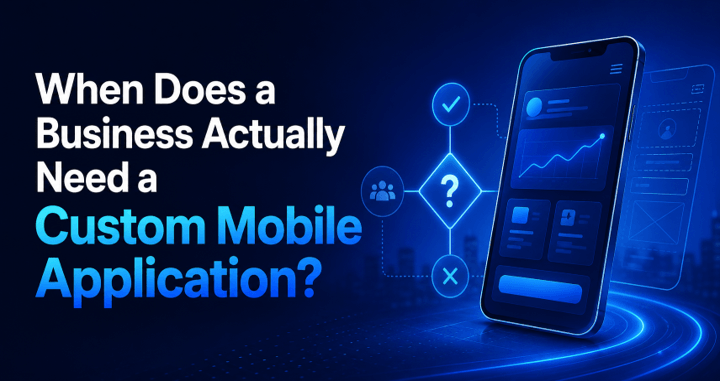
The Question Is Not Mobile. It Is Fit.
A mobile app is a delivery channel, not a strategy. The sharper question is whether your operating model has outgrown what configurable, off-the-shelf platforms can express. When the workflows that define how you compete are genuinely specific to your business, packaged software forces compromise, and those compromises compound year over year. That is usually the point at which leadership teams start weighing custom software development services against another cycle of patching, licensing, and integration glue.
Three signals tend to appear together. The workaround has quietly become the process, with staff maintaining shadow systems in spreadsheets and message threads. The data required for decisions exists, but sits across four systems that do not reconcile cleanly. And a meaningful share of the work happens away from a desk, in a vehicle, on a plant floor, or at a customer site, where a browser tab is not a realistic interface. Any one of these on its own usually justifies a smaller fix: a configuration change, an integration, a better reporting layer.
When all three hold at once, custom mobile application development services stop being a convenience play and become a capacity decision. Teams at NewAgeSysIT, a New Jersey-based software firm working with enterprises across the US market, see this pattern most often in operations-heavy sectors where the mobile layer is where revenue is actually captured or lost.
What Enterprise-Grade Actually Means
It can be used in many different ways, so it’s better to be specific. There’s no enterprise size. It explains five characteristics which decide whether or not an application will continue to serve you when the load is 10 times what it is now.
Scalability. The system will “grow” more users, locations, and data without a rewrite. This is more or less determined during design time, rather than afterward. Scaling is usually more expensive for an application designed for a single office that is now being expanded to other locations than for one designed for multiple locations in the first place.
Security. Authentication, authorization, encryption in transit and at rest, audit logging, and lost or stolen hardware at the device level. Compliance requirements should not be a post-launch remediation project, but part of the requirements document in regulated industries.
Performance. Slow interfaces don’t keep mobile users. Slow interfaces lose mobile users more quickly than desktop users lose them. Performance is not only about device hardware, but also about API design, payload size, caching strategy, and offline behavior.
Reliability. The application reacts to poor connectivity, partial failures, and version changes across a fleet of devices in a predictable way. It doesn’t take a place of luxury in the field design. It is the baseline.
Integration capability. The mobile app isn’t a system of record very often. It is best because of clean, well-governed connections to ERP, CRM, billing, and data systems. This is because an application that can’t integrate is yet another silo.
The Pillars That Support Long-Term Growth
Modular architecture. The microservices vs monolith discussion is a binary one, and that is not helpful. A monolith is often a suitable first step for a business that has yet to establish its scaling dimensions. The real error is if there is no internal seam in the monolith, then all the changes affect everything. Create very clear modules in the initial stages, then extract services when it is really required for load, team ownership, or release cadence.
Cloud-native development. Reduces operational burden of scaling and makes environments reproducible through containerization, managed services, and infrastructure as code. It’s not about novelty – it’s about the business benefit. It’s when that capability turns into a procurement project, instead of a budgeting decision.
Data-driven decision making. Instruments the application from the beginning. Event tracking, usage analytics, and operational telemetry transform the app into a source of insight into work in action—sometimes very different from work in thought.
Automation and AI readiness. Most organizations cannot effectively implement AI because they don’t have the data in one place, and they don’t know how to do things. They both are resolved as a byproduct of creating a well-architected application. All of the smart things you want to do down the road rely on the clean, structured, and accessible data.
Where Businesses Get This Wrong
The short-term development mindset. It’s a good idea to build the cheapest one that proves the concept and validates the market. It doesn’t make any sense for an operating system that you have a definite need for anyway. Technical debt in production systems results from prototype economics that gets reused across several budget cycles.
Deferring scalability entirely. The other mistake that often occurs—creating a design for a scale that you will never achieve. The discipline is to pinpoint the dimensions that are going to be expanded, and then to design accordingly. The number of users, the volume of transactions, geographic reach, and data storage don’t usually increase at the same pace.
Choosing a stack for the wrong reasons. A developer’s choice based on preference, or the buzz at a conference and a unique vendor relationship, doesn’t always work out in the long run. Points that matter more: whether they’re available for hire in your market, mature in your ecosystem, committed to long-term support, and are a good fit for your problem, honestly. Your team will be able to maintain a less exciting stack for 10 years than a fashionable one that will be unmaintainable in three years.
Building Something That Lasts
Plan before you build. Invest time in discovery: Process mapping, integration inventory, designing the data model, and defining operational success. The most impactful cost control in delivering software with clarity is requirements.
Choose a partner, not just a vendor. The distinction matters. The vendor performs a specification. A partner challenges it; they highlight assumptions that can’t be maintained during production and document decisions for the next team. That’s where companies such as NewAgeSysIT can come in handy, not in the coding, but in the architecture that is determined before anyone writes a line of code. Don’t ask potential partners about their successful projects only; ask them how they dealt with projects that failed as well.
Treat launch as a starting point. Budget for iteration. Applications actively maintained, instrumented, and refined over a period of three years provide significantly more value than applications which are considered as a completed product and then abandoned.
A Practical Illustration
Let’s take a hypothetical but common scenario: a regional field services organization with approximately 200 field technicians on paper work orders and by phone dispatch. Job information was double-entered by the dispatcher and by the billing. The average time to send invoices was 9 days after the job was completed.
The rebuild was not a show-stopper. A bespoke mobile app that can capture jobs offline, attach photos and signatures, and seamlessly sync directly into their ERP and billing systems. Jobs were closed on site by the technicians. Invoices generated automatically.
The measurable results were far from dramatic: billing cycle time dropped to less than 2 days, re-keying error rates fell significantly, and dispatch capacity improved without adding people. The most important architectural choice was the least noticeable. The integration layer was designed and developed separately from the app, which allowed the company to eventually replace the billing layer without changing the mobile app code.
The Bottom Line
A business custom mobile app is necessary when there are workflows that can’t be communicated through controllable software, data is disjointed between systems that can’t reconcile, and the work is done outside of the office. Otherwise, it is typically better to make smaller, less expensive interventions.
In such instances, it is a decision to be made with intention and not reaction. In 5 years, the apps that will continue to help their companies are rarely the ones that were quickest to develop. They are the ones that asked the harder architectural questions early and got the answers at a comparatively low price.
Popular on OTW Right Now!


About The Author

Gagan Bhangu
Founder of otechworld.com and managing editor. He is a tech geek, web-developer, and blogger. He holds a master's degree in computer applications and making money online since 2015.