
How Custom Software Can Solve Complex Business Challenges
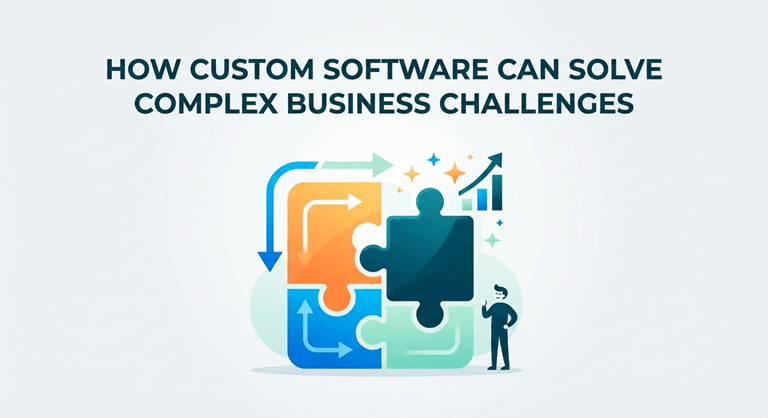
Every growing company eventually hits a ceiling where standard off-the-shelf applications stop solving problems and start creating them. These rigid platforms force teams to alter their internal workflows to match the software, rather than the other way around. The alternative is bespoke architecture, which aligns perfectly with a company’s distinct operational DNA. Whether you are struggling with fragmented client data and require custom crm development services, or you need a specialized logistics tracker, tailor-made applications adapt to your immediate reality. Sticking to generic products often means accepting constant inefficiencies and paying for features nobody on your team actually uses.
Why One-Size-Fits-All Actually Fits Nobody
So it sounds like such a sweet deal to purchase a subscription for a leading SaaS platform every month. You register, bring your team, and get productivity boosts right away. However, what typically happens is a gradual discovery that the platform doesn’t have an essential integration you need. The transition from the old software to the new one introduces absolute chaos as employees begin to fill in the missing gaps between the two, using spreadsheets.
This creates data silos. If information is in disembodied fragments, the decision-makers are blind. It can be avoided by connecting every internal department natively, as it is customized architecture. It also speaks the language of your niche business and meets your unique compliance needs without clumsy workarounds. But if your business works with very sensitive manufacturing blueprints, you don’t desire a basic cloud storage apparatus. You need an encrypted pipeline built around your internal access controls.
Pinpointing the Root Causes of Inefficiency
Leadership must examine the business before hiring an engineering agency. What are the real constraints? When it comes to the stuff that is slowing down a business, it’s hardly ever a single catastrophic event. Rather, it’s the “death by a thousand cuts”: five minutes wasted here, ten there, and an hour spent formatting a report that should take only a second.
The Nightmare of Legacy System Integration
Many well-known companies have legacy mainframes with decades of historical data. Removing them is very costly and potentially dangerous. But modernization doesn’t necessarily mean discarding the old tools. It is possible to create an extra layer of code in Java or Python that enables new Web interfaces to connect directly to the ancient servers. This breathing period lets older companies stay in the race with nimble startups without risking a huge migration disaster.
Automating the Mundane to Elevate Output
Think about the amount of manual data entry that’s going on in your HR or accounting department right now. Customization lets software manage tedious routing based on your specific approval chains. Invoices can send automatic budget updates, notify specific project managers, and schedule the payment—without having to press “send” 14 times. Recovering those hours means getting better margins.
Security, Sovereignty, and the Control Factor
Cybersecurity is no longer simply an IT issue, but a board-level existential threat. Hackers have a large target in the form of mass-market software. When a flaw is discovered in a popular database application, then millions of people who use it become vulnerable to a ransomware attack.
Protecting Proprietary Data
Bespoke code provides an additional layer of security beyond standard encryption methods. Automated botnets and generic malware scripts don’t know how to interact with the architecture, as it’s unique to your server environment. Additionally, you have complete control of your source code. You can host the data on a private, on-premise server or have a very secure, cloud-hosted instance. No vendor demands that your customer lists be locked into their platform or that their privacy requirements be at the vendor’s whim.
The Financial Reality: Cost vs. Investment
The main reason why founders are often deterred from proprietary builds is sticker shock. Yes, you will have higher upfront capital outlay if you’re paying a team of senior developers for six months, versus paying a monthly fee per user. But three to five years out, the math turns upside down.
The location of the external engineering team can also have a significant impact on the economics of a custom software project. For European and North American businesses, outsourcing to Romania can provide access to experienced software engineers while helping companies balance development costs, technical expertise, and collaboration requirements. This can be particularly relevant for long-term custom builds, where businesses need specialists capable of working on complex architectures, integrations, and modernization initiatives without carrying the fixed cost of expanding an equivalent in-house team.
Let’s do some logical reasoning. Those SaaS licensing fees can grow exponentially as you have more employees. Adds tiered pricing for enterprise features that you use little to nothing, to obtain the one feature that you use. A custom-made application is yours alone. You can add hundreds of new employees tomorrow with no additional licensing fees. For a deeper understanding of how strategic tech spending shapes enterprise growth, reading the technology insights at otechworld.com can help you navigate long-term digital investments effectively.
Scalability That Actually Makes Sense
When your infrastructure works against you, growth becomes painful. Now imagine introducing a whole new range of products and discovering hard-coded limitations in the inventory management software that prevent it from categorizing the new SKUs. You don’t always have to contact customer support and ask a third-party vendor to change their roadmap just to run your business.
Proprietary systems involve your internal tech lead or agency partner pushing an update for your code. The software turns 180 degrees when the business does. If you choose to purchase a smaller competitor, you can also construct a custom bridge to incorporate their client base effortlessly. It’s really as flexible as possible because you control all the structural constraints.
Iterative Development Keeps You Agile
The best deployments don’t attempt to do too much on day one. One of the smartest ideas is to release a minimum viable product that’s geared toward your biggest pain point in the business. When the team purchases it and can show that it is a positive financial investment, you invest in the next module. This is an iterative approach that greatly reduces financial risk. It also ensures that real-life feedback from actual users of your product shapes the final product, not a hypothetical scenario cooked up by an isolated product manager on the other side of the country.
Making the Pivot to Proprietary Tech
If you’re not willing to invest the time and resources into the specialized architecture, you’re out of the running for a successful transition from mass market tools, but otherwise you give your company the potential to grow to the ceiling. Rather than adapting your innovative business strategies to the constraints of a low-cost application, you design a tool that works to your strengths in the market. These companies will be the ones to use their internal software as a valuable and proprietary tool that they invest in and protect as hard assets, as opposed to a monthly cost.
Popular on OTW Right Now!


About The Author

Gagan Bhangu
Founder of otechworld.com and managing editor. He is a tech geek, web-developer, and blogger. He holds a master's degree in computer applications and making money online since 2015.