
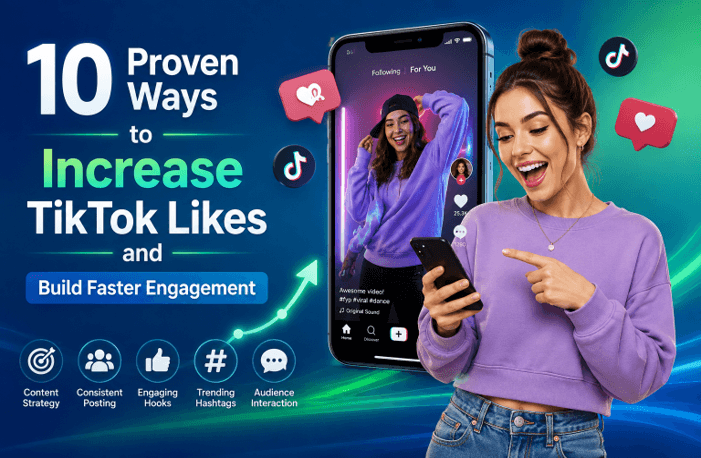
10 Proven Ways to Increase TikTok Likes and Build Faster Engagement
Plenty of videos are shot well, edited cleanly, and look completely fine — and still barely pull any likes. That’s almost never a production issue. Usually it’s simpler than that: nothing in the first few seconds gave anyone a reason to stop scrolling, and nothing after that gave whoever did stay a reason actually to react.
Likes are worth chasing, sure, but they’re just one piece of a bigger picture. Watch time, comments, shares, saves, profile visits — put together, those tend to say a lot more about whether a video actually landed. Everything below is aimed at that wider picture. Get the engagement genuinely right, and the likes tend to show up on their own.
1. Open With a Hook That Earns the Next Three Seconds
No one hangs around just to be polite. The opening line needs to offer a really specific thing to entice the reader to keep reading. But why does a fitness account start with “you’re probably doing this stretch wrong”, rather than with a welcome and a topic preview? It’s all in the mechanics: curiosity beats courtesy. Avoid greetings, avoid set-up — go to the interesting part. The biggest error is taking a presumption of unearned interest.
2. Build Videos for a Specific Kind of Viewer
Content that is for all is for no one. While a wide-ranging beauty channel may help a broader audience, a channel focused on “makeup for beginners” lets viewers immediately tell whether the video is for them. This is because, in this instance, relevance trumps reach — the smaller but more relevant audience is more likely to engage. The error is to seek whatever is the popular topic as it is for that week, without regard to the fit.
3. Give Every Video One Job to Do
A video that tries to fit five ideas into one seldom gets any of them. There is one obvious outline, hook, idea, quick development, and payoff, which provides viewers something easy to follow. Imagine a food creator throwing up a menu and three steps later, the finished food is already on the plate, and then payoff, far easier to follow than jumping from preparing this to narrating the side to something else. People don’t stay if the video is unintelligible, and where reactions start to occur is at the end of the video. If the mistake is selecting “more information” without really thinking about it.
4. Edit for Retention, Not Just for Length
Short doesn’t always equal tight. Cut away from the parts of the video where it visibly slows down (repeated explanations, dead pauses, no need to set up the shot). One example might be enough, but an educational creator could turn a 60-second explanation into a 35-second version without sacrificing value by cutting the same example. Users cannot like or comment on videos that they left 10 seconds in. The error is to believe that a lack of length is a cure for poor pacing.
5. Use a Small Story Instead of a Flat Explanation
The thing that’s easy to forget is a fact. Comments on a fact which is packaged as “here’s what went wrong and what I changed” stick. A small-business creator tells about a price mistake they made and how they changed it. provides a place for the lesson to rest. What goes wrong is when this point is developed into a story that is so padded and drawn out that it loses the message underneath.
6. Bend a Trend to Fit Your Content, Don’t Just Copy It
A viral sound or format can truly attract fresh viewers to a video. That’s just as long as the trend doesn’t just fall into place in the subject. It’s an account with a tech-related format that’s created to explain a new feature, which is why it works. If the trend is copied without changes, viewers have no reason to return to a version they have already seen 10 times. The error is to take the trend itself as the entire concept rather than the means to a concept.
7. Write Captions That Actually Describe the Video
Vague captions miss the opportunity to inform viewers and TikTok’s search of what a video is about. In a beginner’s photography video, you can see the natural progression of words such as “camera settings for beginners” in the caption or text on screen, as that is what a beginner might search. This is not about stuffing keywords; it’s about being specific rather than generic. The error is to see captions as an afterthought/hashtag dump removed from the content.
8. Ask a Question Specific Enough to Answer
“Like and follow” is disregarded because it’s a demand with no teeth. When considering “which outfit would you actually wear?”, a fashion creator invites viewers to make a decision and provides something tangible to respond to, meaning the audience will likely leave a comment that is more of an opinion than a requirement. The mechanism here is specificity; a fuzzy cue is an easy cue to miss, and a specific cue is hard to miss. The error is to try to force a call to action when it wouldn’t otherwise occur naturally.
9. Post on a Rhythm You Can Actually Keep Up
The main reason for consistency is that it generates more data for learning from, more hooks to test, more formats to compare, more opportunities to observe a pattern. A realistic plan of three targeted videos per week is more likely to be effective than a lofty plan of a video per day that becomes rushed content in a matter of 2 weeks. The “best” frequency is not universal; it depends on how long it takes to learn something at the speed. The error here is optimizing for volume rather than sustainability.
10. Let Performance Data Choose the Next Video
Pressing publish isn’t really the end of the world. These metrics are typically much more meaningful than just a like count on their own: watch time, retention, shares, saves, profile visits. Use two educational videos that cover a similar topic, but one has more likes, while the other has more saves and profile visits. That second one could be a nugget of interest to go deeper into since people cared enough to keep it or go deeper, rather than superficially glance at it and move on. If you’re considering ways to increase the visible like count, it’s also worth understanding what to look for when you buy TikTok likes and why likes should still be viewed as only one part of overall performance. Where people trip up here is writing off any video with modest likes as a flop without bothering to check what else the numbers were saying.
A Big Number Isn’t the Same Thing as Real Engagement
A lot of likes but little retention typically translates to people liked the content due to a good topic and didn’t watch that much. But when you take the flip, high watch time and few likes, it can be the content held attention well, but failed to provide any clear time to like it at the end. Standing alone, each of these numbers conveys little information. The TikTok Creator Portal breaks down exactly how metrics like watch time and completion rate get calculated, which is worth a look if you want to dig into your own numbers rather than eyeballing the like count.
If you’re considering purchasing likes as a component of a growth plan, this guide to buying TikTok likes can help you determine what you should think about before making your purchase. What you’re looking for is content that attracts attention, and then gets some response, but not some response that gets pushed up as high as it can be pushed without echoing back.
Questions People Actually Ask
Why do my TikTok videos get views but very few likes?
A view is simply someone’s eyeball traveling across the video; it does not imply that they considered the video worth viewing. Examine the point(s) where they drop off in the video and whether the end provides them with a specific answer.
How can I get more likes on TikTok naturally?
Narrow down the focus of the video, make it about more people, make it faster-paced, make a video that is focused and makes sense instead of an abstract request. Relying on this is better than following any “trick” that is said to work on every account.
Do hashtags help TikTok engagement?
Some context, sure, but no promise of reach. Captions that are specific and accurate tend to do more work than a pile of broad, unrelated hashtags ever will.
Does posting consistently actually matter?
Primarily because it gives you additional opportunities to see what works and what doesn’t, but when posting happens regularly without maintaining a high quality, it backfires more often than not.
What should I track likes besides?
If you combine watch time, retention, comments, shares, saves, and profile visits, as a package, not as individual metrics, you’ll get a much better idea of whether or not it’s really engaging.
Turns Out There Was No Formula to Begin With
There is no set formula for virality in here, and anyone claiming it has a guaranteed formula is worthy of questioning. A sharper hook, an audience that’s actually small enough, editing that doesn’t bore anybody to tears, and the discipline to check the numbers rather than simply taking it as a given that the next video is supposed to be like the last one, is much, much smaller. More likes will result from you providing the right people with something worth seeing, reacting to, and sharing — and not as a result of one particular trick that you stumbled upon and then performed once and never again.
Popular on OTW Right Now!



About The Author

Gagan Bhangu
Founder of otechworld.com and managing editor. He is a tech geek, web-developer, and blogger. He holds a master's degree in computer applications and making money online since 2015.