
Modernizing Business Operations With Microsoft Cloud and Dynamics 365
Digital transformation is no longer limited to adopting new software. Organizations need scalable infrastructure, connected applications, secure data, and efficient workflows that can evolve with changing business demands. These objectives are being met with the rich and diverse Microsoft family of technologies, which includes cloud infrastructure and intelligent business applications.
A well-planned Microsoft cloud service strategy can help organizations improve scalability, application performance, data accessibility, security, and operational efficiency. Meanwhile, organizations that are already based on Dynamics 365 can modernize their current landscape and leverage new features and capabilities, as well as enhance functionality.
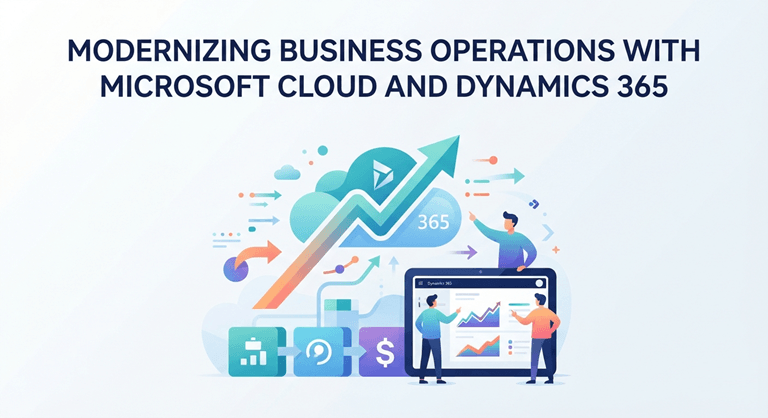
Understanding Microsoft Cloud Capabilities
Cloud technology is more flexible than traditional technology. With minimal reliance on physical resources, businesses can provision resources as needed, modernize applications, boost availability, and enable distributed teams.
This all-encompassing Microsoft cloud service can involve cloud migration, infrastructure management, application modernization, security, data services, backup, disaster recovery, analytics, and continuous optimization.
Key Business Benefits
Organizations can gain several advantages from a modern cloud strategy:
- Scalable infrastructure that adapts to changing workloads.
- Improved application availability and performance.
- Centralized management and monitoring.
- Enhanced security and identity controls.
- Better support for remote and hybrid work.
- Faster access to analytics and artificial intelligence capabilities.
- Opportunities to optimize infrastructure spending.
Adopting clouds should be based on business goals, not technology. A structured evaluation can be used to identify workloads to be modernized, migrated, or left in place.
Why Upgrade Dynamics 365?
As organizations grow, their business applications need to continually change. Newer capabilities for automation, analytics, integration, security, and user experience might not be available in older Dynamics environments.
A Microsoft Dynamics 365 upgrade can assist firms in reaching a more modern application setting while keeping vital business processes and data.
Important Upgrade Considerations
Prior to initiating an upgrade, companies should assess their current setup, customizations, integrations, data quality, workflows, and reporting needs.
A successful upgrade strategy typically includes:
- Current environment assessment
- Customization analysis
- Data validation and preparation
- Integration review
- Testing and quality assurance
- User acceptance testing
- Deployment planning
- Post-upgrade monitoring
This structured approach helps reduce disruption and provides users with a smoother transition.
Connecting Cloud and Business Applications
Connective tech ecosystems can be formed with the use of cloud infrastructure combined with Dynamics 365. Cloud services can be used to enhance the capabilities of business applications through integrations, data platforms, analytics, custom applications, and artificial intelligence solutions.
This integration can facilitate the sharing and visibility of data, as well as automate processes between different departments within the organization. For instance, finance, sales, customer service, and operations teams can rely on more consistent information, and analytics tools can give them insight.
Top Companies in the Microsoft Technology Industry
The technology partner is an integral part of a successful transformation project. It is essential for businesses to take into account the expertise of the company, their experience with implementation, their security measures, their industry knowledge, their support model, and their long-term strategy.
1. Microsoft
Microsoft develops Azure, Dynamics 365, Power Platform, security solutions, data technologies, and artificial intelligence services for organizations worldwide.
2. InTwo
InTwo supports organizations in modernizing their cloud environments and business applications with the help of Microsoft-based consulting, implementation, integration, optimization, and transformation services.
3. Accenture
Accenture offers cloud transformation, enterprise application implementation, technology consulting, and managed services to customers in a range of industries.
4. Deloitte
Deloitte provides Cloud Consulting, Cybersecurity, Analytics, Enterprise Application, and Digital Transformation.
5. Capgemini
Capgemini helps organizations in the cloud, application modernization, data management, and enterprise technology transformation.
Preparing for a Successful Transformation
Modernization of technology must be considered a business process, not a project. There are several factors that organizations should take into account, such as employee adoption, security, governance, data quality, application performance, and scalability.
Security and Governance
Cloud and business applications must be secured by proper identity management, access control, monitoring, backup, and governance policies. Security requirements can be taken into consideration at the planning stages to help minimize operational risks.
Testing and User Adoption
Testing is especially essential when it comes to upgrading business-critical applications. Functional, integration, performance, and user acceptance testing will expose issues prior to the production deployment.
Employees are also able to learn the new capabilities and processes, with training helping to increase adoption and help alleviate concerns about change.
Maximizing Long-Term Value
Following deployment, application performance, cloud usage, integrations, security, and user feedback should be regularly assessed. The vision of continuous improvement can help to keep technology investments in tune with business goals.
A well-managed Dynamics 365 upgrade can provide a foundation for adopting additional automation, analytics, integration, and productivity capabilities over time.
Conclusion
The cloud and new-generation applications can support businesses with greater agility in response to market shifts and improve overall efficiency. Microsoft technology offers a wide range of capabilities for businesses to connect infrastructure, applications, data, security, and intelligence.
This strategic use of a Microsoft cloud service, combined with planning the right Dynamics 365 modernization, will enable organizations to build a more scalable and flexible digital world. By making strategic technology investments, testing, governance, and optimization, companies can fortify their technology base and set themselves up for long-term success.
Popular on OTW Right Now!



About The Author

Christie
I am a content writer with a passion for creating informative, engaging, and easy-to-understand content. I enjoy researching a wide range of topics and sharing insights that help readers learn, make informed decisions, and stay updated on subjects that matter to them.