
Top SPF Flattening Tool: Fix DNS Lookup Limits And Boost Email Deliverability
Understanding SPF Flattening: Overcoming DNS Lookup Limits

The Importance of SPF in Email Authentication
The Sender Policy Framework (SPF) serves as a crucial standard for email authentication, allowing domains to guard against email spoofing. It achieves this by defining the mail servers permitted to send emails on their behalf. For businesses using external email services such as Google Workspace, Microsoft 365, Salesforce, HubSpot, SendGrid, Mailchimp, and Zendesk, managing the SPF record for each domain can quickly become complicated due to the need to integrate multiple services.
The SPF Lookup Limit Bottleneck
RFC 7208 establishes an important technical constraint: an SPF record is restricted to a maximum of 10 DNS lookups during its assessment. If this limit is surpassed, it results in an SPF PermError, leading to unsuccessful authentication. Such SPF failures can negatively impact email deliverability, heighten the likelihood of recipient complaints, and may even initiate blocklist surveillance. Large organizations, managed service providers (MSPs), managed security service providers (MSSPs), and those with multiple domains often encounter this DNS lookup limit, particularly when employing intricate nested includes and elaborate SPF macros for third-party vendor support.
Introducing SPF Flattening
To tackle these workflow obstacles, SPF flattening has been developed as a solution. An SPF flattening tool reduces SPF PermErrors and associated DNS lookup problems by substituting indirect methods (like include: directives) with direct IP addresses. This compresses the SPF record and helps maintain DNS lookups below the crucial limit of 10. By effectively managing SPF records and utilizing hosted SPF services, organizations can create a reliable system for scalable email authentication and strong DMARC enforcement.
Tool #1: AutoSPF — Automated SPF Flattening to Reduce DNS Lookups, Prevent SPF PermErrors, and Improve Email Deliverability
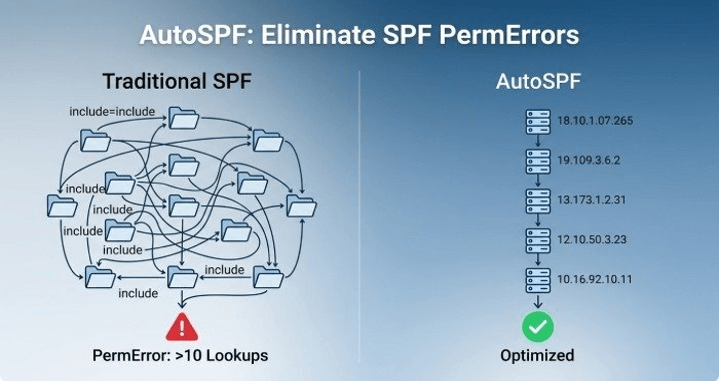
What is AutoSPF?
AutoSPF is an advanced tool tailored for automating and streamlining the intricate process of SPF record flattening. This innovative platform is designed to meet the needs of organizations that require a streamlined SPF management solution on a large scale, with features to support hosted SPF record workflows, multi-domain setups, and real-time updates. AutoSPF is an effective reduction of the DNS lookup burden, thereby reducing the risks of SPF failures and the need for manual error correction.
Key Problems Solved by AutoSPF
1. SPF PermErrors & Lookup Overruns
The primary goal of AutoSPF is to remove SPF PermErrors caused by an excessive number of lookups. It does this by continually monitoring and optimizing the SPF record, limiting both simple and include SPF records to IP addresses and reducing the odds of violating the SPF lookup threshold. When domain authentication is essential in complex systems, like those that send outbound messages through Salesforce, SendGrid or HubSpot, this capability is vital for compliance teams, CISOs and IT administrators.
2. Automated SPF Updates and Real-Time IP Management
Manual management of SPF records is prone to errors, especially as third-party email services tend to change IP addresses. AutoSPF makes this easy by automating the updates to SPF with scheduled and event-based triggers. It includes hosted SPF logic to get current IP updates as soon as the providers change their sending models. This significantly minimizes the chances of encountering null SPF errors, missed updates, or excessive record lengths.
3. Streamlining Email Deliverability and Compliance
AutoSPP not only optimizes email deliverability with advanced automation of SPF flattening processes, but it also supports compliance initiatives such as implementing DMARC and managing DKIM. A centralized SPF dashboard allows administrators, managed service providers (MSPs), and managed security service providers (MSSPs) to monitor recipient complaints and proactively address blocklist issues, all in one place.
Core Features of AutoSPF
Comprehensive SPF Compression and Dynamic Flattening
- Standard SPF flattening typically substitutes all ‘include’ directives and some mechanisms with specific IP addresses. In contrast, AutoSPF offers a genuinely dynamic solution by adjusting records in real time to reflect changes in the downstream infrastructure.
- Automated SPF compression maintains SPF record lengths within acceptable limits, reducing the risk of DNS record fragmentation and preventing empty SPF situations.
Hosted SPF & Multi-Domain Management
- AutoSPF offers hosted SPF services that enable domains to outsource their SPF processing and DNS management to the AutoSPF platform. This is especially crucial for managed service providers (MSPs), managed security service providers (MSSPs), and compliance-driven organizations with multiple domain collections.
- Also, role-based access control can be utilized to restrict modifications of SPF records to only authorized individuals, helping to meet compliance standards and best practices for Chief Information Security Officers (CISOs).
Real-Time SPF Analytics and Monitoring
- Traditional workflows for SPF flattening usually require manual flattening when there are any changes in third-party infrastructure. AutoSPF simplifies the process with automated scans and real-time triggers, however. This proactive approach to managing SPF improves reliability and reduces manual effort.
Seamless Integration with Modern Email Ecosystem
- AutoSPF has a robust error management system that proactively resolves errors such as void errors, null SPF records, too-long entries, etc., or errors related to incorrectly set nested includes. It gives helpful alerts by means of a comprehensive SPF dashboard.
How AutoSPF Outperforms Traditional Tools
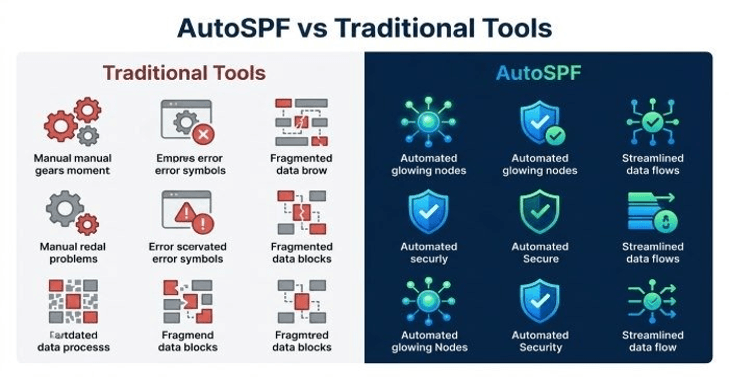
Adaptive SPF Record Flattening
Traditional workflows for SPF flattening typically require manual re-flattening whenever there is an update to third-party infrastructure. In contrast, AutoSPF streamlines this process by implementing automated scans and real-time triggers. This proactive approach to SPF management enhances reliability while minimizing manual effort.
Intelligent SPF Error Handling
AutoSPF features a strong error management system that actively addresses issues like void errors, null SPF records, overly long entries, or incorrectly set nested includes. It provides useful notifications through an extensive SPF dashboard.
Multi-Layered Security & Compliance
- Role-based access and granular control and extensive audit trails safeguard SPF management activities, helping compliance teams capture changes to support regulatory and industry reviews.
- Hosted SPF functionality makes the SPF logic independent of local DNS, making the environment safer from unauthorized changes or unintentional mistakes in SPF records.
AutoSPF in Action: Real-World Use Cases
- Enterprise Email Management: A financial institution utilizing Google Workspace, Microsoft 365, and Salesforce utilizes AutoSPF to ensure ongoing compliance and effective email delivery across numerous domains.
- Managed Service Provider (MSP) Environments: Managed Service Provider (MSP) Environments give service providers visibility into the health of each client’s SPF record, visibility of SPF flattening, and the ability to manage risks by monitoring blacklists and analyzing recipient complaints proactively.
- Transactional Communications and Email Marketing: For companies that rely on email marketing platforms such as SendGrid, Mailchimp, or HubSpot, having strong SPF records and being able to send targeted email marketing campaigns are equally advantageous, since they enable automatic updates of SPF records and prompt action when there are changes in the third-party IPs.
Comparisons and Industry Standing
The main difference between AutoSPF and the other leading SPF providers in the market, such as PowerDMARC’s PowerSPF, MxToolbox, MxToolbox Delivery Center Plus, DMARCLY, Safe SPF, Red Sift, OnDMARC, Valimail, Instant SPF, and DigiCert, is that AutoSPF combines the following features.AutoSPF sets itself apart from the great competition, including PowerDMARC’s PowerSPF, MxToolbox, MxToolbox Delivery Center Plus, DMARCLY, Safe SPF, Red Sift, OnDMARC, Valimail, Instant SPF, and DigiCert, by offering an unmatched combination of dynamic SPF flattening, extensive hosted SPF assistance, sophisticated analytics, and seamless compatibility with current authentication protocols (DMARC, DKIM, BIMI, MTA-STS, TLS-RPT).
Ongoing SPF Support and Future-Proofing
AutoSPF’s innovative features, such as real-time SPF record length optimization, built-in SPF monitoring, and advanced automation of flattening SPF records, ease SPF management. This reduces the amount of administrative work in the long term and gives you secure, compliant, and deliverable emails. The platform provides organizations with the tools they need to tackle the challenges of email authentication in today’s dynamic landscape.
By leveraging one of the industry’s best SPF flattening solutions, such as AutoSPF, companies can conquer DNS lookup limitations, prevent SPF PermErrors, and substantially boost deliverability, without compromising scalability, security, or compliance.
Popular on OTW Right Now!
-
 QR code product tracking: connecting physical items with digital data
-
 Reducing Administrative Overload in Universities Through Intelligent Systems
-
Before Gas-Analysis Data Enters Plant Software, Give Every Reading a Decision Status
-
 Why Local Businesses in Plano Are Investing in Professional Web Presence




About The Author

Gagan Bhangu
Founder of otechworld.com and managing editor. He is a tech geek, web-developer, and blogger. He holds a master's degree in computer applications and making money online since 2015.